
Midterm Paper – Yasmine

The story begins with a family moving to a new place. The main character, Chihiro, is afraid of the change. They stumble upon an abandoned amusement park and find some food. The parents, tempted by the delicious-looking food, start eating. As night falls, spirits fill the space, and the parents turn into pigs. Lost and confused, Chihiro tries to leave but finds herself stuck in the spirit world.

On a random weekend, I was, as usual, looking through a list of hundreds of children’s movies saved on a hard disk, trying to find something I hadn’t seen in a while. Then I found a file I hadn’t noticed before, labeled Spirited Away. Maybe that’s why this movie was so memorable to me—it saved me from drowning in boredom. I watched it for the first time, and by the end, I had no idea what I had just experienced. The movie was long and eventful, yet slow and not intense. It didn’t build up suspense but instead pulled you into the story.

Perhaps it was how different it was from what I usually watched, movies with a clear structure, a villain, a goal, a hero. The first time I watched it, I couldn’t tell you what the movie was about, maybe because I was nine and didn’t understand it. It left me pleasantly confused, and every time I watched it, it felt like a different movie. I processed more of it each time, making it a film you watch repeatedly and always find interesting.

I wouldn’t say it was something I loved immediately, but I’ve found that things that take time to grow on you also take longer to become things you used to like. This happens often with the music I listen to; sometimes I find songs on my playlist that I wasn’t very into at the time but started liking slowly. Those songs stuck with me longer. I think taking your time liking something gives you space to discover new aspects you enjoy, so you like it more every time. Otis Sandsjö said something similar about sometimes listening to his old music and finding that he enjoys it more now than he did back then, which I found very relatable. I think I’ve seen the movie enough times by now, but it brings a sense of comfort and nostalgia whenever I play it.

So why is the movie great? It did win several awards, after all. The characters, I think, make it so interesting. No one is really good or bad; they are just people/spirits that, like in the real world, can present negative traits like greed and spite and also positive ones like generosity and growth. In the 2 hours and 5 minutes, all the characters seemed to develop subtly. Subtlety is an important component of Ghibli movies (the animation studio). They add so much in a small space, representing changes that happens over a long period time in a short amount of time. The changes and messages aren’t in your face, making it more meaningful every time you watch.

I would describe Spirited Away (and all Ghibli movies) as art. Even if you don’t find the story captivating or have seen it so many times it’s gotten boring, the character designs, the setting, and the art style are like looking at a series of portraits.
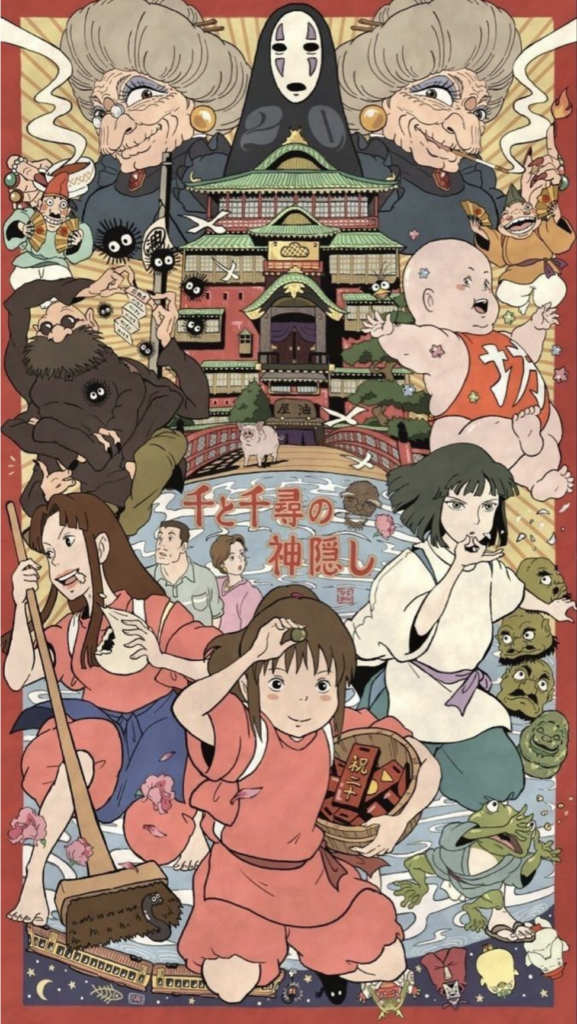
A poster I found on Pinterest that I think is a good represenation

Analogy method creating project – Yasmine

How do you solve a difficult engineering problem?

Break into steps:

  1. Understanding the problem
  2. Thinking of a solution
  3. Debunking the solution
  4. Thinking of another solution
  5. Not being able to implement solution
  6. Asking for help to solve the problem 
  7. Implementing solution 
  8. Solution doesn’t work 
  9. Altering the implementation method
  10. Still doesn’t work 
  11. Giving up on problem 
  12. Maybe finding a solution online or asking chatgpt 

Abstract:

  1. Knowing what’s going through the problems mind, what’s bothering it. 
  2. Building a path out of the problem using a series of thoughts put together.
  3. Get lost inside the problem, the path is going in circles.
  4. Noticing you saw the same tree twice and marking it.
  5. Going towards a lighthouse.
  6. Realizing it was a very bright firefly 
  7. Pulling the drain on the ocean

Analogy: Looking for a solution to an engineering problem is like finding your way out of a forest, then realizing you were in the middle of the ocean.

Idea: A sound collage representation of the analogy

Implementation:

Using Audacity, sampled sounds from freesound.org were added together so that it sounded like someone was walking through a forest, that slowly turned into the ocean and then a drain was pulled so that the water goes through. The samples added were forest, walking, ocean and drain sounds. Then the sequence went so that it was the forest sounds first then the ocean and then the drain. The sounds faded towards the end to give a smoother transition and amplitude and frequency were adjusted to highlight certain sounds at certain moments of the audio.

Sources: All sounds from Freesound.org

  1. HeavyFootStompsInForest2.wav by GaryBran — https://freesound.org/s/75264/ — License: Creative Commons 0
  2. pine forest  winterday 130 pm 240125_0644 by klankbeeld — https://freesound.org/s/726529/ — License: Attribution 4.0
  3. small-forest-stream-in-mountains-surround-sound-rear by CRAFTCREST.com — https://freesound.org/s/204903/ — License: Attribution 4.0
  4. Skoke – Magic forest.wav by dibko — https://freesound.org/s/697052/ — License: Attribution 4.0
  5. BGSaSc Water Beach Ocean Waves Constant Splashing Rocks Many Small Waves Greece 16 by Profispiesser — https://freesound.org/s/550915/ — License: Creative Commons 0
  6. Pacific Ocean.flac by tim.kahn — https://freesound.org/s/174763/ — License: Attribution 4.0
  7. OceanWaves.wav by darren1979 — https://freesound.org/s/58416/ — License: Sampling+
  8. Drain glug.wav by majorasflask — https://freesound.org/s/137028/ — License: Creative Commons 0
  9. WaterDownTheDrain.flac by qubodup — https://freesound.org/s/188728/ — License: Creative Commons 0
  10. Drain by RobinDavidsen — https://freesound.org/s/437209/ — License: Creative Commons 0

Final Result:

Ming Poon’s visit

Ming’s performances were more focused on the audience and although he does not guide the audience to feel a certain way, the reactions and feelings of the audience is an important part of the artwork. This is different from all the other artists who visited us because, although they were also more focused on the process of creating that art than the final result, they didn’t seem to include a certain message or feeling that they were trying to convey with their work. When I asked Merche if she wanted to make the audience feel a certain way while she was improvising, she said that she wasn’t consciously making decisions on the next sound to play, but was more in a flow state, and the artists before said something similar during their performances. This makes me curious if Ming becomes more creative in a similar state of mind or if he is always actively making decisions, since his performances are based a lot on the audience’s response and their interactions, which isn’t the same as interacting with an unusual instrument for example.

Reading response may 30th:

The fear of being wrong often leads us to dismiss ideas that could potentially lead to correct or innovative outcomes. This fear also prevents us from challenging the frameworks within which we evaluate these ideas. However, if we can overcome the fear of being wrong and allow ourselves to explore incomplete ideas or creative works, we may discover results that exceed our expectations.

The two assigned readings, while not addressing the same concept directly, both encourage a similar mindset. One focuses on art specifically, and the other on general thinking processes. Despite this difference, both readings advocate for bravery in pursuing unexpected or unintended paths. They suggest that by allowing ourselves to experiment and take risks, we increase our chances of reaching unexpected and desirable outcomes.

 Merche Blasco’s visit

I found the combination of music and technology in her work very interesting to me. A lot of the sounds she was making using the instruments she built sounded like sound tracks from a fantasy/ sci-fi movie. All the artists so far have explained that during their performances, they are in a flow state and don’t consciously think of their improvisation, so it seems that being in a flow state is an important part of the creative process. I also find it inspiring how she switched to a career that she hadn’t had much experience with, and used her engineering background to do something creative in the field that is unique to her skills.

Design Exercise May 29th – Yasmine

Idea:

As a group we chose overpopulation as the focus of our projects. So I created a sound collage representing an overpopulation of music, sounds and nature sounds. Each sound is competing for space to be heard over the other sounds. 

Implementation: 

Audios from “freesound.org” were placed together on audacity. The sounds were shifted to start at different times, and the amplitude was adjusted so that the same sounds would be louder at some times more than others, because these sounds aren’t playing constantly all at once. The music fades out towards the end, so the end is less abrupt.

Sources:

All sounds were from https://freesound.org/ :

  1. rmr morphagene reels – harps_02 by jjbbllkk — https://freesound.org/s/530726/ — License: Creative Commons 0
  1. Piano loops 155 octave up long loop 120 bpm by josefpres — https://freesound.org/s/736740/ — License: Creative Commons 0
  2. Piano loops 156 octave long loop 120 bpm by josefpres — https://freesound.org/s/735942/ — License: Creative Commons 0
  3. Brush by dmsoler — https://freesound.org/s/737582/ — License: Creative Commons 0
  4. Rocks Thrown in Water by Kraftaggregat — https://freesound.org/s/737644/ — License: Creative Commons 0
  5. mechanical keyboard by multijoy — https://freesound.org/s/737641/ — License: Attribution 4.0
  6. Istanbulskoe Metro by himura.kazuto — https://freesound.org/s/737673/ — License: Creative Commons 0
  7. Busy cafeteria environment in university at noon – Ambient by lastraindrop — https://freesound.org/s/736730/ — License: Creative Commons 0
  8. lanterna.aif by thanos — https://freesound.org/s/27402/ — License: Attribution NonCommercial 4.0
  9. ESE – WHOOSH – EPIC – Level Up.wav by EpicSoundEffects — https://freesound.org/s/475889/ — License: Creative Commons 0
  10. Bass Guitar – Single G#/A♭ Note by SirBagel — https://freesound.org/s/736935/ — License: Creative Commons 0
  11. 102 BPM Industrial Drum Loop #446 (WAV) by looplicator — https://freesound.org/s/737435/ — License: Attribution 4.0
  12. Guitar Loop FMaj 115 Bpm by DaveJf — https://freesound.org/s/736983/ — License: Creative Commons 0
  13. hiphop beat_100bpm by timouse — https://freesound.org/s/736713/ — License: Attribution NonCommercial 4.0
  14. large meadow with nature sounds and nearby city background noises by Garuda1982 — https://freesound.org/s/737002/ — License: Attribution 4.0
  15. Rural soundscape snippet – 2024 05 24 Bouriège by Sadiquecat — https://freesound.org/s/737197/ — License: Creative Commons 0
  16. wind2.wav by eliasheuninck — https://freesound.org/s/29531/ — License: Creative Commons 0
  17. AMBLake_Waves Lapping The Shore.River City Reservoir Pond.Very Close 2_EM by newlocknew — https://freesound.org/s/736967/ — License: Attribution NonCommercial 4.0
  18. raining by ksjin72 — https://freesound.org/s/737584/ — License: Creative Commons 0

Final Results:

Mariana’s Visit

I was especially intrigued by Mariana’s process for creating music, because technology and sound is something that interests me and something I want to explore as a computer engineering major. The way she invents her own instruments is very cool, and at the start of her talk she was explaining that the difficulty in performing her prepared piano in different venues, and I’m not sure if that’s what made her start creating her own instruments, but I remember her saying that it was something that pushed her to perform her own instruments instead. So I think a lot of creativity can be inspired from necessity. 

Reading 2 response

I found it interesting how he was describing codes at the beginning and how we use these codes to make the process of thinking quicker. This was relatable because I usually do something similar while studying. So instead of reading and understanding something thoroughly, if it is familiar, I just fill in the blanks in my head using the idea I already understand, especially when I study math. 

The analogy he uses explains why we fall into the same habits of thought, since once a memory or pattern is formed, it is reinforced when new information is introduced and falls into the  deeper “grooves”.

Response: Lateral Thinking; Bono, Edward de (1970): Introduction (pp 9-14)

The book differentiates between the different types of thinking and how we need to use them all to come up with ideas that are creative in a sense that they are created using new patterns we create instead of reusing the same patterns that we usually recognize. In this chapter, the concepts were a bit abstract, and I didn’t fully understand what he meant by “Lateral thinking is needed to handle the perceptual choice.” He doesn’t explain how lateral thinking really works, but from my understanding of his description, it is coming up with different approaches to the same problem, while vertical thinking is used to develop those approaches.