
- I can definitely see his psychology background in his work (regarding his interest in the interaction between people and their intention/thought processes) which I also find very interesting.
- I really like him as he’s empathetic and understanding but also doesn’t baby people, which I first assumed he’d be like since he asked us about our needs.
- He has a good balance of being there for his participants but also respecting them as capable adults, which i think is a great practice.
Category: 2024
Art & Fear #1 – The Nature of the Problem
“…it is a species of fear– the fear that your fate is in your own hands, but that your hands are weak.”
As a designer, illustrator, storywriter, I know this feeling too well. On the surface I see it as frustration, but I know that it’s a type of fear deep inside. It’s not the same fear I feel when I look over a tall ledge, but a fear that even though I know I’m capable of being as good as I want, there’s nothing else that can possibly make me better at any of these things if I don’t consciously learn it. I’m basically alone no matter whose guidance I receive and what tutorials I read and watch. In the grand scheme of things, no one but me can make me a better designer, illustrator, or writer than me. And that really sucks sometimes.
“The sane human being is satisfied that the best he/she can do at any given moment is the best he/she can do at any given moment. That belief, if widely embraced, would make this book unnecessary, false, or both. Such sanity is, unfortunately, rare.:
This quote made a lot of sense when I first read it. I interpreted it as: if someone is comfortable with what they’re able to achieve right now, there would be no need for this book to address those common feelings.” However, now that I’ve read the sentence again, I have no idea if my interpretation was remotely on the spot. If anything, I agree with my interpretation of the author.
“The best you can do is make art you care about – and lots of it!”
I used to practice illustration by trying to make each piece or even doodle as best as I could imagine it. I realize that’s why my growth stagnated greatly and I eventually lost motivation. Now I’m on a “draw literally as many things as you can” and it’s doing me wonders. I can draw a more diverse set of things than ever before, and somehow the quality of the work started rising along with my motivation too
Making May 29
Topic: electric fan blowing wind
Analogy:
- The fan spins quickly
- The wind is sucked in from the back of the fan
- The wind is blown out from the front of the fan
- You can barely feel the wind in the back of the fan, but the wind blowing out of the fan is strong and cool
- The fan has many blades
- The wind being sucked in from the back comes from a wide angle, but the wind blown out is concentrated
This is like creative teamwork. All members in the group think of ideas from many different perspectives that may sound like nothing in the beginning, process them in a group, and produce a result that is really something.
Differences from the original topic:
- Wind/air is unlimited, but ideas exhaust.
- Ideas can still be generated with only one or two members, but a fan with only one or two blades doesn’t work well.
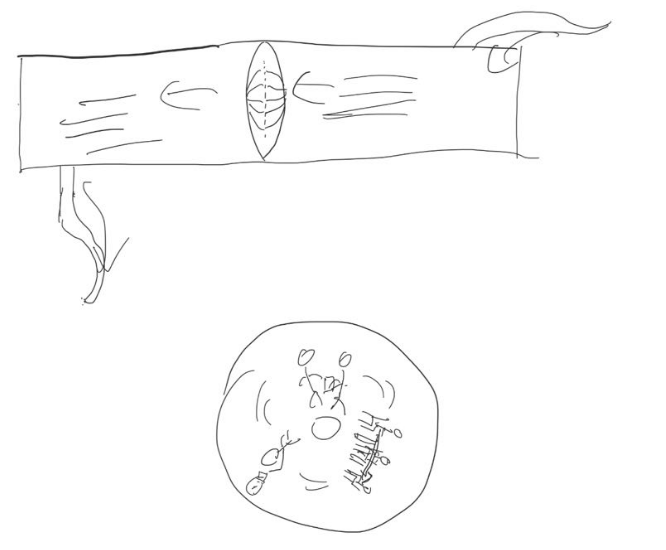
Making: A setup that consists of an electric fan within a tube, there are two smaller tubes for applying air with different colored dust. The fan spins and the dust is blown from the right to the left. The color of the dust changes over time, and the fans when spun show three images: people discussing, people getting inspiration, and people showing ideas to another one. The following is an indication of how the setup will look like.
Reading responses
I resonate a lot when reading the lateral thinking piece. I am the type of person who’s afraid of making mistakes. I’m not sure if I’m born with trait, but it’s further aggravated with playing chess. The number 1 rule that I follow is that, for every move I make, I have to think in my opponent’s shoes to make sure there’s no mistake. Therefore, I have the habit not risking to do things unless I’m at least 99% sure that it will succeed. Upon reading this, I feel like there’s a need for me to try to put away such mentality. Especially for not important business, like sharing my opinions in class, I could be less worried about making mistakes.
Similarly, the second piece of reading about art and fear talks about how art belongs to ordinary people. For most of my life, I consider myself bad at drawing (if viewed in a conventional lens, it’s indeed true…). Therefore, for most making assignments, I choose not to draw because of my lack of talents. But this reading piece gives me the idea that I shouldn’t stop myself from doing that. Art is made even before people consciously make them: art should be an expression of feelings (and sometimes no one cares about your work), so why bother hiding it?
Reading Responses
Art and fear reading response:
This chapter reminds me of a quote I heard in the movie Walk Ride Rodeo a few years ago that has stuck with me since then, it goes “Hard work beats talent when talent doesn’t work hard”. I have gotten in the habit of repeating it to myself whenever I catch myself doubting myself and trying to find reasons to give up. Even though in the movie they were referring to barrel racing, I find that this logic applies to almost everything we want it to. As the author mentions, yes some people might be more talented than others but in the end it’s about who puts in the work. A lot of famous artists got recognized only after their death, imagine if they had stopped creating because they weren’t getting the feedback and recognition they wanted. I also believe that in this day and age, people are more accepting of different forms of art than in previous generations so if we find that our art is not really accepted, then we’re in the wrong place.
Lateral Thinking Response:
In today’s chapter, the author focuses on the idea of suspending judgment which is exhausting wrong solutions just because a correct idea can still be derived from it. I found this interesting because throughout my life I’ve been disregarding any ideas that are wrong from the beginning because that was what I’ve been told to do throughout my time. I wonder how many times I’ve made the process harder for myself when it could’ve been easier. The author also talks about how this could be very dangerous because people tend to be more arrogant when they are in the habit of canceling out all wrong options because then they think that any idea they come up with is the right one and the only right one. Unfortunately looking back now, I see that I may have fallen down this path before, but now that I know better, I hope I can get over this.
Reflection: Lateral Thinking #3 – Innovation and Suspended Judgement
Just from the title alone before I even read the chapter, I was reminded of this very concept I learned as part of my Intro to Entrepreneurship class. During the ideation process, we were taught two very important lessons.
The first lesson was to suspend judgment when members of the group brought up ideas. Even if you didn’t agree with their idea or think it’s garbage, don’t verbalize your disagreement until everyone gets to discuss the ideas.
Another lesson we learned was to think with restrictions. Professor Scheck would give us stick notes with pretty random subjects on them. For example, my team was trying to start a student-run Thrift Pop-Up event. Professor Scheck gave us the theme of “moon”, which you might think had nothing to do with anything, but it actually let us come up with some really unique ideas like theming the pop-up around the moon stages and hosting it on lunar eclipses or full moons so students know when to expect a Thrift Pop-Up during the year.
Even if we didn’t follow through with those unique ideas, it was still a very effective ideation strategy I’ll remember. This is more or less what De Bono is discussing when he explains the difference between “being right” and “being effective.” Being effective just means being right at the end, so there’s no pressure to always be right because that’s not important. In a way I learned about lateral thinking through Professor Scheck echoing the same concepts in Intro to Entrepreneurship without me knowing it as lateral thinking.
One of my favorite takeaways was when De Bono points out the human tendency to borrow units of things from pre-existing concepts like building a mechanical hand with specifically five fingers to pick apples. I can’t remember where I read this but I remember learning that humans have a tendency to assume the human approach is the best approach. After all, we’re at the top of the food chain so surely we must understand everything better than any other animal, right?
Well, I think that’s where modern design leaves a lot of room for biomimicry. This was a really passionate topic for me back when I thought I wanted to be a biologist and engineer in high school, but it’s actually still relevant to me as a designer.
It’s not like animals designed their bodies the way they are of course, but they can serve as a reference for what might be the best solutions to a human problem, like using the shape of a Kingfisher beak and applying it to the nose of the Shinkansen bullet train.
Another takeaway was how to approach obviously wrong ideas. De Bono says the lateral thinking approach would be to shift one’s attention to why the idea is wrong and extract whatever usefulness it has before you move on. My reading of this paragraph is to essentially reverse what you think is obviously wrong and see the opposite idea, which may or may not be an idea to add to the solution.
Making 5 – Analogy step
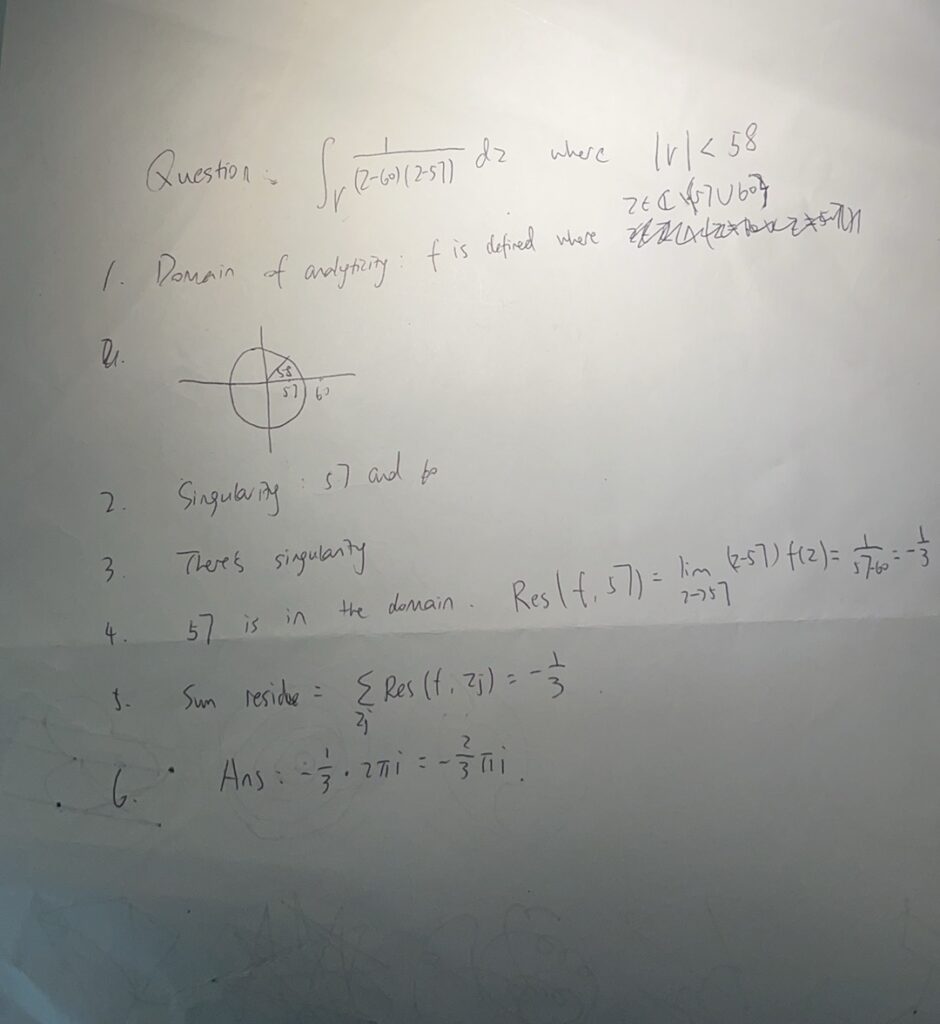
Using analogy step to solve a complex-analysis question involving finding the integral around a closed curve (defined as r).
Processes
- Find out the domain of analyticity of the function within the curve
- Find out all singularity points
- If there’s no singularity, result is 0
- For each singularity points, find out the residue
- Sum up all the residue
- Multiply 2pi i with the sum of the residue
Abstract
- Solving a huge problem resembles zooming in and solving each small problem respectively
- Spotting all small problems
- Sometimes there are lucky cases
- Transforming unknown questions to known questions
- Link what you come up with to what’s already given
Analogy
- Finding a way out from a forest
- Surviving in the wilderness
- Ruling a country
The work that I made was simply an example question with solution using the processes given.
Reading 2 Reflection 5/29
One of these assumptions moved me a lot, as I have experienced such things recently. I felt so resonated when I saw the sentence “Making art provides uncomfortably accurate feedback about the gap that inevitably exists between what you intended to do and what you did.” I am working on an indie game project, and I have a sort of ambitious vision that I want to realize in a few years. However, I have been working on the basic structure and architecture for a whole semester now and I am still stuck on some of the most basic things, and what I have right now looks nothing like what I have envisioned. It frustrated me for a long while but now I am embracing it. It does not matter whether this result would perfectly be what I envisioned. It only matters that I have gained valuable experience making this project and I can look back an be proud of what I have achieved.
Reading 1 Response 5/29
All my life (until recently) I have been dealing with STEM topics. In my experience doing these problems, you have to be correct at every step. It was also in our education that every step must be present and correct to get full marks. Sometimes even when there is a different and correct way to do a problem, we are asked to use the method that is most likely to be the standard one, because it will be easier for the teachers to grade and have the least risk of being deducted marks. Personally, My thoughts move rather rapidly, and I could be reminded of stuff that sounds totally unrelated but just has a small link in it, and even that link might be only present because of my personal experiences. Therefore I struggled a lot in the education system I grew up in. So I really like the idea that sometimes a wrong move or a seemingly irrelevant step might be the key to the answer.
Documentation #5: Reversals
Entry Point:
The foundation of a creative idea is always the hardest to come up with.
Reversal #1:
The foundation of ANY idea is always the hardest to come up with
Reversal #2:
The foundation of a creative project is the easiest to come up with, building upon the foundation is not.
Reversal #3:
The foundation of a creative idea should come up naturally.
Reversal #4:
Only the foundation of a Creating class idea is hard to come up with.
Reversal #5:
Narrowing down the creative ideas is the hardest part, not coming up with the ideas.
The entry point was literally what I was thinking as I sat blankly at my laptop screen, and I realized that could probably work as my entry point.
I came up with five reversals but I feel like the second idea I came up with, “The foundation of a creative project is the easiest to come up with, building upon the foundation is not”, really resonated with me because I thought of this one flip phone game I would play over a decade ago on my cousin’s phone. I searched it up and I found out it’s called Tower Bloxx.
Basically you try and build the largest tower you can, but the crane operator is both extremely proficient while being completely drunk on the job.
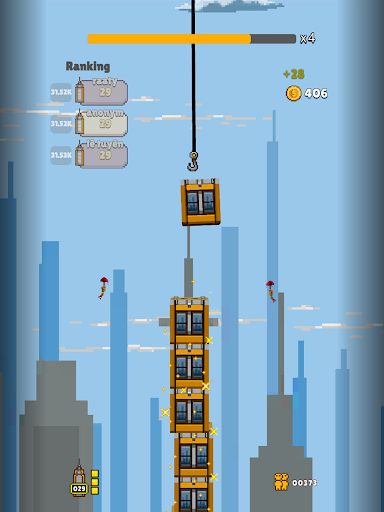
The challenge is the crane swings the next floor of the building wildly and you have to time when to put it. Obviously putting the foundation of the tower is the easiest cause you literally can’t mess it up, but building upon it is very difficult.
So we all know how the elevators on NYUAD campus could be quite slow right? Since we can’t speed up the elevators, why don’t we build something to help kill time and create a little form of community engagement.
I think a simple version of this game being placed both inside the elevator and outside the elevator where you call it to your floor would be the perfect game to implement. Anyone can pick up where someone else left off.
People could sign their names as well to let the next person know which people have worked on the tower so far and who’s dreams and aspirations they’d be crushing if they misplace the next floor and fumble.
Below is the mockup I created. I don’t have a proper name for it but the working title was “tower of ideas” to symbolize the process of building upon a creative endeavor.
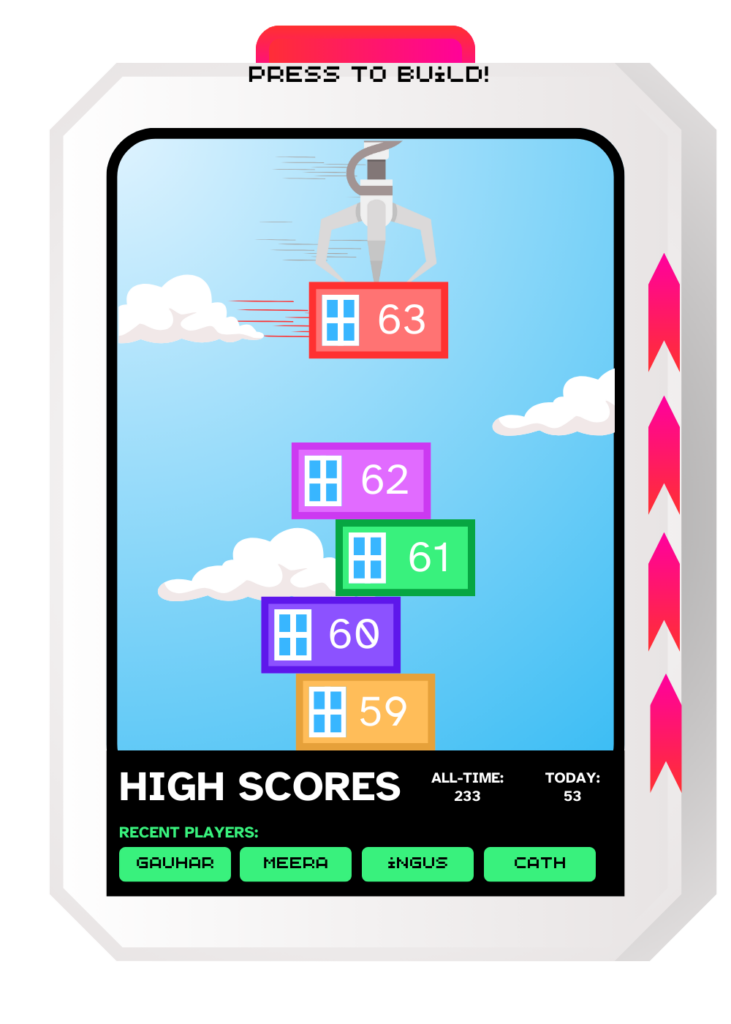
It’ll be a wall mounted device with a 21 inch LCD touchscreen. The only button needed to play the game is the red one on the top of the device. It was put there for the taller folks and people who find button presses more reliable. Alternatively, just pressing the screen works as well.
I would love to actually implement this someday, maybe I can propose it to be one of my IM class projects. This would be the both a great time killer and form of community engagement.