Final Project Discussion 3 – Oscar/Shahram/Siddhant

Among the three plans we discussed yesterday, we decided to go with the Scavenger Hunt idea which is technically easy and not boring.

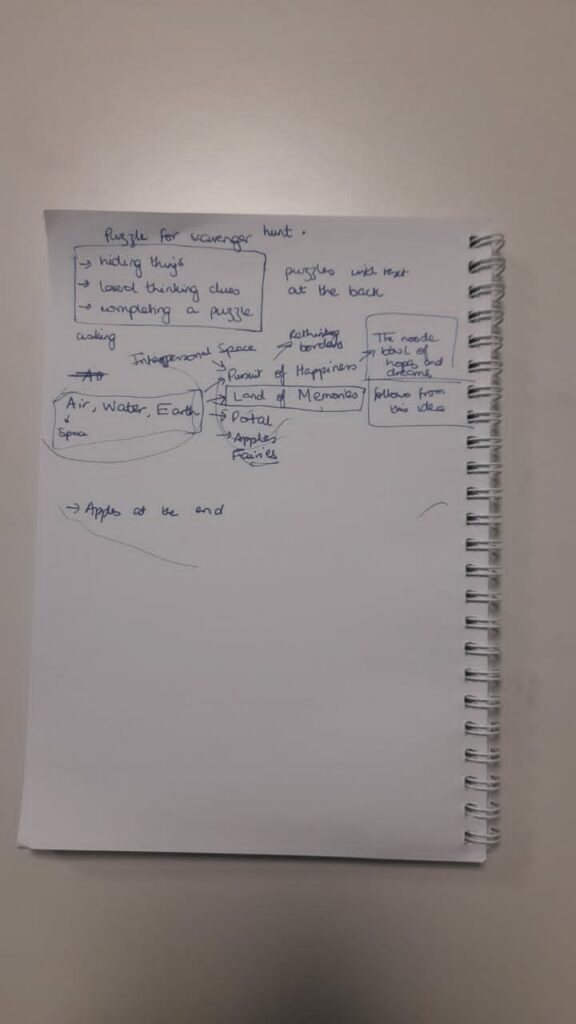
The audiences are sent out on a quest for our in-class creative projects hidden somewhere in the venue. The locations of them are suggested by clues created through lateral thinking. The projects form a puzzle, symbolizing a “land of memories” for the past. 

A soundtrack will be played incorporating our creative projects during the hunt. The background of the puzzle, land of memories, is based on Oscar’s assignment 2. Each color corresponds to an assignment. They are interconnected through the logic shown in the following picture. Projects Included: Sid #1 Space (Air), Shahram #1 Underwater (Water), Oscar #2 Land of Memories (Earth), Intercampus Portals, Apple Fairies, Pursuit of Happiness, Noodle Bowl of Hopes and Dreams…

The back of the puzzle shows the creative strategies in an infographic. Alternative: a video showing our transition and strategies will be played once the puzzle is completed. Apples will be given at the end, signifying the growth of us and the audience.

Final Paper – Oscar Wang

“The creation of something new is not accomplished by the intellect but by the play instinct acting from inner necessity. The creative mind plays with the objects it loves”

–Carl Jung

I have always been regarding myself to be someone with creative potential. Since childhood, I have been living with the world of my imagination and have long been intrigued by exploring the non-stereotypical and unconventional. Nevertheless, I have also been a person with affection towards structural and systematic disciplines, attaining top-tier grades in school subjects such as mathematics, computer science, physics, and chemistry. I have long been living with conflicting selves, willing to express my creative side but suppressed by external doubt and fear of exposing anything too personal, including my skills, thinking, and uniqueness. I have chosen NYUAD, engineering, and more importantly, this creating class, to try to solve my self-doubt on creativity and discipline, to learn to employ creativity in my future academics and careers, and to, hopefully, elegantly settle the aforementioned “conflict” and truly embrace the wonderful concept of “the intersection of arts and technology”.

Regarding these goals, I believe that I have transcended myself as I am now closer to them. Through the readings and assignments, I now can more confidently embrace my creativity and can learn to use them in a controlled way. Before this class, I believed that the difference in creativity between people is only determined by their pre-wired “talent”, so average people like me can only wait until it strikes, just like finding treasures in the ocean. I still remember my first assignment, when I came up with analogies, meanings, and interpretations of the word “desert” but failed to find the best “idea”. In fact, this was already some lateral thinking after I learned the analogy method. All it takes then was to get my hands on, to be sure about myself, and to perfect from trials and errors — just like the group that was asked to make the most pots in Art & Fear. Moreover, the daily making assignments facilitated this transition process from solely imagining to starting making. For example, I started my assignment 6 (How to get to School on Time?) with just three ideas, and the latter three came by combining asking “what if” and “why” during the making process. These creative strategies covered in class, the readings, and implemented by the assignments are like maps, directing me to “find more treasures” and “find them faster”. In another way, I also learned to look “beyond treasures”, in that some ideas may not sound genius at first but perhaps wonderful when the making process starts. Apple fairies might sound impractical and imperfect from a pure engineering, result-driven, vertical perspective, but wouldn’t we all love their elegance when we just adopt this concept first and then realize later that they can actually be implemented with current and near-future technologies, as well as their immense marketing potential.

Class visits accomplish more than learning about works and creative processes. They are also chances for me to meet new, interesting, and respectful people and communities. I had the chance to learn about new forms of art, which in turn let me realize that art is not defined by external criteria but by whether their creating processes relate to a part of the artists that they are willing to explore and show. Ming Poon created social-experimental dance pieces such as Undressing Room and Project June 4th. He may have used simple techniques, but the chill they gave was extraordinary when I realize how magical it is that he could bring people together to achieve art or political activism. Ephemeral Tomorrow created hardcore scientific installations that engage the public and show them the beauty of real-time data and astronomy in a form that I have never seen before. The carefree working style of Kollage Kollectiv and the embracing environment of field.io resonates with me on the importance of mental enjoyment in addition to pure skills, which can efficiently boost our creative energies just like what the book Flow mentioned about the Flow State. In fact, I found none of them boring and can extract the best from each talk.

Last but not least, I would love to appreciate the importance of wellness stressed by the professor and respected by the class. Meditation helps bring me back to the present in this bustling world. Moreover, being extremely sensitive to interpersonal dynamics and new to sharing to others my creativity and everything else that was “too personal” for me in the past that I was only willing to share with myself, creating and maintaining a “safe zone” is initially important for me, and I now have the confidence to say that I will grow till I can gradually let go my dependence on a deliberate “safe zone”.

Final Reading Response- Flow

-Paths of Liberation (pp 20-22)

The control of consciousness plays a vital role in determining the quality of life we experience. It is through the liberation of our consciousness that we can break free from the dominance of impulses and social controls. One notable attempt at achieving this liberation was psychoanalysis, which aimed to uncover and understand the deeper layers of the mind.

Across the world, various disciplines have sought to emancipate consciousness, offering different methods and practices. For instance, the example of a yogi illustrates the pursuit of freeing the inner life from the threats of chaos and the rigid conditioning of biological urges. The ultimate goal is to gain independence from social controls that shape our thoughts and actions.

However, even though the path to freedom of consciousness exists, it is not a straightforward journey. The wisdom necessary for emancipating consciousness is not cumulative; it is not something we automatically inherit or acquire. Instead, it must be continuously reformulated and adapted to the ever-changing cultural context.

The systems and approaches that were once effective in emancipating consciousness may no longer serve us in our present society. As societies develop and evolve, new challenges and complexities arise that demand fresh perspectives and approaches. It is important to recognize that the pursuit of freedom of consciousness is an ongoing and dynamic process.

 – The Conditions of Flow (pp 71-77)

The author delves into the concept of flow, which is a state of complete immersion and focused engagement in an activity. Being “in the zone” benefits our well-being and productivity. The key conditions to experience this flow are:

  1. Clear goals and feedback: the activity provides immediate feedback to adjust accordingly.
  2. Balance between skill & challenge: flow is more likely to occur when the challenges presented by the activity match our skills
  3. Total concentration and absorption: when fully engaged, we are completely absorbed in the task and lose track of time.
  4. Loss of self-consciousness: our sense of time, worries, ad self-doubt diminish, allowing us to fully devote ourselves to the task
  5. Enjoyment and intrinsic motivation: The activity itself becomes enjoyable and the motivation to continue arises from within, rather than external factors.

When discussing the first point, I believe that clear goals and feedback are not entirely necessary to get into a flow. In my opinion, to get into a flow, you must have a rough sketch or idea of how to begin which you can then mold into what becomes through your creativity. By setting a specific endpoint, you increase your self-doubt and worry about the final product without enjoying or focusing on the creative project of the task at hand.

Artist Visit: Mariana Carvalho

Mariana Carvalho

Soundscape: listening to the environment, ecology. (Human framing?)

Prepared piano, different objects that change the sound of the piano (customizable), ceramics, wood, gum, screws

Free improv : experiment

Color to sound, many layers recorded on top of each other

Eutony

Instrument creation out of other materials (fan)

Friccao interna, collaboration during the pandemic, Ines terra

making animal like sound for music (Kate Bush Get out of my house)

Sound propagation on different materials

A lot of sound, all at the same time (amazing experimentation, but bad for my sensory issues)

Estudo em nylon

A lot of biting, bone conduction

microphones that emulate human hearing (how does it work?)

Listening inside someone else’s head

Talking about relation, not nece3seraly music

How non musicians express themselves

Me alimento de voces, people singing inside of her mouth (emmm ok)

Anthropophagy

Fighting for the air

Creativity: series of works, a progression, accumulation of tools, experimental, developing, deep listening , body practices

(Her process feels really why method to me )

Class Visit- Mariana Carvalho

  • I found the use of water as a medium interesting
  • The concept of talking/screaming into another person’s mouth (eating voices) is weird, and I did not like the idea
  • She was very invested in prepared piano
  • As a previous pianist, the concept of damaging the strings, keys, and more hurt me 🙁
  • The use of nylon as a medium was also interesting
  • The way her mind works is very interesting but also scary

Reading Response 8 – Flow: Paths of Liberation and the Conditions of Flow

The first part of the reading summarized the techniques and importance of freeing one’s consciousness from the domination of social controls and biological impulses. The second part of the reading is more relevant about the ways to control consciousness in order to maintain the flow state. Flow state refers to the state where one is so immersed in his or her tasks so that external attention or even self consciousness becomes irrelevant. The practitioner is so self-motivated to do the work that he or she constantly gains satisfaction from it.

I feel that what I said in class about increasing the assigned work time between daily making assignments is actually intended to maintain good flow for me even if I did not know this concept before hand. Flow is a balance between complexity and skills. For example, if my vision for creative assignments are complex, my limit in skills may require the time to be lengthened to reduce anxiety. Another surprising yet reasonable connection the authors made was religious rituals as tasks to maintain flow. Since religion are the earliest agent to create order and higher causes in our consciousness, the rituals should be intuitively remedial for mental health. Generally speaking, the author, as well as me, believes finding enjoyment in any task given is essential to maintain a good mental health and high productivity.

Class Visit 5 – Mariana Cavalho

  1. Experimental Sound Artist, focuses on sound art, body and vibrations, “inner listen”…
  2. Casual talking style but feels very confident about her work
  3. Prepared Piano (e.g. John Cage): Modify the piano strings by putting objects etc.; Free improvisation; Graphical Score; Engage with People; Body + mind practice experiences inspired her to put body into music; interested later in propagation of sounds through different media (hydrophone and the fan instrument)
  4. Estudo em Nylon:  Extend piano strings to space
  5. Nylon Bites: Bone conduction and a type of microphone that captures what each ear hears
  6. Me Alimento de Voces: Sing inside the mouth; “eating voices”; research-based project; has health concerns
  7. Creative Practices: Deep Listening; Collaboration; Readings, theory and research.

Reading Response – Art & Fear Ch.4

There are a number of connections that can be drawn between the chapter and the studio or class visits we’ve had. It has become observationally clear that most (if not all) artist have to work with the fear of others. And each artist has a different way of ensuring that this fear does not interfere with their work.

The fears related to understanding, acceptance, and approval are deeply interlaced.

The first fear the chapter discussed is understanding. The premise was less about whether the audience understands your work, but rather whether the audience understands YOU and accepts you as one of their own (a fear much that exists everywhere, not just in art). Creating authentic artwork involves exposing your weird-ness to the world, and as such opens the doors for alienation by the world. I love the examples the authors provide, such as the example of being picked last for a game, as such fears are easy to understand.

The talk on understanding reminded me of Ming Poon’s class visit. He in his work, also seems to abandon the idea of ‘fitting in’ the world. He let’s his ideas and thoughts, benign or radical, out for the world to experience without fear of being ostracized or alienated by society and norms around him.

In regards to acceptance and approval, the chapter reminded me of Robert Seidel saying, “Do not underestimate your audience”. In a time of rapid change in regards to the technology and mediums of expression available to artists, sticking to the norms and playing it safe would be a disservice to our artistic potential. We must trust our work, let it speak for itself, and let it be judged honestly. The alternative is mediocrity or worse, inauthenticity. This is bound to cause dissatisfaction with our artistic work.