
Reading Response 4.1 – Innovation and Suspended Judgement

Shahram Chaudhry

In these two chapters, the author emphasizes the importance of lateral thinking and suspended judgment in driving innovation and progress. They highlight the blurred distinction between backward and forward thinking, where backward thinking involves reevaluating progress and adapting future actions, while forward thinking entails creating something new. I believe that both approaches are complementary, as moving forward often necessitates reflecting on the past.

Suspending judgment is a valuable skill because the fear of being wrong often inhibits our exploration process. The constant need to be right, ingrained in us through vertical thinking, limits our creativity. Unfortunately, the prevalent banking system of education worldwide largely promotes vertical thinking. For instance, in high school, if we struggled to solve a particular type of question, teachers would simply instruct us to memorize the method. While this approach may yield immediate results, it proves detrimental in the long run as we fail to truly learn. This is why lateral thinking is essential.

Lateral thinking focuses on being right in the end, rather than constantly judging throughout the process. It allows for various ways of restructuring information and ideas, even if they may not initially appear correct, as they can lead to sound outcomes. By delaying the evaluation of ideas and refraining from discarding those that seem wrong, we can overcome the fear of being incorrect and extract the most value from each idea. Even when we are wrong, the author suggests that we should focus on how seemingly incorrect ideas can propel us forward. The example provided by the author of carrying water in a bucket with holes is compelling. While most of the water may flow out, there is still progress towards the ultimate goal of transferring water. It is a better approach than being disheartened and doing nothing. In fact, using the broken bucket may even inspire us to think of alternative solutions, as necessity is the mother of invention.
Studio Visit 2 – Field.io

  1. Field.io is a very inclusive creating environment that engages all its members as a community. They are R&D based and their start point for creation is play or experimentation. Their medium is computer graphics with a focus on physical simulation
  2. Physical simulation can either visualize / generate feelings for abstract topics or extract abstract topics from a concrete object. In other words, it is like finding an visual anchor that can slightly guide the audiences’ imagination on the concept. The former aspect can be exemplified by the IBM project, while the latter one can be exemplified by the Quantum Computing project. 
  3. Their projects can be also used to intensify a feeling that people feels in some environment. The key is to capture elements that condenses the vibe of the environment. Examples include the London and Beijing Adidas project
  4. One of the creators are inspired by narratives instead of previous CG examples because this provides freedom to create something unique. However, the other one thinks that the narratives alone are too flat.

Reading Response – Art and Fear (pp1-7)

Majid Ibrahim

The author criticizes the notion of talent being the sole determining factor to an artist’s success. I wholeheartedly agree with that point. I think that believing in that mantra, even though it may seem to be true, is ultimately self-limiting presumption. There is no benefit or utility in adopting such a mindset and discourages a person from pursuing an endeavor before he/she even begins. 

The author’s point about self-doubt is also something that resonates with me. When pursuing an endeavor it is often our own inner critic that shuts us down rather than other people. The never-ending need to achieve perfection will always be an innate part of human nature, however, we need to learn to embrace the fact that we are imperfect beings and as a result produce imperfect work. Our inner voices often criticize us for just being the way we are meant to be. We need to learn to ignore/subdue this discouraging inner voice.

Artmaking, like any other skill in life, can be improved upon. Repetitive and unyielding consistency in practice is what yields significant results in the long run. Having that fatalistic mindset would achieve nothing but dissuade a person from putting in the hours of practice that could have turned them into great artists. While in practice, it is also important to not pass judgment on yourself as it is in the process not the destination.

Lateral Thinking Chapter 9&10 Reflection.

I agree with the author’s perspective on embracing new ideas and being open to exploration. Traditional vertical thinking that always emphasises being right can hinder creativity and progress. By suspending judgement, we can create an environment that encourages the generation of diverse ideas and promotes innovative thinking.

I also agree with the author that education often focuses on correctness and established facts, which can limit creative thinking. Encouraging the generation of multiple ideas, even if some are wrong, can lead to breakthroughs and new insights that would not have been possible otherwise.

The author’s emphasis on the value of being wrong at times and the potential for valuable discoveries that may arise from erroneous ideas is a critical perspective. It highlights the need to embrace uncertainty and not be afraid of making mistakes in pursuing innovation.

The concept of delayed judgement and the outlined stages at which judgement can be applied provide a framework for fostering creativity and collaboration. Suspending judgement allows ideas to develop, encourages contributions from others, and challenges existing frames of reference, leading to the potential for breakthrough solutions.

Regarding the practical application of suspended judgement, I agree with not rushing to evaluate ideas and valuing exploration over immediate judgement. Extracting value from seemingly incorrect ideas before discarding them is crucial, as even flawed ideas can offer unique insights or serve a purpose.

I agree with the author’s emphasis on embracing a mindset that supports the generation of new ideas, the exploration of unorthodox perspectives, and the deferral of judgement to foster creativity and drive progress.

Reading Response – Lateral thinking (pp105-111)

I can relate a lot to what Bono is saying in this chapter with regard to the education system. The education system truly does “standardize” thinking by forcing all its students to follow specific procedures to achieve the correct answers/grades. This leaves little to no room for any creative or “outside the box” thinking. I think that education should also emphasize the importance of unorthodox approaches and also allow students more opportunities to collaborate with one another to nurture their lateral thinking skills. 

Another interesting point he makes in this chapter is the concept of suspension of judgment. By doing this, people can be open to creative thought, new ideas, and different points of view and follow trains of thought that may have seemed initially wrong. Even if the train of thought does not lead to anything fruitful, there is a chance that the person would have gained more insight on the problem he is facing which could eventually lead to a correct solution.

Suspended judgment means keeping an open mind, trying new things, and realizing that both good and bad ideas are worth something. By changing the education system to promote different types of thinking future generations will consist of people that will be better able to think of new and innovative solutions instead of just being able to score well on tests.

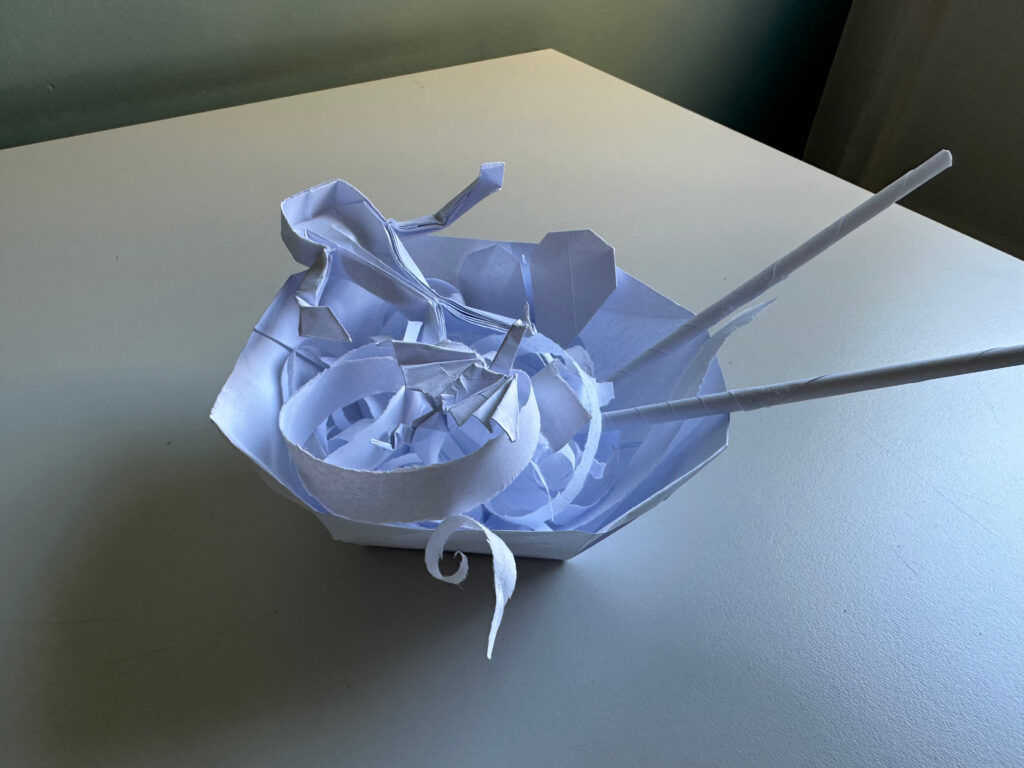
Making #4 – The noodle bowl of hopes and dreams.

I remember that I was hungry while making the last project. I was craving a noodle bowl. So I made a noodle bowl, with origami.

I thought about what else a person can be hungry for? adventure and fantasy, perhaps love, maybe they crave to be seen? So I added some extra toppings in my bowl to crave these hungers: a heart, a dragon, a person, and of course noodles and a pair of chopsticks.

Art and Fear reading response

The author’s viewpoint on the challenges artists face in their creative process makes a lot of sense to me. They talk about how artists often struggle with self-doubt, uncertainty, and doing the same things over and over again. I think many artists can relate to these difficulties. The author also asks why some art is left unfinished, which makes us think about the obstacles that can get in the way of creativity.

It’s interesting that the author mentions how artists in the past may have had more support from institutions. Nowadays, artists often have to find motivation within themselves because they don’t always get external validation. I agree with the author that it’s important for artists to find fulfillment in their own work.

The author criticizes the idea that talent is the only thing that determines artistic success. They believe that art involves skills that can be learned and improved through hard work. I think this is an important point because it encourages artists to believe in themselves and keep going.

I also like how the author talks about the difference between making art and looking at art. They say that making art can be a transformative process that helps artists grow personally. It can be a lonely journey, but the author emphasizes that creating art for oneself is valuable, even if others don’t appreciate it.

Finally, the author challenges the idea that art is just about expressing oneself. They suggest that art has different purposes and meanings throughout history. This allows artists to explore different paths and find their own unique style.

Robert Seidel – In-class visit – Rough notes

  • Visual artist, amazing transitions, and sounds to pair the movement with the music. Very in sync
  • Very detail-oriented (Color, shape, sounds, movement)
  • The art piece is done sometimes a few instances before his show starts, and he might modify them based on the reactions of people there. (V exciting and rare to hear about this type of art, as usual, with things exhibited, they don’t tend to change.)

Class Visit – Robert Seidel

Very dedicated and interested in his own work

Mysterious 

Open minded and willing to change his mind at any moment

An optimistic person who created something amazing out of chaos

Neither pressure nor underestimate your audience.

Very cool and captivating projections