
The chapter covers communication, patterns and it uses. It starts by explaining communication as a code, as a series of cues that are interpreted by us and that have a meaning. Since it is a code, it uses patterns to establish meaning. For this reason, communication is not necessarily a two way road. Humans pick on cues from the environment, we find patterns, even if they were not intentionaly put there, and even if we cannot respond to them. This makes me think of how can personal experience can present a problem for communication. Not everyone has the same pattern system, which causes misunderstandings to interpret the same information. I wonder how we manage to have a close enough sysmtem to even begin to communicate. I guess this is what the book means when it says that it doesn’t matter if patterns are worng, as long as they are definite. I find interesting the idea of the mind being a passive element of organizatoin, which is probably why pattern recognition is not effective all the time. Cues are ignored or misinterpreted all the time. I am not sure I understand how lateral thinking can be used to overcome these problems. I get the idea of the patterns to be “broken” in order to find solutions, changing the perspective to arrive to a different idea. But I fail to undestand how this could be a mechanism, a consistent one at least .
Author: Sophie Molina Orozco
Chocolate: childhood games
Chocolate ⇒ Games, playing ⇒ childhood, friends
Hand gestures ⇒ languge, code ⇒ secret code among friends
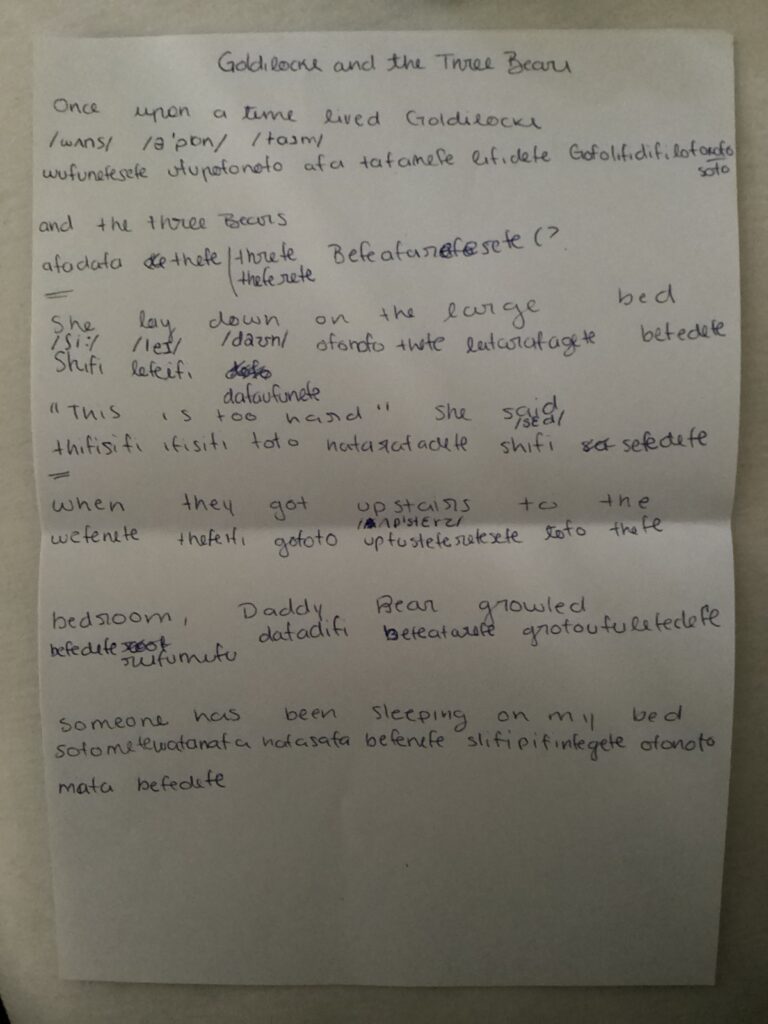
These two paths brought me to something called “the f language” in Spanish. It is a funny way of communicating for children. The idea is to add a syllable with the letter “f” to each syllable within the word. For example, the name Kate would be “translated” to Kafa-Tefe. I thought it would be an interesting idea to pass this game to English. For this reason i “translated” some passages of a fairy tale, i chose Goldilocks, and this are the results.
“ wufunefesefe ufupofonafo afa tafamefe lifidefe Gofolifidifilofokofosofo afadafa thefe threfe Befeafarefesefe.”
“Shifi lefeifi dafaunefe of ofondofo thefe lafarafagefe befedefe -Thifisifi ifisiti tofo hafarafadefe- shifi sefedefe”
“Wefenefe thefeifi gofotofo upfusteferefesefe tofo thefe befedeferufumufu dafadifi befeafarefe grofoulederefe -sofomefewafanafa hafasafa befenefe slipfipifinfegete ofonofob mafa bederefe-”
I used the International Phonetic Alphabet when I was not sure of how to add the fa/fe/fi/fu sounds.
Lateral thinking introduction response
The book explains what lateral thinking is by relating it to some other terms. Humor, creativity and insight all share basis with lateral thinking. I think humor is often forgotten when talking about creativity, so introducing it to the conversation helps to expand the understanding of lateral thinking. I also think comparing it to vertical thinking, which is more usual, helps to understand better the concept. The analogy of digging a hole was amazing for me, it cleared out the difference and how both complete each other. I also liked the way artistic creativity was approached and how there is usually the misconception that creativity is a gift that only few posses. The book also highlights the importance of lateral thinking as a process sand not something that “just happens”
Studio Visit: oval
The visit to the Studio was interesting. However, I do not agree on most of the artist’s opinions, which I actually think is good, because it made me realise I had opinions on certain topics. Diving between Artists and Content creators didn’t seem like a great idea to me. I see what he was trying to convey, but I felt his ideas on creativity (and the idea of artists/ content creator) were limited to music. Which makes sense, since that’s his artistic career. I wished he had explained more about his own process behind some o his artworks, it could have been interesting to know, for example, where he got the concept behind his latest album, how it evolved over time and what he would have change now.
Chocolate- 1st assigment
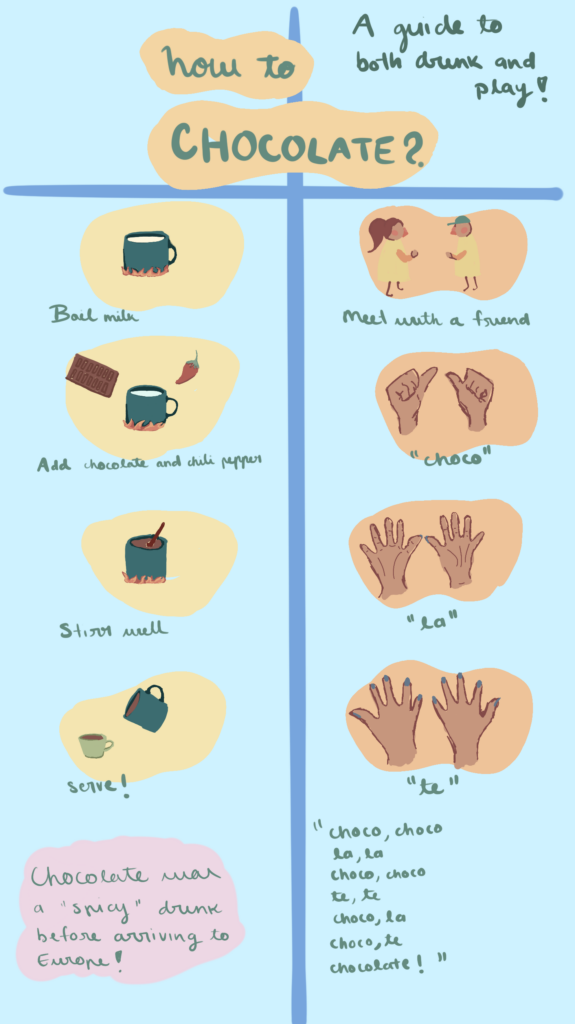
When thinking about chocolate, I first thought of a hot cup of chocolate. But this was not enough. I needed something else, I needed somethinto spice things up.. and then I remembered. Chocolate was supposed to be spicy, it was a spicy beverage before the colonization of Mexico. Why shouldn’t I try to make some? Do I know how to cook? No. Have I ever tried chocolate with chili pepper? Also no. Was this a good idea? probably not.
I quickly found a store that sells mexican products,where I found my favorite chocolate and bought some chili peppers.
I decided that this was just the inspiration I needed and not the actual creation. See, making chocolate (even the spicy one) was too obvious, and I had been doing something related to chocolate lately, something different. Chocolate is also a game in Mexico. It is just a hand game children play (or played, I am not sure anymore) when they are in kindergarden or primary school. I recently taught a friend how to play it. Combining these ideas, I decided to draw a guide to do/play chocolate the way Mexicans do it.
Here is a video of the drawing process:
I also ended up making spicy chocolate. I personally liked the flavor, but a friend tried it and (politely) ran to get some water and some milk to get rid of the flavor it left behind. I was not planing on including the hot chocolate as part of the assigment, and I didn’t get a good recording of the process, but here is a video of a friend and I playing chocolate.
https://vimeo.com/829639267?share=copy
Disclaimer: This is not the friend that tried the spicy chocolate
The Creative act of listening to a talking frog The Creative act – Response
Kermit, the one and only, explains some basic concepts of creativity: how it is present in everyday life, how it comes from an unusual perspective and how it is an inherent part of the self. He also talks about how creativity might not feel “present” when one is only trying to survive. For me, I wonder if it is not during hard times that creativity is forced to emerge. The video does talk about necessity and creativity being the “parents”, but for me, creativity is usually the product of necessities. Another highlight for me is the part about knowing the rules. Even if it’s to ignore it, I believe that the process of creating needs a methodology. Even if it is a flexible one, it needs a regulated process. If there is no structure, it is just “doing stuff” for me. In order to create there needs to be something else, which I believe is (partially) rules.