Response 8, Flow

“Do an activity for 21 days, and it becomes a habit.” I do not remember the exact source where I got this from, but it is a guiding principle I rely on for personal improvement. This approach reflects my commitment to “mental discipline” rather than the “constant spontaneity” discussed in “Paths of Liberation.” By consistently turning actions into habits, I believe it is possible to achieve a state of flow, since the book suggests that one of the reasons for failing to achieve flow is the inability to modify our habits.

Similar to the example of Alex and tennis, I find myself in a state of flow when I am learning and truly understanding something new. Here is where I stop aligning with the book. The book claims that repetition, as a specific level of challenge, leads to boredom and disrupts flow. I disagree. Since achieving complete mastery over a skill is impossible, there is always something new to learn from repetition. For instance, while practicing a tennis shot, the way I rebound the ball may stem from repetition and established neural patterns. Yet, I can still experiment with different techniques or the power of my shots and observe the results. This continuous experimentation and adjustment represent a learning phase, thereby inducing flow.

Furthermore, Roger Caillois’s division of the world’s games into Agon, Alea, Ilinx, and Mimicry overlooks everyday activities such as exercising, cooking, or singing. It is entirely possible to achieve a state of flow while engaging in these activities.
Making assignment 7 (Jackie, Jason)

We start off with the why technique: why do we want two people to get to know each other? Because there are monetary rewards from doing so. Why do people want benefits? Because they want to get rich. We start here with the premise that being rich is a common desire.

Our initial idea was that two people will be placed together and get to communicate with each other. There will be guided topics provided. After 10 minutes, each of them will be given a set of questionaire about the other, and they will be given money based on how many questions they answer correctly in total. The questionarie will be written by an observer who improvises questions from their conversation. Based on this setup, we thought it was cliche to have it similar to a coffee chat in which they just sit here and talk. Therefore, we refined it to having the two people in different rooms, not seeing in other, and their voice altered by a voice changer. There might be some psychological facts about the effect of seeing in each other’s face and hearing the actual voice to our understanding of the other person.

The guided topics could be about the following

Hometowns: ask to describe their hometown and what they like to do there, find their hobbies; ask stereotypical questions in a non-offensive way (for example oh so you must like *** food); etc.
Job: ask what their jobs are; whether they like it or not; then ask for reasons, from these reasons deduce their personalities and ask them if they are like that, and continue.
Hobbies: in case the hometown question didn’t reach here, ask about hobbies and why they liked it, what they liked about it, find connections, and think about future activities to do together.

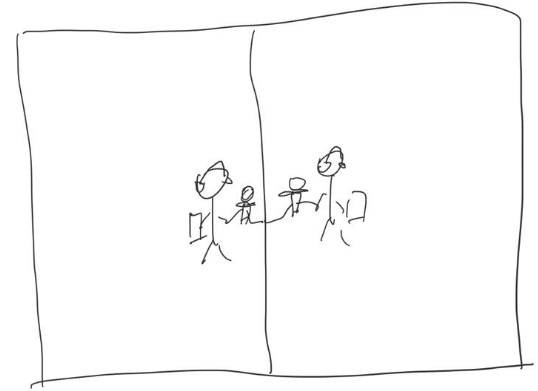
A graphic design will be the following

In which there is a wall blocking them. A microphone is used to alter voices and a headphone used to receive. The square is the paper with guided questions on it.

June 5- Mariam

Creation (Fatima & Mariam):

We were tasked with creating something that brings people together. Initially, we brainstormed common and realistic methods, such as dating apps, movies, and family events. However, we then employed the “why” method to explore deeper reasons for people coming together. By asking why people need to connect in the first place, we concluded that the goal was to help individuals connect with strangers they might have more in common with than they realize. This led us to the idea of “Stranger Confessions,” where strangers come together to answer five prompts or questions, fostering a deeper connection through shared responses.

 Flow; Csikszentmihalyi, Mihaly Response:

I really resonated with Csikszentmihalyi’s concepts around achieving flow states. His examples of how activities like games, art, and rituals tap into our core desire for enjoyment and growth by letting us push our skills and take on bigger challenges – that just clicked for me. The way he illustrated that cycle of mastering skills, then craving greater complexities to regain that optimal experience was an eye-opener.

His take on how religions originally facilitated those meaningful, flow-inducing connections, while a lot of modern pursuits fall short on that front, definitely made me think. Even if contemporary flow activities seem more pleasure-seeking on the surface, his point about them being the truest expressions of a culture’s character and pursuit of happiness rang true.

Thoughts on  Robert Seidel

I thought Robert Seidel’s art was really interesting, especially how he used AI to integrate and elevate his work which made it look so artistic and innovative.

Even though his art is impressive, a more energetic presentation would have made it more interesting to watch.

Response : Flow – Paths of Libration and The Conditions of Flow

The text delves into a profound exploration of how mastery over consciousness can greatly enhance the quality of life. It’s fascinating to see how this concept has been explored through various cultural lenses, from the philosophical meditations of Aristotle to the rigorous mental disciplines found in Eastern practices like Yoga and Zen. The universal struggle to control the fluctuations of the mind resonates deeply with me, especially in our modern world where distractions are incessantly at our fingertips.

From my understanding, the text emphasizes that true mastery of consciousness isn’t something that can be simply learned from a book or taught in a lecture. It’s a deeply personal, often lifelong endeavor that requires consistent practice and adaptation. It suggests that while the journey towards self-mastery is challenging and unique to each individual, it is also universally accessible and potentially rewarding.

The concept of “flow” as described in the text especially strikes a chord with me. It’s a reminder that finding balance between our skills and the challenges we face can lead to profound moments of engagement and satisfaction. This has practical implications for how we choose our tasks at work, our hobbies, and even our social interactions. 

What I take away from this is a renewed motivation to engage more deeply with activities that challenge yet complement my existing skills, with an aim to achieve that state of flow more frequently. Whether it’s through my professional work, hobbies, or even physical activities, the pursuit of mastering my own consciousness seems like a worthwhile endeavor that promises to enrich my everyday experiences and overall sense of fulfillment.

Making-7-Jun.6.Rishan&Linda

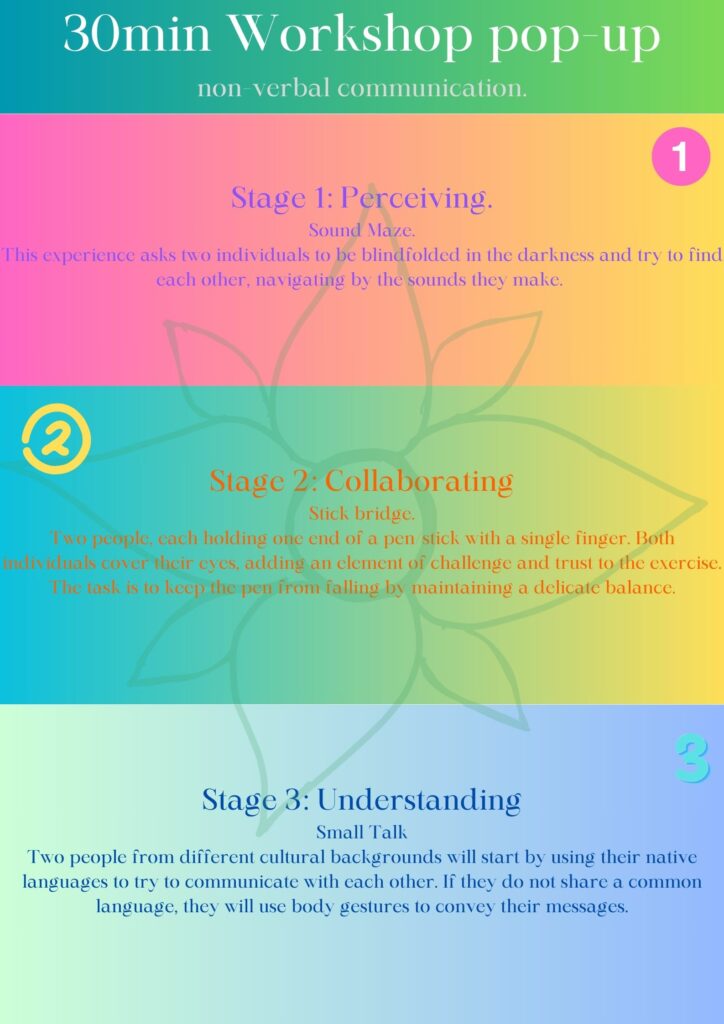
This is a flyer for:

30min Workshop pop-up on non-verbal communication.

We designed a workshop that intends to connect two strangers together. Human connection is not that difficult, we believe that every stranger can learn a bunch about each other in 30 minutes, even if they don’t say anything. 

Stage 1: Perceiving.

Sound Maze.

This experience asks two individuals to be blindfolded in the darkness and try to find each other, navigating by the sounds they make. 

  1. You need to design a specific sound for yourself. Use of language is not allowed.
  2. You will be blindfolded, meaning that you can’t see anything. 
  3. Soft, non-harmful barriers will be present in the room to stop you from reaching to the other person easily.
  4. There will be speakers all around the room, broadcasting sounds that distract you from reaching your partner.

This experience brings participants back to a natural state of life. When language, the primary tool for communication, is removed, and individuals are placed in an unfamiliar, dark environment, our innate social instincts are activated, and we involuntarily seek companionship. By creating this basic level of misattribution of arousal, we intend to help participants understand the fundamental nature of human connection.

Stage 2: Collaborating

Stick bridge.

Two people, each holding one end of a pen/stick with a single finger. Both individuals cover their eyes, adding an element of challenge and trust to the exercise. The task is to keep the pen from falling by maintaining a delicate balance.

  1. You can move around, as long as the pen stays.
  2. You will be blindfolded, meaning that you can’t see anything. 
  3. You have three chances

This requires communication, trust, and a shared goal, much like the dynamics in real-life relationships and communities. Just as the pen will fall without a coordinated effort, our personal and professional lives can become unstable without the support and connection of others.

Stage 3: Understanding

Two people from different cultural backgrounds will start by using their native languages to try to communicate with each other. If they do not share a common language, they will use body gestures to convey their messages.

Ben – Reading response extra

The part about changing the environment physically to more easily enter flow (such as wearing uniforms in football) reminds of the simple advice of not working in the bedroom. It is the same principle: you gotta put yourself in ‘work mode’ somehow, and getting out of the leisure space is probably a good first step.

Though the author showed a bit of disdain towards the rationalization of flow, in psychology we learned a simple fact: the brain gets used to new stimulus pretty quickly, and that is part of the reason why we are so curious about everything. We are continuously chasing the high of first times. This is also applicable to the flow chart in the reading: as people surpass challenges many times, they have to seek new challenges in order to find that enjoyment again. Its sounds a little depressing, that we are always chasing something impossible in a sense, but this principle is core to human growth and is a big part of why we are practically every where on Earth today.

Ben – Artist thought (Robert)

I love how he is presenting all these amazing work in the most monotone voice ever (no hate to him, I just think it is kinda funny). Overall, I like how he has found a way to bring his aesthetic (which is abtract interconnected lines/shapes) into a lot of his work without them being too similar. I also like that he is very meticulous in most of his work, but he has shown willingness to go with the flow like in the Florida exhibition. I really like his work and would definitely like to go to an exhibition in person.

Impressions of Robert Seidel

His work was hypnotizing. The first film he played for us did not make sense to me. I could not understand neither his intentions nor his art. However, his last demonstration: Hysteresis was mesmerizing. I could make out shapes in his art and it was breathtaking to watch. When he said “there is so much more than what others see”, I recalled to how the book Art & Fear talks about the efforts to success being invisible and only the results mattering. His presentations today directly relates to this. He also talked about the process of development which I found very useful since I was introduced to a new term Optical Flow algorithm, and he also mentioned several 3D rendering tools: Blender, Touch Design, and VQFan which I will be experimenting with in the near future.

Making 7, Darko & Ronal

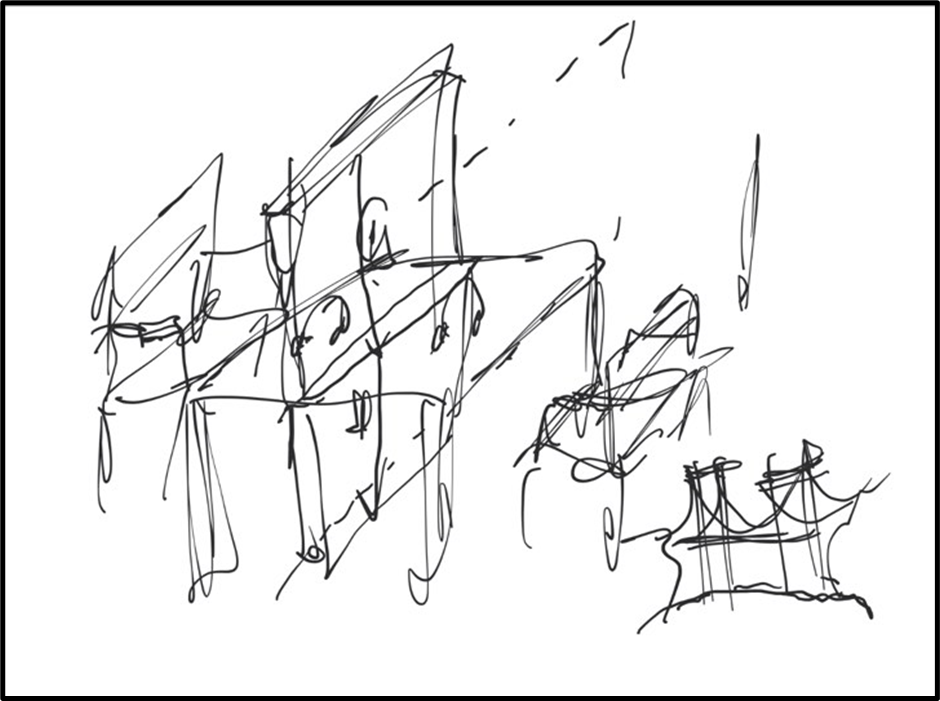
For this Making assignment, we decided to create a meaningful connection between two individuals by having them listen to each other’s heartbeat in a contactless manner. Initially, we proposed having the participants face each other while maintaining eye contact to provide a sense of intimacy. Each person would wear headphones connected to a heartbeat monitoring device, such as a stethoscope, which allows them to listen to their partner’s heartbeat. Since the assignment was for people to have meaningful connections, however, we considered enhancing the experience by separating the participants so they could not see each other. For that we decided to place a partition in front of their seats which would drop down at the end of the experiment so that the participants would be able to see each other and contextualize their partner. This was our first alternative. Below is a rough sketch we made. It might not be too clear, but you should be able to make out the table, chairs, and partition.

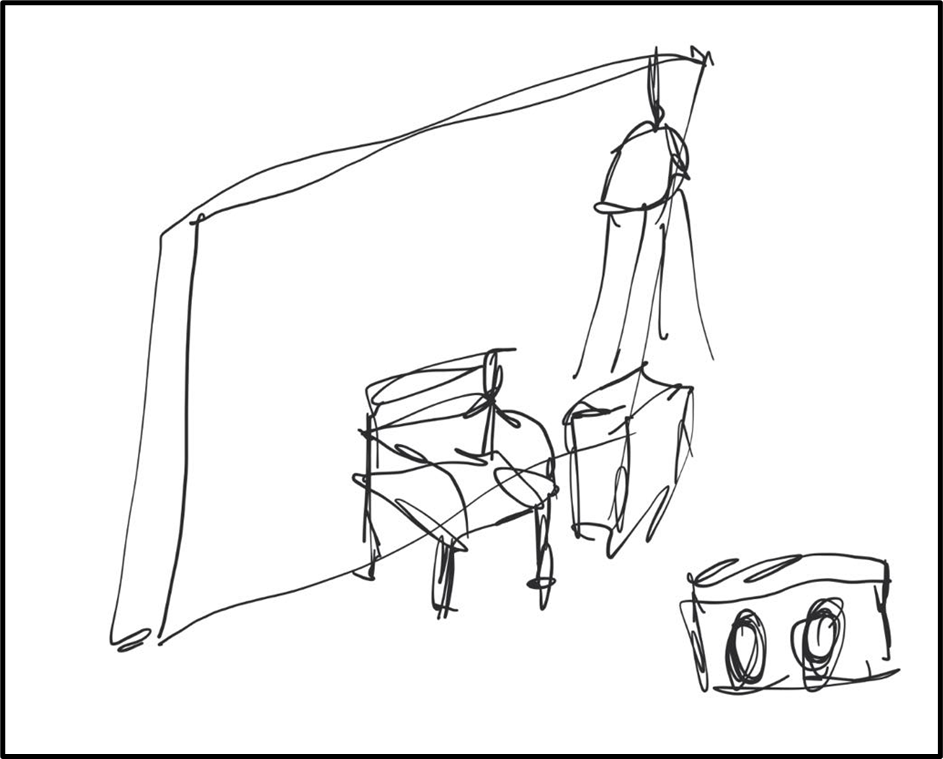
Then, we refined our approach to create an even more meaningful experience by having the participants interact anonymously.  To achieve this, we decided to remove the partition and instead place the participants in separate rooms or divide the room with a wall. Our plan was to have the room dimly lit to diminish their sense of sight, thereby enhancing their other senses, particularly hearing. In this way, each person could concentrate on the sound of the heartbeat more intently. Additionally, we considered using speakers to amplify the heartbeat sounds, so that each person could not only hear the heartbeat, but also feel the vibrations. Following is a rough sketch of this version.

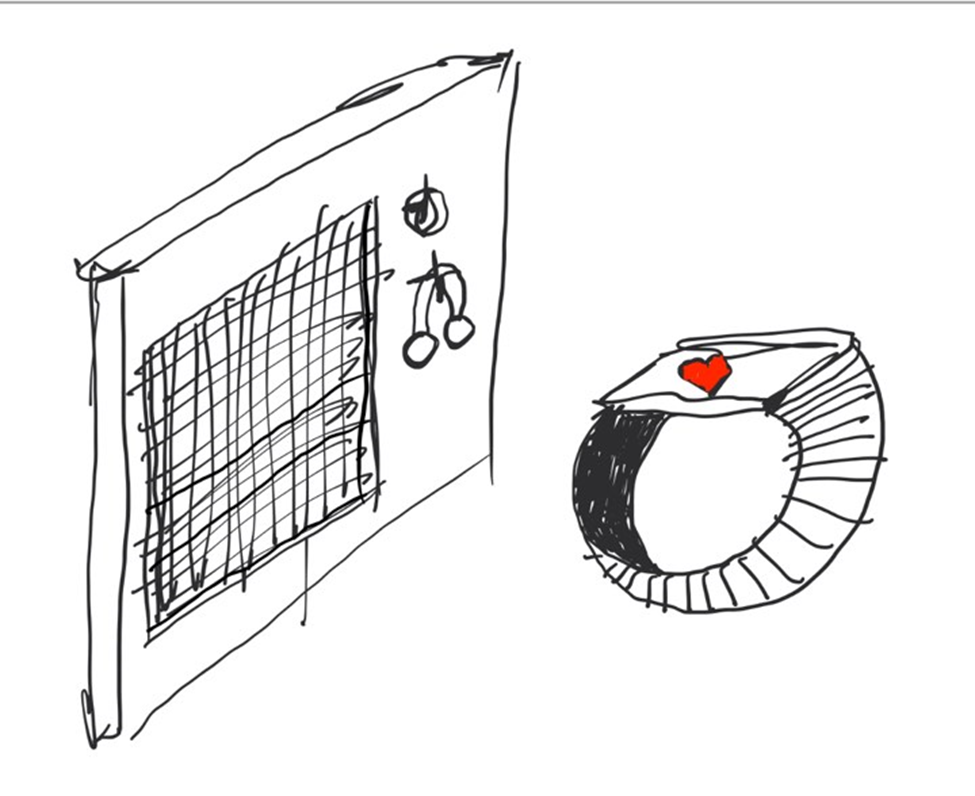
Finally, instead of vibrations, we thought of using a pin screen to have the two people interact with each other. Since the screen constantly changes based on each push, it provides for a more realistic contactless interaction experience. We also had to figure out how to record the heartbeat after being in separate rooms. For that, we decided to use a fitness watch.

To facilitate the in-class demonstration, we have sample heartbeats ready to be played.

Reading response & thoughts on Robert

I find the flow diagram intersting and explanatory. Indeed, it reflects our learning processes and provides guidance on how to optimize our learning experience: the art of finding balance between challenge and skill. It also explains why we sometimes give up on learning something, and it reminds me of my experience with the card game “Avalon”. I learned this game with a couple of friends who were also new players. At the beginning, since we just learned the rule and no one knows how to properly play, our skill and challenge balances out, and we were all in A1. After few rounds, some people became better and studied some “tactics”, thus the group was divided into people entering the boredom state A2 and others entering the anxiety state A3 (the “how can they learn it faster than me” mentality comes into play), which drives us all to continue playing and practicing (back to A4). Therefore, in the first few weeks, we were all very addicted to the game and would spend long time playing it whenever given the chance. However, after months, where we all sort of knew the basic tactics and had invented some “rules” amongst us, our skill at that point surpassed our challenges. Due to not having outside players, the game became more boring and we nevered entered the flow state again. Therefore, we barely play this game now when we meet.

Thoughts on Robert

He’s a very cool guy, although looking a little bit shy. I really like his work, despite the fact that my interpretations may at most time different from what he has in mind when creating. But his work is the type of abstract art that I would just spend time staring at and not feel bored. I really appreciate the music in his videos: they fit very well with his paintings. Furthermore, his usage of 3d technology really impresses me. It’s enjoyable to look at the development of his work from 2002 to 2020, a fairly long timespan.