Assignment #2 – They are all looking at you

For this assignment I analyzed the Collage me and Mariam made and came up with these topics:

  • A basketball player dunking over waves
  • Eyes looking at you in every step of your journey
  • Life is full of ups and downs, and you should go in as hard as you can
  • Life Is a game, score the basket and win the crown
  • Rise over the waves and become the best version of yourself while everybody is watching

Out of all of this topics I chose the last one as the most interesting one (Rise over the waves and become the best version of yourself while everybody is watching) and these are my concepts for it:

  • A motivational video with people looking right at you to tell you that everybody is watching and it’s your turn to rise up
  • A drawing of people standing all around you in a circle while you are struggling in life
  • A collage of how social media and phones are watching you while you are committed to achieving your goals
  • A picture (taken by a camera) on the roof of a building watching all over the city (It gets lonely at the top)
  • A painting of the ocean full of fish and you rising above it

Out of these concepts, I chose the first one (A motivational video with people looking right at you to tell you that everybody is watching and it’s your turn to rise up) and made this video:

I really hope you like it!

Ben – Reading response 2

The emphasis on restructuring information is interesting. In a different class, I learned about remixing, which is also about rearranging existing information in one’s mind in order to utilize it in more work. The focus of the education system in vertical thinking is also quite interesting, as a similar problem was identified also in another class I took: there is not enough emphasis on connecting the information learned, which in this case would be similar to connecting some of the tunnels in the book’s analogy.

Visit Reflection #1: Otis Sandsjö

While I can’t recall the last time I heard a saxophone by itself, I was not expecting the saxophone to sound the way it did when Otis played it. There were so many different types of sounds .

Everything kinda made more sense when he mentioned he was trying to integrate aspects of electronic music in his sax playing. I was also wondering if the occasional air blowing sounds were occasional or if he just messed up because he was trying to play it quietly. 

I wasn’t sure how to feel about the track he showed from his new album Y-OTIS TRE though. I can’t honestly say I liked it but I was interested in why it felt like there was a lot of secondary noise, like the recording wasn’t very crisp. I assume that’s intentional but personally I don’t enjoy that vibe.

Ben – Visit thought (Otis)

Otis’s improvisation was great. I didn’t know improviser could a role/thing someone do, and it’s cool that we got to hear about some of the thought process behind his improvisation. I love his advice of having small building blocks (soundbites in his case) ready whenever he wants to create something so he doesn’t have to start from scratch.

Make 2

five new interpretations of make 1:

  1. Someone watching a documentary about animals at the beach while someone next to them is listening to music 
  2. A lion at the zoo roars at a stray cat, but the zookeeper plays a dinosaur noise to silence both of them (weird right?), music is playing on the zoo speakers and the wave sound is from the the sea lion tank
  3. The sound is from a living room, where person 1 is playing the piano, person 2 is watching a tik tok that was filmed at the beach, person 3 is trying to find the perfect roar sound to use for their project and the family cat is meowing because it’s hungry 
  4. The sound is from a fictional game, the scene is set by the beach, the main character is a dinosaur that has to kill all animals in sight to win the game. The game has a soft melodic background music.
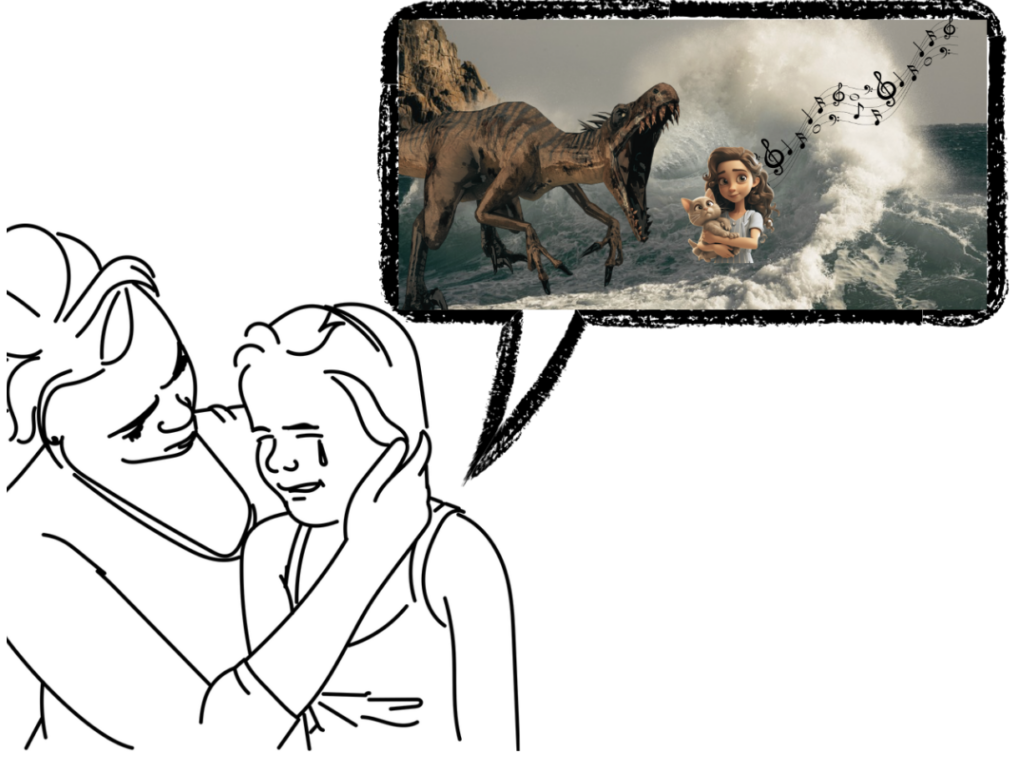
  5. The sound is what is imagined in a woman’s head when her little girl retells her nightmare; it was 80 millions years ago when dinosaurs still existed, the girl was by the beach, cuddling up with her cat when they were attacked by the dinosaur

five possible things I could make of the fifth point:

  1. A story narration 
  2. A puppet show
  3. A picture
  4. A video 
  5. A paper origami model

I decided to create with the picture representation of the fifth interpretation. I didn’t really have a visualization of what I wanted it to look like, but I forced myself to start anyway. I started adding the elements and moving things around, but i wasn’t really satisfied with the draft I had. It looked off to me. Below is the first draft I had.

I decided to start over. At this point, I still didn’t know what I wanted it to look like. I only knew what I didn’t want it to look like. I tried to more realistic looking elements.

Below is the final result I reached.

Otis Sandsjö-May.24.Linda

I feel like his music is something that I would usually listen to so it’s great to have him there with us. What he says about having a limit in a way leads to more creativity & embracing the healthy fear of losing inspiration is pretty helpful for creators. I wish he could show us the process of creating a piece tho.

Reading Response (Lateral Thinking) and Thoughts about Otis

To start off with the reading, I really enjoyed how in this class we are going to push ourselves to think differently, creatively, with the intention to deconstruct and reinvent, in one word, Laterally.

This short reading introduced us to this way of Lateral Thinking. Ever since we were little, we were prompted to recognize patterns because that is how the brain works most efficiently. However, this way of thinking even though efficient, does not broaden our imagination and thus Intelligence. Yes, I said it well, Lateral Thinking is closely connected to Intelligence and the reading encourages us to practice this and combine it with Vertical Thinking. You get the ideas with Lateral Thinking, Construct, Deconstruct and then you deepen those ideas with Vertical Thinking.

Overall I am really excited to learn more about this process.

Thoughts about the artist (Otis):

  • Overall I really enjoyed Otis coming down and talking about his creative process. He seemed like a person who really enjoys what he does, with passion and dedication.
  • It was really Interesting to see where life takes you, as with Otises life story, we can all learn that if we pursue what we really want in life and are dedicated enough, we can all make it.
  • Lastly I was really disappointed I couldn’t make it to his Vinyl Listening Party (Mariam fell asleep), but hopefully we get to see him perform again in the next few weeks.

thoughts about Otis’s visit

I really enjoyed Otis’s class visit today. Being a musician myself, I’ve seen plenty of artists perform different forms of music over the years. Otis’s style of music may not be very high on my preferences list, but I still really enjoyed his performance. You can see in the way he performs that he genuinely enjoys what he does and at the end of the day that is the most important thing because without passion, no matter how good you are, you can only do so much. I have never heard a live solo that sounded as multi-layered and diverse as Otis’s performance. The airy layers of his performance reminded me of a windy desert, the sounds of his finger on the metal keys, even though not really a part of the music, reminded me of the sound of strong rainfall. The array of different elements of music produced by his saxophone was absolutely fascinating especially knowing that it was all improvisation. It was also nice to hear from a musician in the industry about the different stages and challenges faced in music composition and production.

Response 2 – Lateral thinking

Growing up, my mom used to always tell me to think outside the box. As a kid I couldn’t really understand what it meant. What box? I was confused as to why some ideas are considered in the box but others are out of it, what criteria separates the ideas? she would tell me not to be scared to have crazy ideas because even if they’re wrong, it’s better than having nothing. I’m a very realistic person, I try to find the most realistic explanations. Everything has to make sense for me, so I was confused how having wrong ideas would lead to the right place at some point, it just seemed impossible. Now that I think about it, what my mom was trying to teach me is similar to lateral thinking. Having been introduced to lateral thinking, I understand that the point is in the process. It’s about losing those rigid patterns set by our minds. If we allow our minds to consider crazy cases, even if they seem impossible, we will reach the desirable solution. I see how this would also encourage and influence our creativity because I feel like our minds often suppress creative ideas by trying to be realistic and sticking to the familiar.

Reading Response 2, “Lateral Thinking”

When attempting the exercise of making an L from a square with 2 cuts in class, I was fixated on turning the larger leftover cutout into the required shape. However, the first solution that was later presented was not restricted by this limitation I had assumed. Instead, by using a single straight cut through the middle and arranging one of the halves vertically over the other, which remains horizontal, an L shape could still be achieved. This simple solution showed me what lateral thinking is, as mentioned in the book: a process of “restructuring, escape and the provocation of new patterns.” The passage also provides a revision of the in-class discussion about the differences between “Natural Search for Alternatives” versus “Lateral Search”. In both the book and the discussion, an idea that is brought up is the possibility of different approaches to a problem or task. It reminded of Otis Sandjso’s process of improvisation and how he mentioned that the songs he makes are layers upon layers of different practice sessions, building one over the other but never completely replacing any one of them. It makes me wonder how much of his improvisation relies on lateral thinking and in what capacity is the former concept dependent on the other.

Impression of Otis Sandsjö

  • Amazing saxophone skills
  • Excellent improvisations
  • Enjoyed listening to him
  • His responses to questions mirrored many points in Kermit’s TED Talk
    • His music directly applies the “conspiracy of craziness”, unconventionality and experimentation.
    • He mentions he “didn’t know where he was going” when he started his musical journey.
    • He never expects his music to be perfect.
    • He mentions the endless possibilities for a beginner, much like in Shoshin.
    • His mentality of constant practice and to not be result-oriented is a direct reflection of the section where Kermit talks about “explore, experiment, make mistakes”.