Make 5

using the reversal method

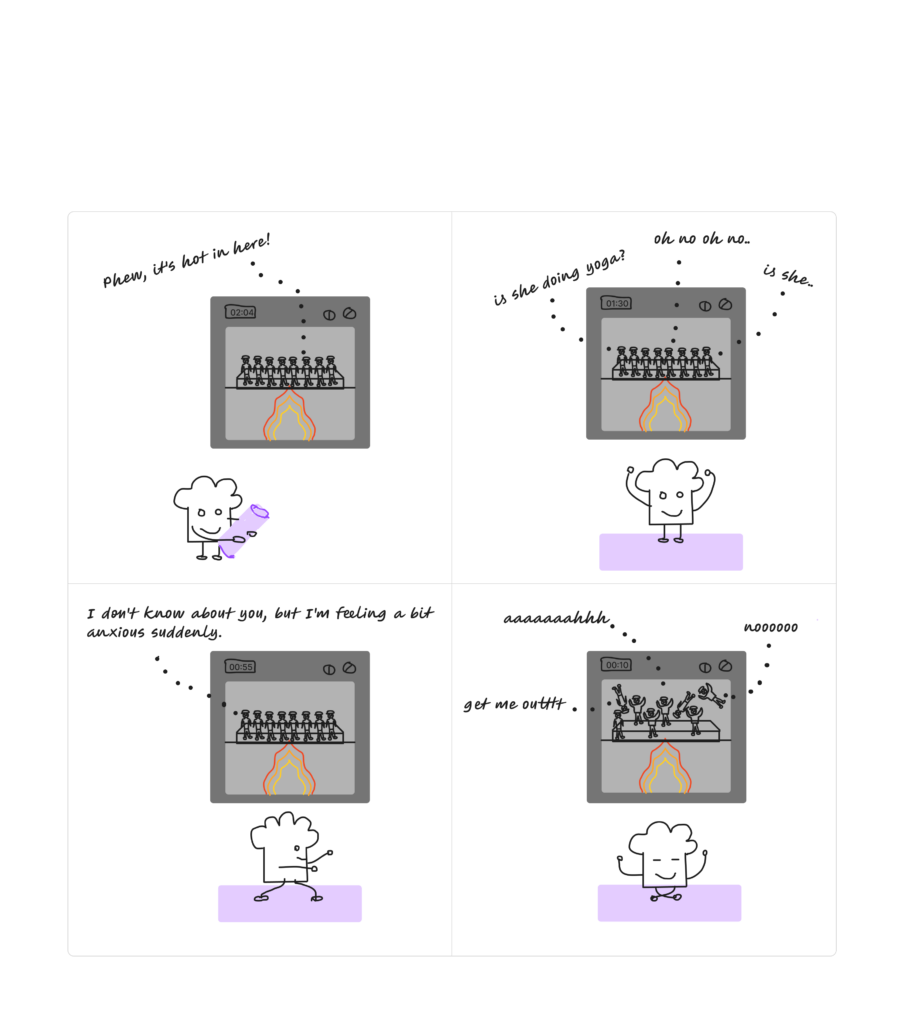
entry point: Baking cupcakes can be therapeutic to some people

Baking cupcakes can be distressing to some people

Baking some people can be disturbing to a cupcake

Disturbed people can be relaxing to a cupcake

chosen reversal: A relaxing cupcake can be disturbing to baking people

Baking people can be disturbing to a cupcake

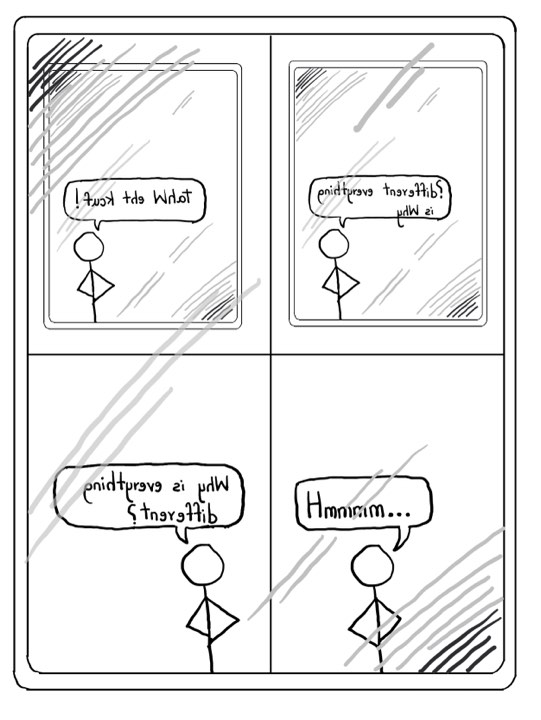
We were asked in class to choose an idea that resonates with something we love. I thought alot about it, I got down this rabbit hole of what do I actually love? Why do i like this and not that? Which started to get me a bit stressed out. And then I remembered that usually when I’m stressed out, I start baking cupcakes. So I decided to just go with that. After multiple reversals, I reached the idea that a relaxing cupcake can be stressful or disturbing to people that are being baked. I decided to make a cute comic strip to represent it.

Making 5-May.30.Linda

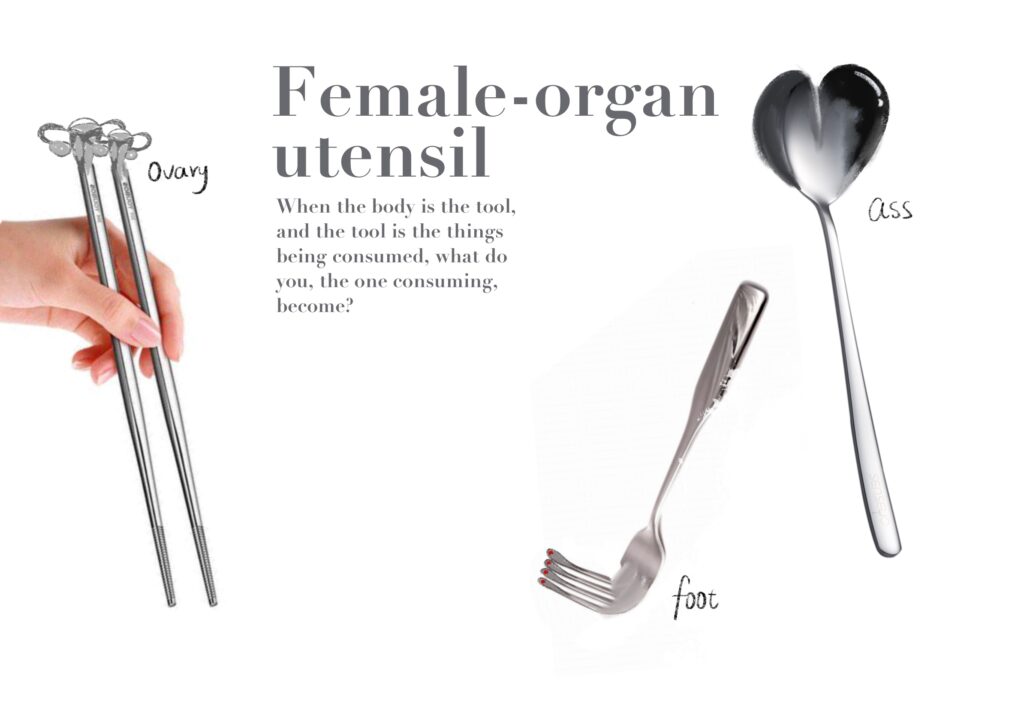
My final product is a conceptualization of female body utensil sets. It’s a utensil set made for everyone. For female-identified consumers, I want them to embrace their body more. For male-identified consumers, I want them to reflect on their daily life behavior. Violence resembles consumption of food, vice versa. When the body is the tool, and the tool is the things being consumed, what do you, the one consuming, become?

My thought process starts from:

Women getting killed in wartime

Reverse:

  1. Wartime kills peacestime with man and woman 
  2. Women killed the war
  3. Non-binary people getting killed in peacetime and then killed the war 
  4. Women killing women in wartime

Analogy method

Processes

  1. Catch a woman.
  2. Steal their possesions.
  3. Put them into a camp and then kill them.
  4. Or kill them on site

abstract 

  1. Eyes locked on a moving subject. 
  2. Human using tools. Mind telling body instructions. 
  3. The touching between a metal object and a fresh, warm organism.
  4. If sexual desire arouses before the action
  5. Objectify a human being to an object that is waiting to be hunted.

Relationship

  1. A human to a woman
  2. A man to a woman
  3. Object to organism
  4. A group of human to another group of human
  5. Resources to another resources
  6. A hunter to a prey
  7. A person with more power to a person with less power

Analogy

  1. Lion hunting a sheep
  2. Woman getting killed in wartime is as usual as having a breafast everyday
  3. Storm destroying a garden
  4. Trees being cut down in a forest

thoughts about Ming’s visit

I thought his work was pretty cool. It takes great courage to be able to present a work that is completely dependent on your audience. I liked that he has a message for all of his works. I also liked his perspective on failure and fear. However, I was a bit unsettled by his speech about death. Not everyone has the same perception about death and surely not everyone has had the same experiences with death so I didn’t like that he kept saying more so that we should accept death and greet it with open arms. I think that before he goes on to talk about death in great detail, he should at least give a disclaimer since it’s a sensitive topic for some people.

Ben – Making 5

Reversal method

Entry point: Game developers crunching to get games out on time.

5 reversals:

  • Games trying to ‘dress up’ (i.e., finish) on time so the developers don’t beat them.
  • Developers hounding executives to go find more funding.
  • Developers breaking down a finished game into small pieces.
  • Developers making a game leisurely.
  • A game making itself.

This took me a bit of time since I tried to keep things logical at first. I decided to go with idea 3. I made a collage of headlines about features that have been removed from video games sequels and/or updates, or just video games being shutdown in general.

Reversal and Analogy – Darko

For this assignment, I chose to think outside of the box and instead of making two different projects I combined the concepts of Reversal and Analogy and created one thing. Let’s dive deep into it.\

For the reversal exercise, I came up with these concepts:

The swimming instructor is measuring my swimming time – I am measuring my swimming instructor’s coaching time

I’m pouring hot water from a pot to a glass – I am pouring hot water from a glass to a pot

I am playing basketball with a bouncy ball – The bouncy ball gets flat and I can’t play

I want to make a peanut – butter sandwich – The peanut butter jar breaks

I’m throwing a football at my friend – My friend is throwing a football at me

After doing the reversal method I chose to go with the 4th option (

I want to make a peanut – butter sandwich – The peanut butter jar breaks) because it seemed very fun and different from what I have done before.

Step 2: Analogy – How to make a peanut butter sandwich (If the jar breaks)

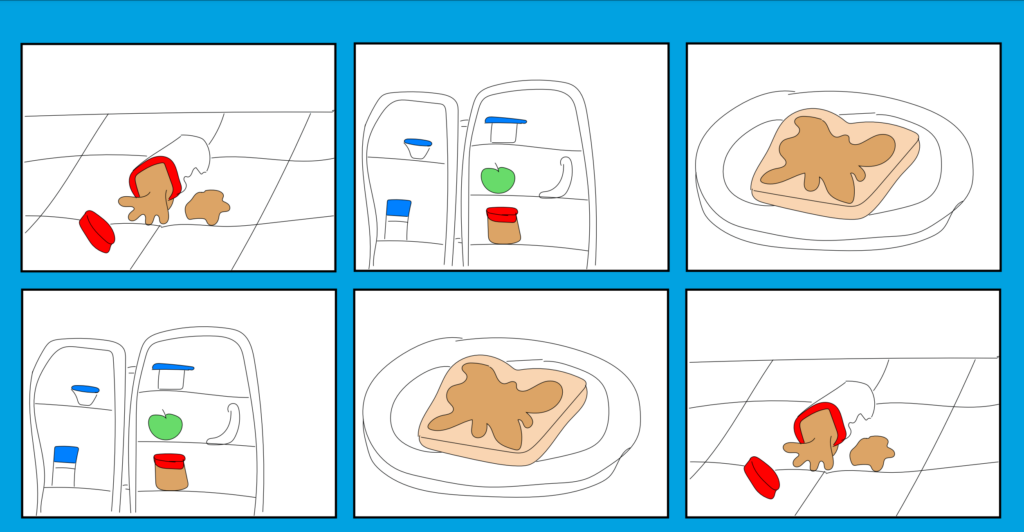
Open the fridge – Get Peanut Butter – Slice a Piece of Bread – Spread Peanut Butter – The Jar slips

OR: We can do the opposite

The jar slips – Open the fridge- Get a new jar of Peanut Butter – Slice a piece of bread – Spread peanut butter

So In order to combine these I decided to make a short comic representing both situations:

Thank you!

Thoughts on Ming Poon

The visit from Ming today was remarkably enlightening and unique. I used to think that art was solely about natural talent and that being an artist required inherent skills. However, Ming’s insights today expanded my understanding of art and how it integrates into daily life. I learned a great deal from Ming, beginning with his perspective on what art entails and how I should shift my own views on it. He embodies the authenticity of living a life true to one’s self. His work is not only impactful but also inspiring, even to those who might not typically be interested in art. His research ideas, particularly how he connects them with his life and engages with his audience, were especially intriguing. I learned the importance of vulnerability and letting things unfold naturally. Overall, I was captivated by his research projects and his immersive approach to his artistic life. Ming’s sincerity is evident in all he does. Lastly, his concept of embracing failures resonated with me; it’s a reminder that without failure, we can’t truly discern what is wrong and right. Overall, his work was profoundly inspiring, and I learned a great deal from him.

Reading Response 4: Lateral Thinking

I really enjoyed how things are written in the way it makes sense. We can see that lateral thinking is portrayed as a means to generate alternatives and challenge assumptions, focusing on the process rather than merely the correctness of ideas. This approach encourages forward thinking, which is about creating something new rather than merely analyzing the existing.

A major theme highlighted is the concept of suspended judgment. Unlike vertical thinking, where judgment is continuous and exclusionary, lateral thinking allows for a temporary acceptance of possibly incorrect ideas to foster creativity and lead to valid solutions. This is crucial because it allows ideas to evolve without immediate rejection, potentially leading to breakthroughs that rigid thinking might miss.

The text also criticizes the traditional educational focus on being correct at all times, suggesting that such an approach stifles creativity and innovation. It argues for the value of being effective rather than just being right, advocating for a more exploratory and less judgmental thinking process. By delaying judgment, ideas can be developed more fully, encouraging a richer array of solutions and insights.

This emphasis on the transformative power of lateral thinking and the strategic suspension of judgment provides a compelling argument for reevaluating conventional thinking paradigms, especially in educational and creative contexts. I found this text particularly interesting because it embraces the reality of incorrectness as an opportunity rather than a setback. When you’re not afraid of being incorrect, you’re more likely to bring the right elements into your process, focusing on rearranging information to create and innovate something new.

Reading Response 5: Art and Fear

The most interesting aspect of this reading was how it connected with my reflection on Ming’s visit. His discussion on research projects deepened my understanding of art and paralleled my own shifting perceptions of creativity and innovation.

The narrative challenges the notion of the “gifted” artist, advocating instead that art is a craft developed through persistence and hard work. This idea resonates strongly with Ming’s insights, which debunked the myth that art relies solely on natural talent. He emphasized that art integrates deeply into daily life and reflects the artist’s personal journey, including their vulnerabilities and failures.

Ming’s concept of embracing failures aligns with the text’s emphasis on valuing every piece of work, successful or not, as a crucial step in the artist’s growth. His approach, intertwining research with personal experiences, illustrates that art-making transcends skill; it’s about authenticity and honest self-expression.

Additionally, the text illuminates the often solitary and thankless nature of art-making, discussing the existential challenges artists face, such as confronting incomplete works and feeling unsupported by society. It stresses that art is not just about talent or divine inspiration but is a skill honed through practice. Moreover, the idea that art is made by ordinary people with flaws and sometimes strengths reaffirms the importance of perseverance and the iterative nature of creating art.

Overall, this reading and Ming’s visit provide a comprehensive view of the modern challenges of making art, advocating for a more inclusive and realistic understanding of what it means to be an artist today. This class has profoundly transformed my understanding through both theoretical insights and real-world examples and I am so thankful for that!
Reversal method – creating

Step 1: Choose an Entry Point

The entry point is the everyday activity of making coffee.

Step 2: Generate Reversals

1. Reverse the temperature: Instead of making hot coffee, make an intentionally crafted cold coffee beverage.

2. Reverse the sequence: Typically, coffee is brewed first and then additives like milk or sugar are added. The Reverse of this is mixing additives first and then introducing coffee.

3. Reverse the grinding process: Normally, coffee beans are ground before brewing. A reversal would be to brew whole coffee beans directly in hot water, allowing them to steep longer to extract the flavors.

4. Reverse the consumption method: Instead of drinking coffee, it is possible to create a way to consume coffee in solid form, like coffee edibles.

5. Reverse the time of consumption: Coffee is usually consumed in the morning for energy. It is possible to design a coffee meant to be consumed at night, possibly with ingredients that promote relaxation.

Step 3: Choose a Reversal and Make Something

I chose the fourth one “Reverse the consumption method”. This idea transforms the liquid coffee into a solid, edible form that can be enjoyed as a snack or dessert.

I chose to create coffee-infused chocolate.

Artist Visit: Ming Poon. May.29.Linda

It was great to see a member of the Asian queer community who truly embedded his theories in every moment of his life. I echo most of the things he said about embracing fear but keeping a boundary, queerness combatting colonization, and how he gets away with censorship using different methods. I am so curious in his daily life that I almost want to make a documentary on him. 

Artist Visit: Merche Blasco. May.28.Linda

The visual/audio spectacles and the heavily contextual public performances go towards different directions but she somehow was able to make me believe that they are from the same artists. Hate to frame it this way, but I can definitely see more commercial value in Merche’s works than other ones. I really wanted to ask if she uploads her sound to a sound library but somehow that idea just slips away 🙂 I think her stuff reminds me more of a usual, contemporary performance that I would go and watch with friends. Really enjoy how all of them have such a solid foundation of research which i think is the soul of all their arts.