Making Task #2

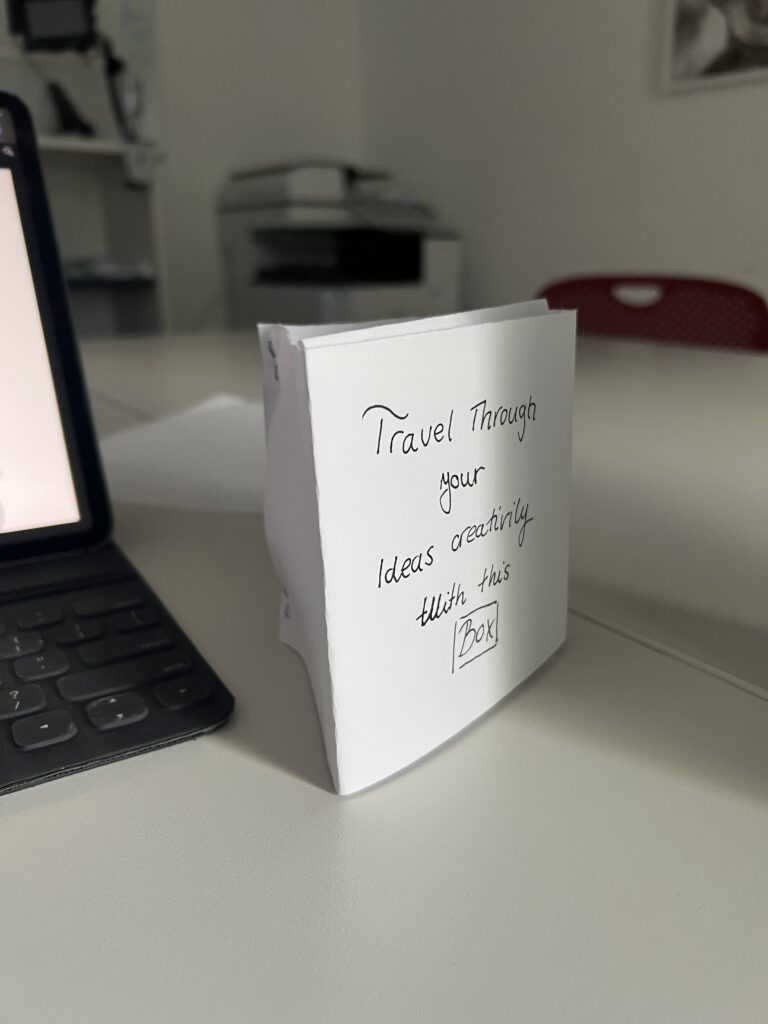
This was a really fun and nostalgic challenge for me as I had to turn my childhood time wasting game into a new box of ideas for my making tasks, each time I get a new task, I will write it on a piece of paper, and put it in this task, in order for me to see how much I have progressed since this task.

It was really fun to play DIY arts and crafts when you lack most of the material, but I let creativity take the wheel and guide me through how to turn the surface of my game and its distinct shape, into a box for my future ideas.

As I will have all my ideas in this box, I will be able to “Travel through my ideas” and in some way i would still be time traveling, for some reason, my goal for this exercise was to keep something of the game from the previous assignment and just build up on. It without fully modifying the existence of the first, which is where the concept of traveling through time came from.
Reading response #2

response to: Lateral Thinking – Introduction

When discussing the ways in which ideas are updated, De Bono mentions that “(…) the [conflict] method does not work at all when the new information can only be evaluated through the old idea.” I found this really interesting as it reminded me of the importance of ideology in the formation and propagation of knowledge.

Back home, in Brazil, there have been increasing attempts to remove racist, mysoginistic and other bigoted content from traditional books, many of which are read in school. The idea is to rephrase those stories according to the morality of our current time. From my understanding, this sounds a lot like the linear progression inherent to vertical thinking. In my opinion, however, this strategy of simple erasure is fruitless when it comes to educating a new generation in social and political problems that, to quote de Bono, cannot be evaluated objectively. Instead I would suggest a strategy, perhaps similar to that of lateral thinking, where those stories are contextualized. After all, only by evaluating the past can we understand the struggles and ideological shifts of the present.

Artist Visit – Sara

As someone that isnt really familiar with the art of music as much as the other arts, it was interesting to hear what art means from a musician’s perspective, despite me not being able to feel his feelings and understand truly and deeply his art process. I found the idea of capturing scents and turning them in a way into sounds and songs, very interesting to me and would like to look up or learn a bit more on how that actually happens and how does it work. Overall, new experience.

Response to de Bono

Edward de Bono described vertical thinking as the traditional way of thinking in which we move forward by a series of sequential and verified steps and lateral thinking as a way of thinking in which one generates new ideas and breaks out of the established patterns in one’s mind. Throughout this reading, I could see the clear difference between the two ways of thinking, and while I could think of examples for vertical thinking (because it was described as the traditional way), I could not think of an example of lateral thinking. Bono’s point could have been made stronger and clearer if he had employed real world examples. Nevertheless, I found the reading enjoyable. 

Bono referred to the patterns our mind makes as useful with certain limitations, and while I can understand that it may be limiting to not deviate from a certain routine your mind makes, one could argue that some limitations are more good than bad. In this case, the pattern making mechanism of our mind saves us time and energy. Like a daily routine, this attribute of the brain keeps us sane in that it stops us from incessantly questioning everything in our existence. Perhaps this is why Bono advises the use of both ways of thinking, because if that was not the case, I imagine lateral thinking would do more harm than good.

Studio visit response #1

visit to Markus Popp

I appreciated Markus’s mentioning of the importance of going beyond one’s artistic field (e.g. Music) and instead focusing on a message, theme, “passion,” etc. I hadn’t thought from this perspective and it made sense to me to accomodate for multiple skills and interests while maintaining some sort of artistic identity.

I just wish he had talked more about his own practice. Half of the presentation sounded very coach-y and I personally didn’t agree with his absolute claims about “having a clear goal that you will not compromise.” I don’t think this fixed ideas are realistic, especially for us who are just in the beginning of our careers.

Response #2 – Lateral Thinking (Intro.)

The premise of the book “Lateral Thinking” is fascinating and captivating, both for the artist and the scientist.

Bono states that most of education has so far been focused on vertical thinking (also referred to as logical thinking), where you reach a conclusion on the basis of a series of logical steps, each of which can be well justified. In addition to vertical thinking, the author advocates for development of lateral thinking. Lateral thinking is the process that allows us to take ideas and concepts in our head, and restructure their connections in our brain. This restructuring creates new information, new ideas and even strengthens our insight into previously understood ideas. This restructuring and building new connections is often how some people might describe creativity.

While readily understood in the context of art, this theme of rethinking and changing how we connect ideas in our brain is seen in new insights in the sciences as well. As Bono says, lateral thinking lets us dig holes in different places, while vertical thinking helps us dig deeper in one place. A restructuring of ideas lends itself to uncovering new discoveries, that can then be dug deeply into using the logical approach.

Making Assignment 2 – Underwater

Shahram Chaudhry

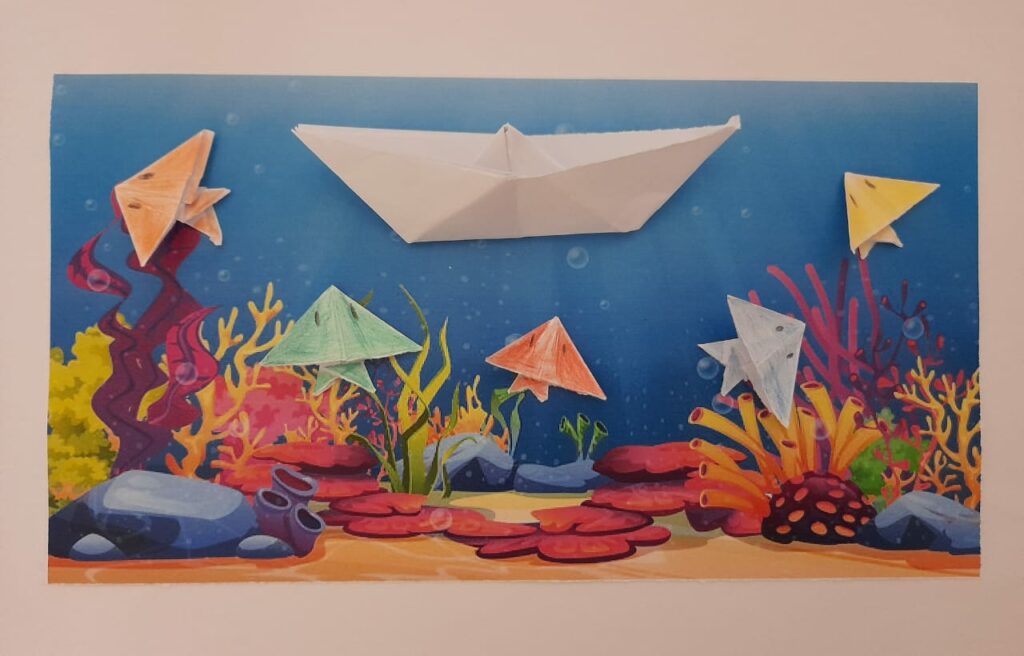
In class, we discussed games that involved making origami. With that fresh in my head, when I got to jotting alternative ideas for my “underwater” project, making an underwater scene using origami was on the top of my list. Since I had previously used the topic metaphorically, this time I wanted to use the literal meaning of underwater by depicting an underwater scene. 

I found a picture online that went well with my idea and printed it – trying to figure out the correct color settings for the printer was quite a challenge though. Then I got to making origami fish and of course, I could not miss including a boat – I mean that’s the first origami that we were taught as children. I have to accept that when I tried to make a boat consciously, I got stuck and couldn’t figure out how to make it. But by solely relying on muscle memory I was able to make an origami boat. 

Then it came to deciding the colors of fishes and I wanted to choose meaningful colors. I used blue to represent calmness and tranquility, orange to represent vibrant and enthusiasm, yellow to represent joy and optimism, green to represent growth, harmony and balance and finally red to represent passion, strength and vitality. I kept the boat white to symbolize purity and simplicity. I think these are all the traits of a perfectly balanced system (in this case my underwater ecosystem) but in broader terms the general societal structure and system.

Lateral Thinking by Edward De Bono response

The author highlights the close relationship between lateral thinking, insight, creativity, and humor, emphasizing that they all stem from the same foundation. While insight, creativity, and humor are often seen as elusive and unpredictable, lateral thinking is portrayed as a deliberate and systematic process, akin to logical thinking but distinct in its approach. The author further explores the role of culture and education in shaping and improving ideas, with conflict and new information serving as catalysts for change. They argue that while conflict can lead to the suppression of opposing ideas, insight is a more effective method for restructuring patterns of information, particularly in situations where objective evaluation is challenging. The importance of lateral thinking as a tool for generating new ideas and breaking free from old concepts is emphasized, with the recognition that creativity is a valuable asset in driving progress across various domains.

In my view, I agree with the author’s assertion that lateral thinking is a practical and deliberate process that can be developed and honed. It offers a distinct approach to problem-solving and idea generation, enabling individuals to break free from the confines of traditional thinking patterns. The author’s emphasis on the need for tangible techniques and practical application of lateral thinking aligns with my belief that simply hoping for insight or creativity is insufficient. By embracing lateral thinking as a habit of mind and adopting specific techniques, individuals can enhance their ability to think innovatively and foster meaningful change.

Reading Response 2

Shahram Chaudhry

In the introduction, Bono first distinguishes between creativity and lateral thinking by explaining that creativity is the description of a result while lateral thinking is a description of the process. When we admire someone’s creative result such as a painting, we are appreciating the outcome of someone’s creative process. On the other hand, lateral thinking refers to a cognitive process that encourages unconventional and non-linear thinking. While creativity is often attributed to the result, lateral thinking focuses more on the process of thinking itself.Lateral thinking is concerned with thinking outside the box and looking in a different way at things that have always been looked at the same way. The main distinction between lateral and vertical thinking is that because vertical thinking is sequential, there’s no room for mistakes while in lateral thinking one could go wrong at one or more stages and still achieve a fruitful outcome. 

The writer uses the analogy of digging a hole to explain the concept of lateral and vertical thinking and I don’t think it can be explained in any better way. He compares lateral thinking to digging different holes and vertical thinking to digging the same hole deeper. Now both actions can be equally important depending on circumstances and some situations might require both of them together. So lateral thinking and vertical thinking go well together and are complementary. In conclusion, while lateral thinking encourages individuals to adopt a mindset that embraces ambiguity, welcomes new possibilities, and explores diverse perspectives, vertical thinking helps in achieving results in a particular direction, and both are essential to success.

Studio visit quick notes

I found the concept of using perfumes as a creative medium Interesting. It was fascinating to explore how scents can evoke emotions, memories, and associations, adding depth to artistic expression. I’ve had some serious déjà vu triggered by a whiff of a certain smell, so this perfume power move got me hooked. The relationship between music and perfumes was also mentioned, highlighting how certain scents can be linked to specific sounds or musical compositions, further enhancing the creative experience.

He threw in this idea that creativity doesn’t always need to start with an endpoint in mind. He wanted us to tap into our inner kid, that never-ending curiosity and wild inspiration that leads us down unexpected and thrilling creative paths.