As Elon Musk has put it beautifully, humanity is in decline! Not because of rising ocean levels, ever more frequent extreme heat, and complete destruction of biodiversity. But because birth control and abortion have made smart people have fewer babies! The United Nations projects that the human population will continue to increase at a fast pace until the end of the century, driven by fertility rates in Africa and Asia. But can we trust that these newborns will be smart like Elon Musk, who is very smart and not just extremely lucky? Of course not!
Live Forever Lab believes in change and smart people. Are you a special millionaire with some money to spare? Invest in our potions and add some more years to your life.
Don’t believe it when they say you rely on privilege and centuries-old wealth and land inequality. You are special. We are special.
One of my 5 alternatives projects to the topic of ‘space’ was a collection of sounds of different spaces or places, specifically the sound of silence in different places. Every room and street has a different sound of silence, and I wanted to create a catalogue of that. Most of the sounds were recorded between 6 and 7 am. The world wasn’t as quiet as I had expected, but I realized that these sounds can just as well serve as an “Audio Tour” of the little pocket of the world around me. These sounds have very few voices, and are very representative of the ‘background’ of these places. If you could hear a picture of an empty place, I believe this would be it. We often tune out these sounds, but here the background is the centerpiece.
In the 20 sounds below, I take you from my room to the trains, and then on a short tour of the streets around our housing at NYU Berlin. After each sound clip, I’ll try to provide a description of what I heard (I was initially just expecting to record silence, and only later realized that there were so many details to listen for). I’d recommend wearing headphones. If you hear something interesting, comment below!
1.Bedroom:
The room was quite isolated from the sounds outside, since my window was closed
2. Kitchen:
There’s a faint sound from the electronics (like the microwave). You can also faintly hear the birds chirping outside.
3. Bathroom:
There a droning sound that was also audible in the Kitchen. Here we hear it much better, with some faint chirping from the birds outside.
4. Silent Study Room:
We move out of my room and go into a “Silent Study room”. The room is dark. You can hear my clothes and a few creaks from my shoes. The birds are much more audible now.
5. Group Study Room:
Notice how although the room is virtually the same as the silent study room, the ambiance is very different. Other than the change in the background, you can hear the birds much more clearly, there’s a slight breeze coming from the windows, you also hear the occasional car moving on the road outside.
6. Moving outside the building:
As soon as we go outside the building, we are hit with cold breeze and the sound of birds. Midway through the clip, an engine sound emerges, which might be from a truck engine starting nearby.
7. Park:
We move from the building to the nearby park. It’s early morning, so there are birds everywhere. You can hear an assortment of chirps. I hear a crow there somewhere. There’s the sound of a vehicle moving on the road nearby. My shoes make a sound on the gravel.
8. Coffee Point:
At this point, I’m craving a coffee. So we move to the nearby coffee place. The background is slightly different from the other closed room’s we’ve been to. There’s a faint sound from the owner talking to a customer.
9. Police Station:
It’s time to make our way to the trains. We pass by the police station on the way. Here, we can hear my footsteps, some faint chattering of people, the sound of my clothes, and some wind towards the end.
10. Checkpoint Charlie Train Station:
We finally enter the train station. It’s a little windy. There are a few people walking. A train was leaving right as we enter. The sound of my footsteps is clear. There’s the sound of some liquid dripping nearby towards the end.
11. Train Incoming!
Our train is finally here! It’s the U6. You can hear the sound of the wind as it pushes it out of the way, the sound of the wheels on the tracks, and the sound of doors opening at the end.
12. Inside the U6:
Inside the U6, we hear the train accelerating and you can feel the floor moving. There’s a small ‘alarm’-type sound. You’ll hear the announcements on the speakers. See if you can find me clearing my throat.
13. Leaving the U6:
We’re out of the train now, at Stadtmitte station. The sound of the train leaving is similar to the train arriving, but it’s distinctive feature is the fading away at the end.
14. Stadtmitte Station:
Stadtmitte station is quiet compared to Checkpoint charlie. See if you can hear me moving. Here, the mechanical sounds of the station are easier to isolate.
15. Back at Checkpoint Charlie:
We’re back at Checkpoint charlie. There’s a lot of wind coming through the entrance. You can hear the train leaving during the beginning, and the footsteps of people.
16. Walking to get some groceries:
Now we’re walking towards Rossman, a grocery store to get some food. You can hear my footsteps clearly here, the birds are back, the traffic from the road ahead is audible. There’s a little construction work happening.
17. At the Rossman:
Now we’re outside the Rossman. You can hear me say that it’s closed under my breath (of course it is, it’s 6am). The traffic is very audible.
18. Birds and Critters:
On the same road, we find a patch of grass and trees with a lot of birds. The sound of pigeons should be easy to make out. There are other critters too. As soon as I stopped recording, a fat mouse appeared out of the bushes with a huge piece of bread in it’s mouse. We stared at each other for a few seconds and then it squeaked away….
19. El Gino:
Now we’re at the pizza place near the housing.You can hear the cars and the birds. There’s a traffic light nearby, you can here it’s ticking over the background of traffic.
20. Back home?
We make our way back home and try to tap our cards on the sensor to get into the building. But it doesn’t work! I try a couple times till a guard let’s me in and tell me the sensors start working at 8am, so our cards don’t work early in the morning.
I really don’t have much to say about yesterday’s visit. The artist some interesting ideas about thinking about your goal and working for it. I liked the list of questions he answers before doing something, and I took away some points from it, like always finding a way to motivate yourself, doing the things you enjoy, and always thinking outside the box to create something new. I also liked his idea of finding our own definitions for artists and content creators and choosing whichever we prefer. And looking for inspirations from different things in our surrounding. However, most of his ideas were really centered around music, so I couldn’t relate well. Overall, the visit was somewhat insightful, but I believe that Marcus could have done better to make his talk more interesting.
Hand gestures ⇒ languge, code ⇒ secret code among friends
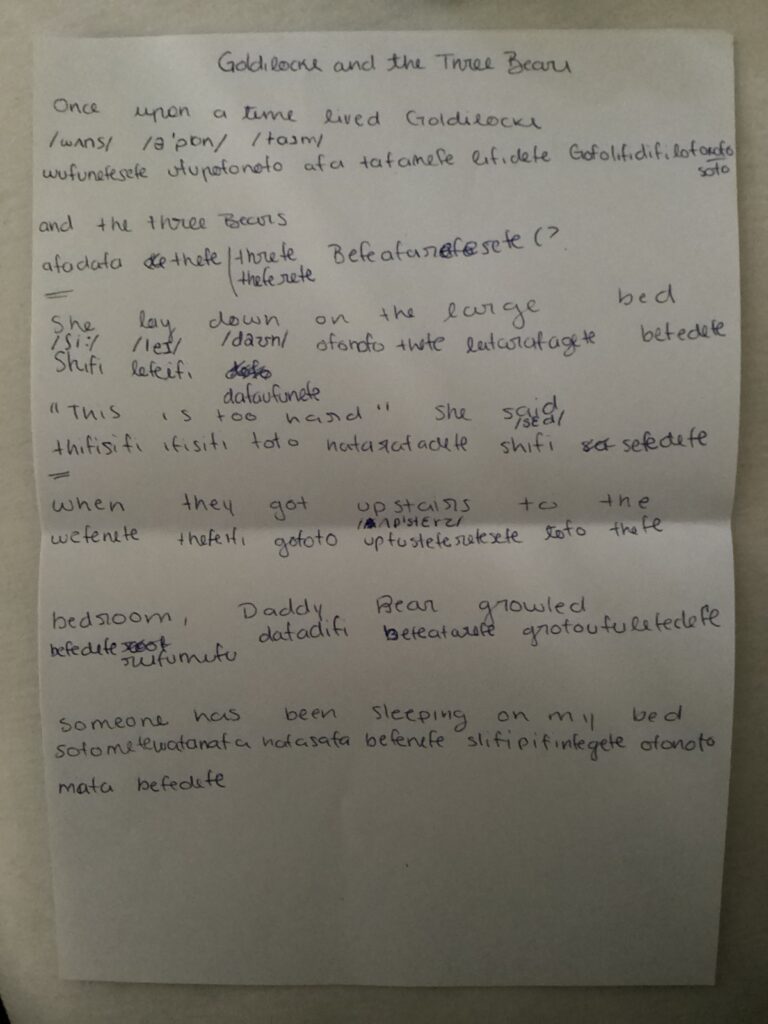
These two paths brought me to something called “the f language” in Spanish. It is a funny way of communicating for children. The idea is to add a syllable with the letter “f” to each syllable within the word. For example, the name Kate would be “translated” to Kafa-Tefe. I thought it would be an interesting idea to pass this game to English. For this reason i “translated” some passages of a fairy tale, i chose Goldilocks, and this are the results.
One thing I could think of in class to expand my first Dream menu was to create an add for it, so I compiled different snippets from movies and Tv shows to create the following.
In this brief reading, one quote specifically stood out for me:
”Lateral thinking is generative. Vertical thinking is selective”(p.12)
I really liked this quote because I believe it perfectly encapsulates the concept of a creative process. For instance when I am choreographing a new dance recital, I start playing the song I want to dance to, and throw a series of dance moves and see what feels like the best option, I move fast, then slow, then add a jump or two, maybe even a twirl. All these moves, would come from lateral thinking, me trying to generate different ways or ideas to fill the times of the music and making it seem good. After I generate all these different dance steps and ideas, I like to turn on my vertical thinking and see how I can combine these dance moves, and turn them into a proper dance choreography. In my head, both the “rational” and “creative” are crucial for my final piece, for my final goal. Which is why, It really stood out to me what the author said in the mentioned quote. I also fully agree with him about how these two ways of thinking complement each-other and therefore, we are unable to reach our final goal, which is the project completion, without the two.
This also pulls me towards the Ted Talk we watched with kermit the frog where he used the term “Controlled Chaos”, I think that the complement between The two ways of thinking, is in a way, a controlled chaos as well.
In his book “Lateral Thinking: Creativity Step by Step”, Edward Bono introduces a new way of thinking that he calls lateral thinking. He defines it as a process of finding and rearranging patterns in information to generate novel and original ideas. He contrasts it with vertical thinking, which is the conventional mode of thinking that follows a logical and linear path to reach a single correct solution. He argues that lateral thinking is the true source of creativity, while vertical thinking is useful for analyzing and validating existing information. He also claims that most education systems favor vertical thinking over lateral thinking, and thus limit the potential for creative thinking. As a university student, I can relate to his critique of the education system, as I have been trained to think vertically most of the time. I think that vertical thinking is important, but not sufficient, for solving complex and dynamic problems. I would like to learn more about lateral thinking and how it can enrich and diversify my thinking skills.
The book explains what lateral thinking is by relating it to some other terms. Humor, creativity and insight all share basis with lateral thinking. I think humor is often forgotten when talking about creativity, so introducing it to the conversation helps to expand the understanding of lateral thinking. I also think comparing it to vertical thinking, which is more usual, helps to understand better the concept. The analogy of digging a hole was amazing for me, it cleared out the difference and how both complete each other. I also liked the way artistic creativity was approached and how there is usually the misconception that creativity is a gift that only few posses. The book also highlights the importance of lateral thinking as a process sand not something that “just happens”
The visit to the Studio was interesting. However, I do not agree on most of the artist’s opinions, which I actually think is good, because it made me realise I had opinions on certain topics. Diving between Artists and Content creators didn’t seem like a great idea to me. I see what he was trying to convey, but I felt his ideas on creativity (and the idea of artists/ content creator) were limited to music. Which makes sense, since that’s his artistic career. I wished he had explained more about his own process behind some o his artworks, it could have been interesting to know, for example, where he got the concept behind his latest album, how it evolved over time and what he would have change now.
I found his use of perfumes as creative inspiration very interesting. As someone who connects feelings to perfume and music I thought this link was brilliant to have as an established artist. I could see the “uniqueness”, the “my music plus X” in this regard.
I thought most of the points he was making were quite contradictory
Content creation is different from Art. I always knew this, but Markus Popp made the distinction a bit clearer.
Does the length of time it takes to create something speak to the quality of the thing created??? Markus Popp seems to think so
Artists (him specifically) don’t like AI
I didn’t agree with most of what the artist said, but again I did appreciate the love and respect he has for his art and what he brings into the artistic scene. The perfume and music combination was by far the most interesting thing he showed us/talked about. I wish he would have elaborated on that more. I do think, however, that the music he made was more for his time in life when he was wearing that perfume than it was for the feeling the scent of that perfume captures. These are two very different things. It is the latter that I find more interesting.