Why do we need to be ready for the next day? To hop on a new adventure.
But why would be hop on a new adventure? To learn about life and make memories.
But why do we make memories? To never forget it.
This is the thought process I had when I was questioning why I chose “sleep” as a topic of inspiration; four “why”s later, we are talking about never forgetting memories.
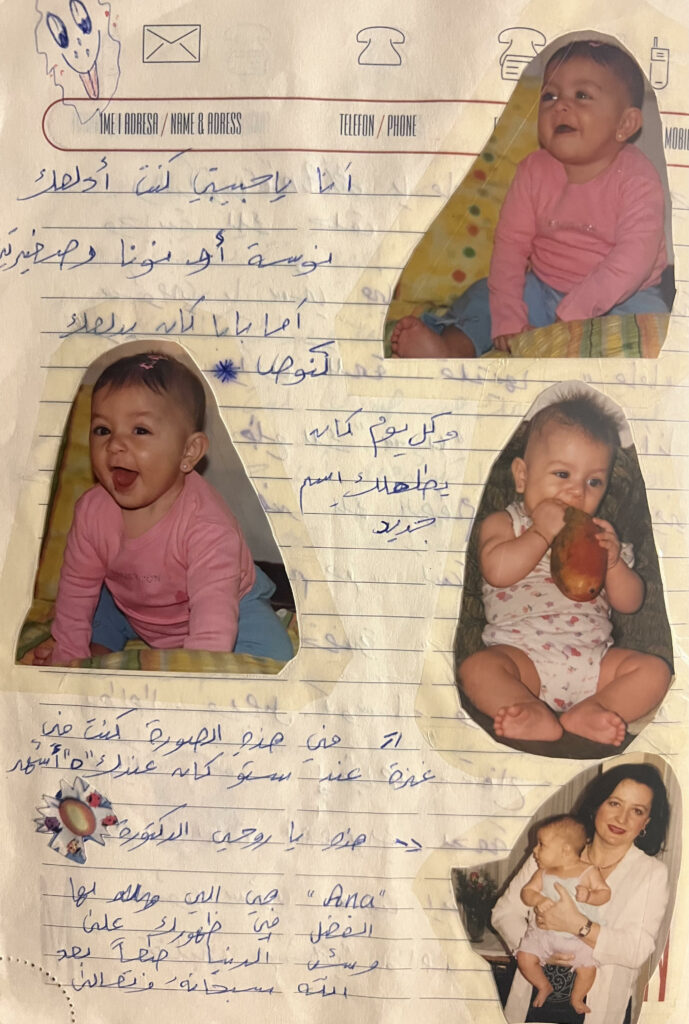
For this assignment, I then got inspired by a diary my mom made of me when I was young of a bunch of random memories of me that she did not want to forget.
That inspired me to start a scrapbook about my time in Berlin and my daily adventures here so that when I read it a few years later, I wouldn’t have forgotten anything, even though I slept the day before reading it or not.
In chapter 1, the author talks about the code system of the brain and how it can only work with preset patterns. These patterns are worked beforehand and have code headings so when certain information is required, only the code name needs to be transferred which serves as a trigger to identify and acquire the required information, saving time and effort. So this means that humans can react appropriately to a situation almost instantly without having to examine it in detail beforehand and sometimes even while the situation is developing, using their prediction skills.
The authors also discuss the mind as a pattern making system and how its effectiveness is often associated with its ability to create patterns, store them and recognize them. Exploring the concept of how these patterns are made, limited attention span can play a huge role because it means mostly a certain part of the brain will be activated, which will most likely be the familiar one and that part of the brain has more chances of being activated in the future because it is becoming increasingly familiar.
While the pattern recognition system has its advantages such as quick recognition and reaction, established patterns cause the mind to become rigid and non accepting of change. Also another problem is generalization of information, anything that slightly resembles a pattern is recognized as such so this can polarize information, leading to extreme opinions.
The mind is adept at creating concept patterns, but it faces challenges when it comes to modifying or updating them. This limitation highlights the importance of lateral thinking, which encourages innovative and alternative approaches to problem-solving.
I also love this quote from the reading, “A memory is anything that happens and does not completely unhappen.” However, I don’t quite understand the landscape and the jelly example.
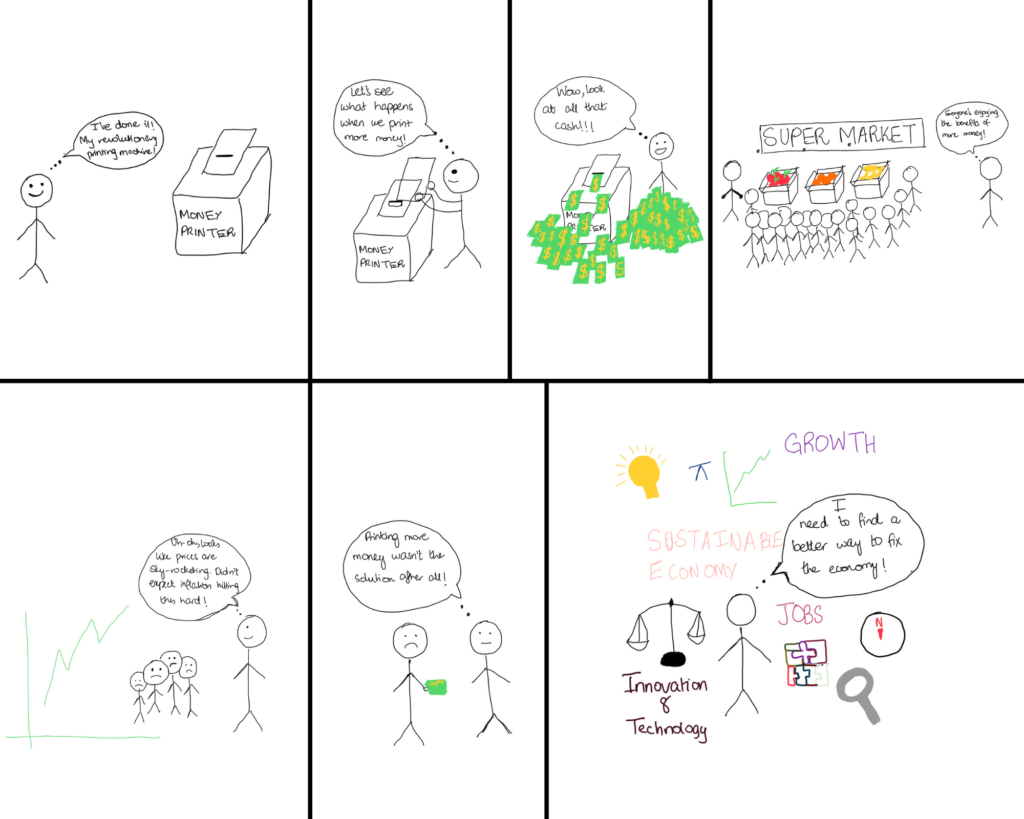
The most basic question we ask when we’re introduced to the concept of poverty as children is , “Why can’t we just print more money?” The answer to that could be that it would lead to inflation and decrease the value of the currency.
“Why does printing more money lead to inflation and decrease the value of the currency?”
A possible answer could be that printing more money increases the money supply without a corresponding increase in goods and services, creating supply demand issues.
“Why does an imbalance between supply and demand result in inflation?”
When there is more money in circulation relative to the available goods and services, people have more money to spend so the demand increases without the supply increasing causing prices to rise, resulting in inflation.
“Why does an increase in prices due to inflation decrease the value of the currency?“
When there is inflation, the purchasing power of each unit of currency decreases.
“Why does a decline in the exchange rate further reduce the value of a currency?“
When the exchange rate of a currency falls, it means that it can buy less of other currencies impacting international trade, increasing import costs etc.
In the comic, the character, let’s name him Abigail Johnson, tries printing money and then realizes that it has negative consequences such as inflation, and people not being able to buy the things that they were able to before.
De Bono’s emphasis on the need to foster an environment conducive to lateral thinking is interesting to me. Looking back on my own education, I can see how De Bono’s claim that an emphasis on vertical thought makes it difficult to develop lateral thinking is supported by my own experience. I often felt like there was little place for creative expression or asking challenging questions in the classrooms I attended which limited my creativity in general.
I agree with what De Bono said, that humor can strike unpredictably. From my own observations, I’ve learned that the most successful jokes and humorous remarks are those that present an unusual viewpoint on a common situation. It seems that in those circumstances, I use lateral thinking instinctively to generate funny thoughts. These examples show the value of lateral thinking even in things such as humor.
The prompt was to pick a topic and ask why? Then make something out of it. I started with why is the sky blue which lead me down a rabbit hole that led to the point of absurdity. However, I was still clueless on how to actually make something out of this ridiculous line of questioning, after a bit of thinking, I decided to zoom out a bit to think of the bigger picture. It struck me that I could make the whole line of questioning a part of the thing I was going to make. So I naturally ended up using p5js because it allows me to easily translate a thought in my head to an experience on the screen. I basically put all the line of questioning I thought of as a series of responses in p5js and I left 2 options that were identical – why? As the user picks either option the text starts shaking more to give the effect of the person answering getting more annoyed by the incessant questioning. It reaches a point where the person answering refuses to give an answer.
Here is my line of questioning:
The sky is blue.
Because of the way Earth’s atmosphere scatters sunlight.
Due to the composition of gases and particles present in the atmosphere.
Because of natural processes and human activities.
Because they interact with the environment and produce certain byproducts.
Because that’s just how things work in our complex world.
Because it’s a product of countless interactions and variables.
Because the universe is vast and diverse, leading to infinite possibilities.
In the introduction to Lateral Thinking, de Bono discusses the need to go beyond traditional thinking methods and embrace lateral thinking as a tool for creativity and problem-solving. He highlights the limitations of vertical thinking and encourages us to break away from the constraints to explore alternative perspectives.
He makes it clear that lateral thinking is not a random or chaotic process but a structured approach that can be learned and cultivated. Additionally, De Bono highlights the importance of creating an environment conducive to lateral thinking. He states that educational systems prioritize vertical thinking when we should be encouraging lateral thinking.
This thought process inspired me to come up with my creation: a “cheque” that represent the connection between note-taking and making money in the future. In this connection, note taking is like writing a personal cheque to ourselves, with the amount reflecting the average worth of a degree per class. The idea is that taking notes is similar to investing in our future, just like writing a cheque for our own benefit.
Why do we need to get places? To get around the city
Why do we live in a city? Because we are students
Why are we students? Because we go to university
Why do we go to university? To get a degree
Why do we need a degree? To work and be successful
Why do we need to be successful and work? To live a happy and fulfilling life
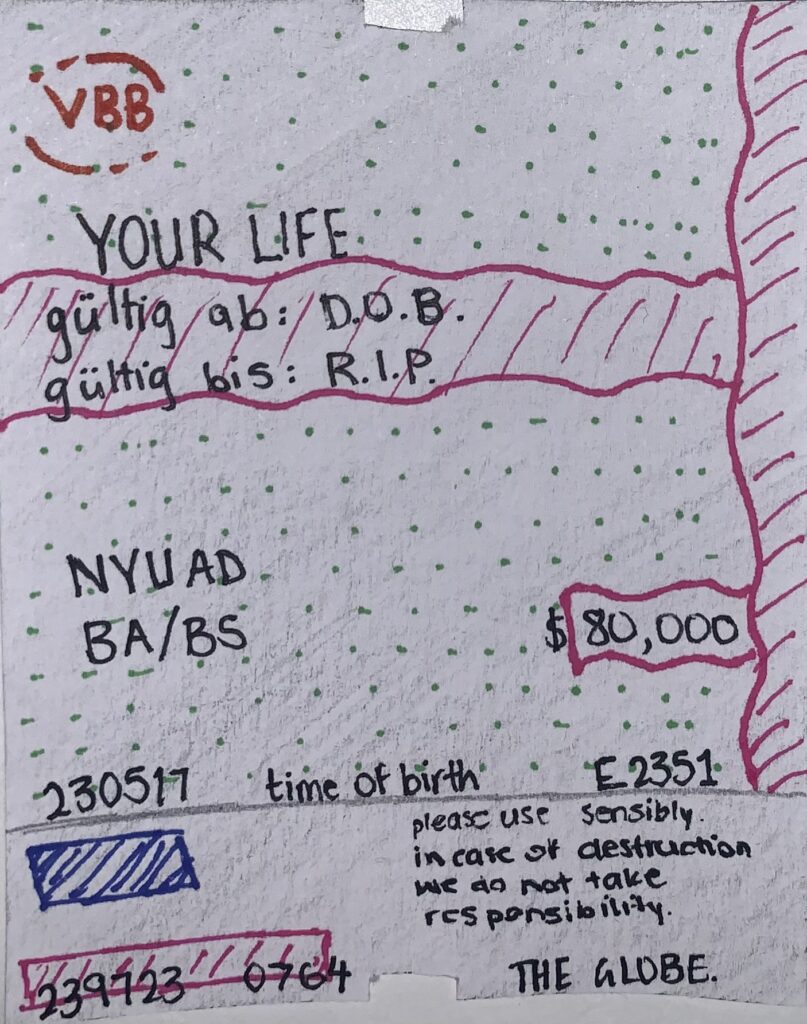
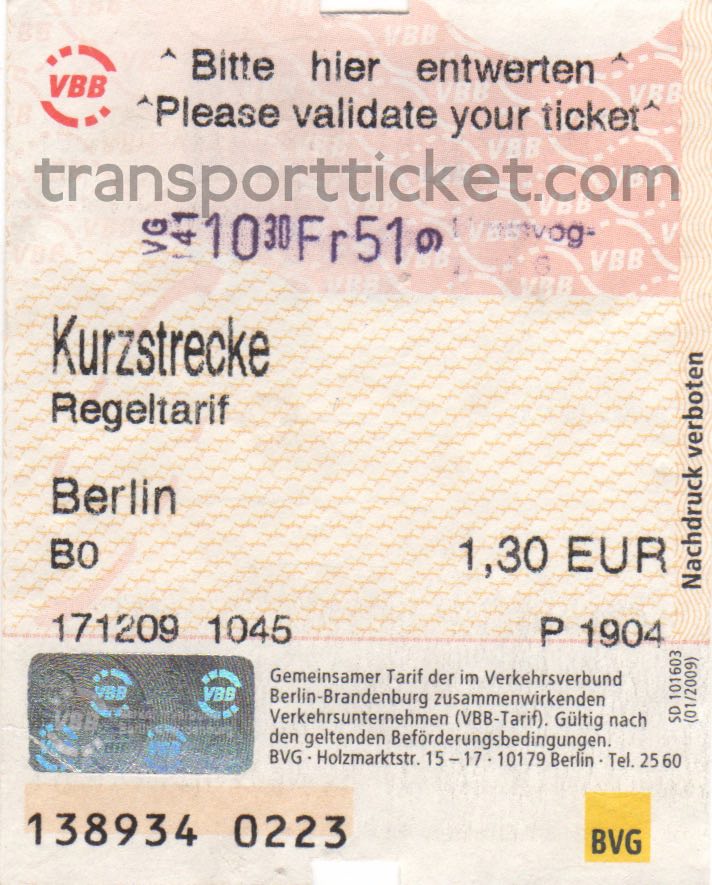
For my third making project, I decided to go with cars as my topic. Then I began the thought process of my “why” questions, which led me to university, work, and success. I eventually decided to create a replica of the public transport ticket but as our ticket to university and life. Our issuing date to life is our date of birth and the end date is our death day. I then decided to write NYUAD as the location in which we attain a Bachelor of Arts or a Bachelor of Science which is around $80,000. For the rest of the details, the time we are issued our ticket to life is our time of birth which we are then allowed to explore the world and live as we please.
The globe is our terrain and we may go and investigate the world around us with its many areas, terrains, and cultures. Through the use of transportation, we lead ourselves down a path to explore ourselves through school, university, work, and travel.
In this assignment, I have to consider a topic and question its original intuitive logic through the lateral purpose of “why”. The intention of this kind of “why” is to create discomfort with any explanation or established assumptions through vertical thinking. The result of this chain of why’s should be counterintuitive from the starting logic.
When I was returning to the dorm passing through the Gedenkstätte Berliner Mauer, this topic suddenly flashed into my mind:
Physical Borders
Why do countries have physical borders? To completely separate different kinds of people and control their flow.
Why do they want to completely separate them? They want to control the mixing and interaction between people.
Why do they want to control this? Because different countries have different laws and regulations.
Why they have different laws and regulations? Because their societies are formed with different cultures, social norms, ideologies, values, and histories.
Why is different cultures, social norms and stuff a problem? Because these are difficult to change which make people put barriers without thinking but just assuming the negative effects of difference.
Why do people tends to avoid the negative effects of difference? Because firstly-perceived differences are often superficial and stereotypical. They just represents tendencies.
Why are firstly-perceived differences superficial and stereotypical? Because direct interaction between the two sides are limited.
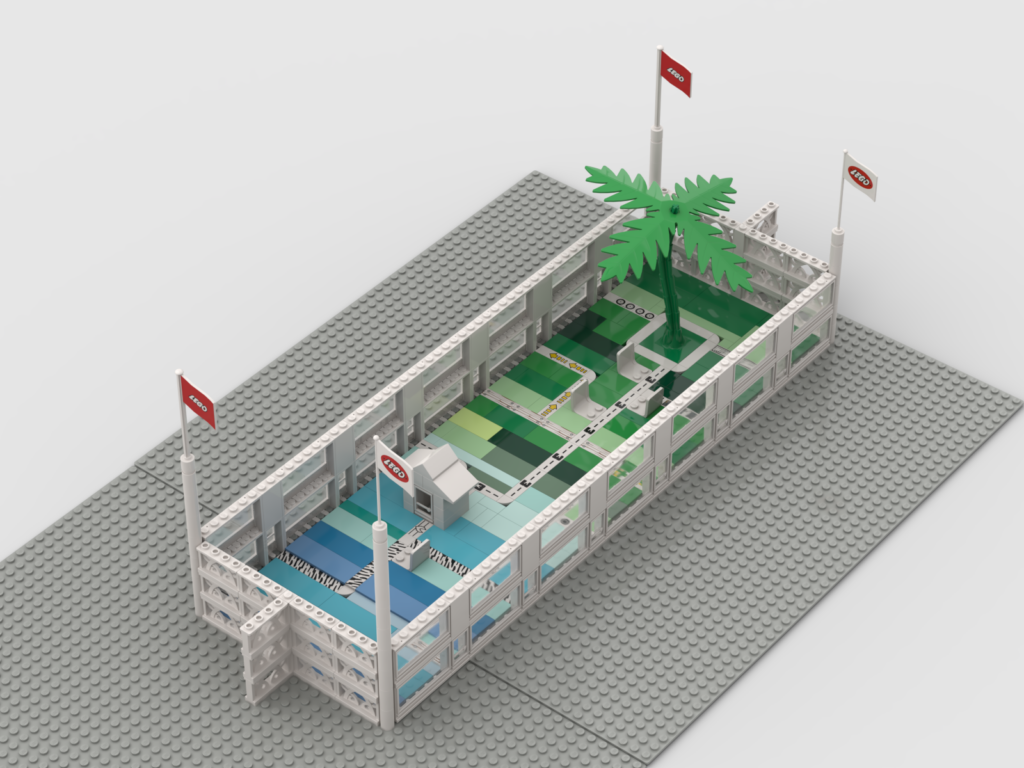
At this level of questioning, since the two sides of such physical borders are usually limited in interactions, which gives rise to a vicious circle pointing back to points 5 and 6, instead of creating a drastic line separating the two, why don’t we create a wide area of conversation, tolerance, and exhibition between the two while still maintaining some control? We can see the effects of the lateral purpose of “why” here. We started from physical borders but went down to human interaction. Moreover The facilitating nature of this structure is counterintuitive from the separation nature of traditional physical borders people would assume.Using BrickLink studio, a virtual LEGO designing software that can produce real-looking images, I can render my idea generally using this LEGO model.
The gradually mixing color of the tiles symbolizes the communication between the two. The red and white LEGO flags are used to represent country flags. The walls are made of glass and glass doors are placed densely, providing easy means of seeing through and passing the border. I used trees, houses and chairs to symbolize the facilities that can be established in between this space. Between the walls, people of either sides can engage in recreational activities, relaxing, commerce, reading, concerts, public events, speeches, sports and so much more…Especially events that are both competing and uniting like sports, an inspiration I got from the border volleyball between US and Mexico border residents.
I wish that someday in the future, when the gigantic metal and concrete cage walls between countries that are interested in establishing these jarring structures all come down, the world can unite and celebrate its diversity under the leaves, roofs, and cheer of these redesigned borders, and all of us can play volleyball with our friends on the other side, across the long-gone walls replaced by only markings or volleyball nets just like what the Berlin Wall is now.
In this chapter, the author explored the reasons behind the need for lateral thinking and also pointed out why creativity, humor and insight cannot be easily trained. He first mentioned the self-coding / pattern making and self-organizing nature of our mind and then used the resulting jelly model of our memory surface to visualize our brains’ processing of new information. We have a tendency to fit them to existing patterns. Humor and Insights, however, are basically restructuring the patterns. However, they are sudden and cannot be predicted. For my personal experiences, the sense of humor comes to me like an electric shock when I see something that I can make humor on. This points to his description of the inherent disadvantages of this system caused by the great advantages of it which makes us tend toward using and relying on it. Lateral thinking can tackle especially three of them: it can help escaping cliche patterns, remixing information into ideas, and restructuring. The use of random stimulation can be effective on our self maximizing memory surface as it creates new patterns actively. Disruption and provocation can help dividing and diverging existing patterns.