Reading Response-Art & Fear; Bayles, David & Orland, Ted (1993): The Nature of the Problem (pp 1-7) Chapter 1Reading Response-

In Chapter 1, Bayles and Orland discuss the challenges and fears that artists face throughout their creative process. They state that art is filled with uncertainties and that artists should emphasize these uncertainties to overcome their fears and obstacles throughout their creative process. Some common fears that artists face are fear of failure, the unknown, and judgment.

They state that fear is an initial part of the creative process and is necessary for growth and progress. To increase creativity, individuals must go through this cycle of trial and error to achieve self-discovery. According to the authors, the willingness to confront and work through these difficulties is what separates successful artists from those who give up. Additionally, Bayles and Orland touch upon the notion of expectations. When artists set high standards, they tend to receive disappointment in return as well as self-doubt. They encourage artists to focus on the act of creating itself, rather than being fixated on the outcome or recognition.
Studio Visit – Field.io

I really enjoyed the talk we had with the people at field. The work that they do seems very professional and to the point. They broke down the process of creating each project in a very intriguing way. With each project, they seem to do a lot of research first to align themselves and get onto the same page as their clients.

It was interesting to also hear about the frustrations of producing a product that they are proud of but are then rejected by the client. Occasionally this also happens in some of my uni assignments so I resonated with that feeling of frustration.

I also really appreciated the posters they distributed to the class. Overall they did a great job of conveying how their design process works.

Reading response- Lateral Thinking; Bono, Edward de (1970): Innovation and Suspended judgment (pp 105-111)

In these pages, de Bono discusses the concept of suspending judgment and its relationship to lateral thinking. He states that traditional thinking relies on the evaluation of thinking, which stifles creativity and the creative process. On the other hand, lateral thinking relies on going against judgment to enhance creativity and explore ideas.

He highlights the concept of “po” which focuses on a state of open-mindedness and non-judgment. With this strategy, one enhances the use of lateral thinking and allows one to delve into deeper ideas and thoughts that could not happen with the use of vertical thinking and judgment. Additionally, he introduces more techniques to break away from fixed patterns of thinking and uncover hidden possibilities.

Moreover, he highlights once again the importance of working in group settings to generate new ideas. He states that individuals should refrain from criticizing or evaluating ideas prematurely. With a new and open-minded environment, individuals are able to explore their creativity without the pressure of judgment from themselves or other people.

MAKE – Apple Picker/Storage – Majid, Enock, Ahsen

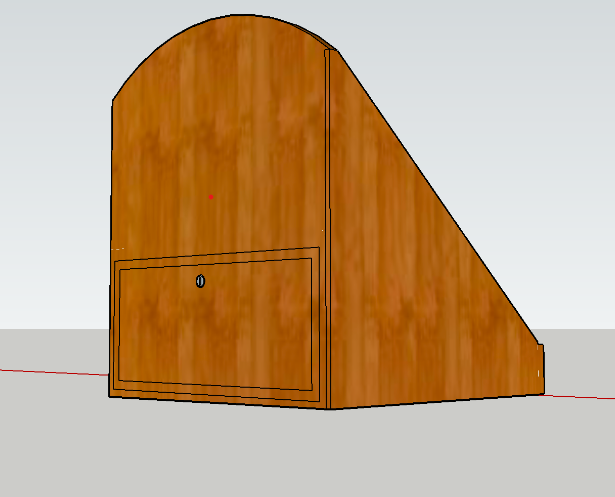
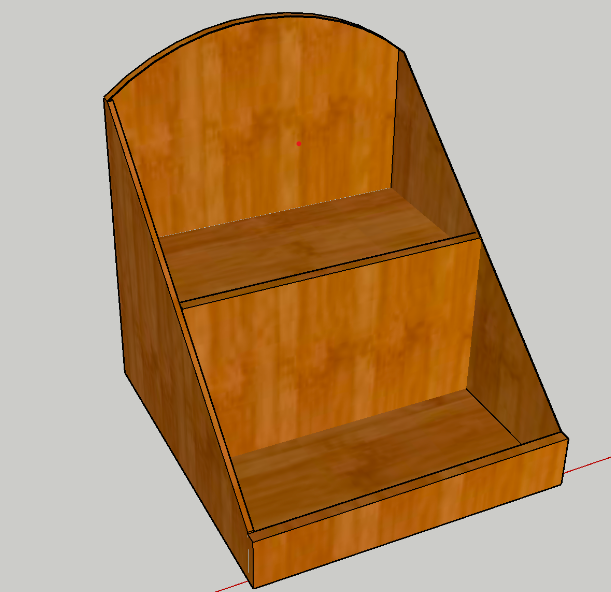
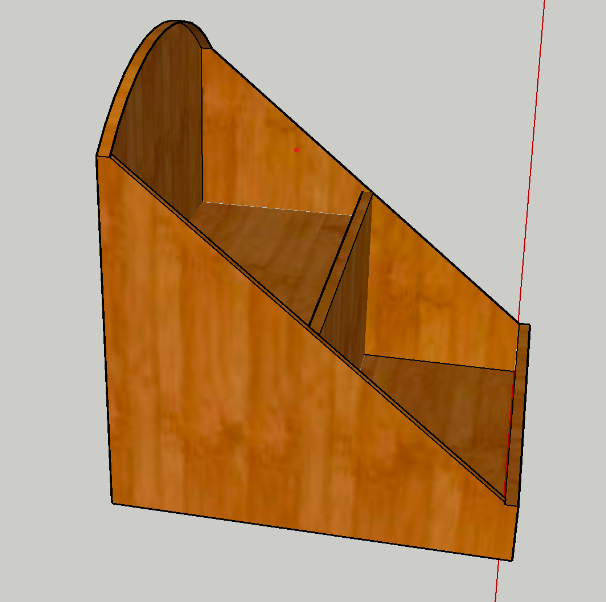
For this project, Enock designed an airing rack that doubled as apple storage. Recognizing the importance of proper ventilation and exposure to sunlight after washing, he aimed to develop a solution that fulfilled these requirements efficiently. He utilised SketchUp to create the 3D model to aid in the design process. This allowed him to visualize and refine the design. The rack was specifically designed to facilitate optimum airflow, ensuring the apples would dry thoroughly while exposed to the sun’s rays.

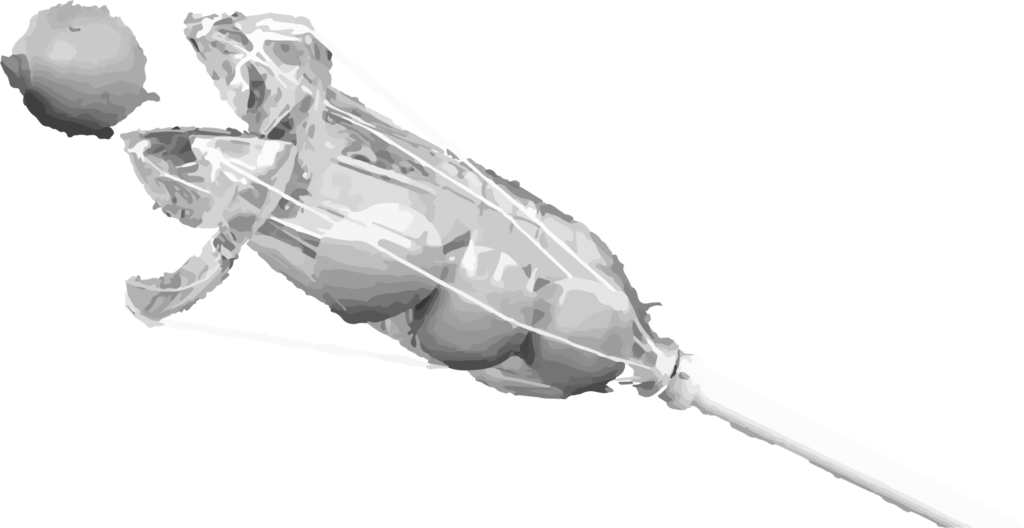
Ahsen worked on a sketch for out apple picker product. He created this on illustrator which was then exported to Majid.

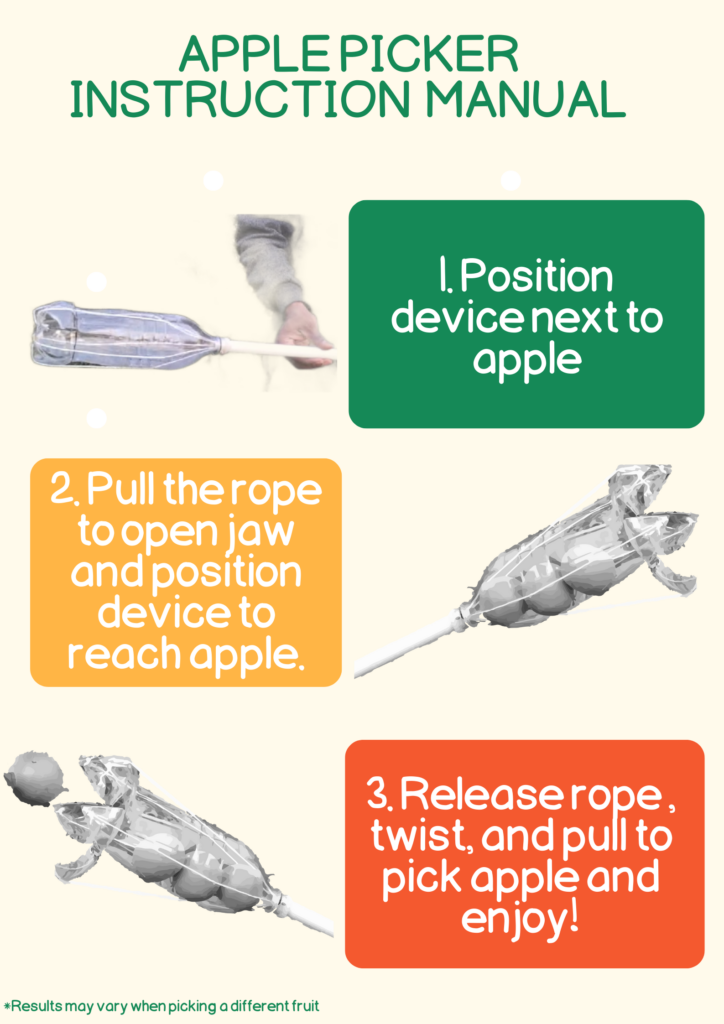
Every tool needs an instruction manual, so Majid decided to create one for the apple picker. He used images from Ahsen’s sketches and put it all together on Canva

Reading Response – Art and Fear (pp23-36)

Majid Ibrahim

I think that this chapter heavily ties into the previous one with regard to the suspension of judgment. We are innately perfectionists, that is what has allowed us to develop as a species. However, now we are paying the price for this ability we possess through the constant inner critic criticizing our every move. This leads us to have a fear of making mistakes which will inevitably hinder our ability to explore all the possibilities our minds can conjure.

Instead, an artist should focus on what is possible within his current capabilities and actually lean into the imperfections in their work to learn and grow from them. Each mistake helps us get better at what we do and how we see art. Accepting our flaws can help us become more open and willing to take risks. This method lets us use our imaginations instead of letting it drag us down.

Reading Response 5 – The Nature of the Problem

The main argument that the author makes is that art is not expression of self, but artmaking (the process) is a way that tells the maker more about his or her nature. Art are often left unfinished due to a wide range of fear, one of them being fatalism. I personally resonated with this concept as I usually question if I am talented or educated (in terms of craft and art) enough to make art. The author’s argument about art skills can be learned and art are made by ordinary people is really informative and help me see the process and skills of making art in new ways. Another point I resonated with is the “arrogance” that the artists are sometimes gripped by their faith in their deep understanding of a topic and disregards others who understands it in a different way. 

However, I did not agree with the author’s point in saying that the art is not an expression of self. Since we are discussing artistic thinking as “art” here, the word “art” is defined more specifically separated from fine craftsmanship or simply aesthetically pleasing objects. Hence the argument that art arouse before consciousness was invalid. I believe that the core of artistic thinking is a positive feedback loop of discovering and expressing oneself, while building confidence and self-understanding during the process. The result is highly tied to the process and can also be expressive of the artist’s ego.

Studio Visit: Field

Different from previous visits. R&D emphasis, physics simulations + creative liberty. Clients, abstraction, teamwork….culture. Inspiration from real life. “Visual Anchors”.

Reading Response 4 – Innovation and Suspended Judgement

In the preceding chapters, the author discussed deliberate generation and challenging of assumptions. These are basically the “coming up with 5 alternatives” and “asking why” that we have practiced before in class. However, they are not far removed from original vertical thinking as they are more backwards thinking, which are based on explaining some effect instead of bringing about some effect. Innovation is more forward thinking. To apply it, one should know suspend judgement, which means not judging if the step is right until the end.

One of the dangers associated to being right all the time that I didn’t recognize before reading this book is that being right usually let people think that right is enough, while blocking the possibility of a better arrangement. Another thing that is informative to me is that I always take care of the absolute correctness before I speak. For example, when commenting others online, whenever I came up with an idea, I have to do research and logical thinking to ensure its correctness as to avoid any criticism. I would say this is acceptable in some circumstances, but if the environment is more acknowledged with the use of suspended judgement, we should learn to consider wrong ideas and see its use, both in stimulating new ideas and to push people forward (sometimes you have to lie a little bit to convince others).

Reading Response 4.2 – The Nature of the Problem (Chapter 1)

Shahram Chaudhry

Based on my experience of completing assignments for this class, I agree with the author’s perspective that unfinished work often holds an allure, as we imagine the possibility of achieving better results. However, amidst this uncertainty, it is crucial to discover a personal motivation or spark that drives us to create, even when there is no external audience or reward. The author also emphasizes the importance of not subscribing to the notion that artistic talent is solely innate, as it can discourage creativity. Ultimately, talent becomes indistinguishable from hard work and perseverance in the long run. As an example, I may not possess the same level of intelligence as my twin brother, but through my dedication and effort, I often achieve similar or even better outcomes. In other words, art is created by ordinary people. Our flaws and weaknesses, though they can pose challenges in completing our work, can also serve as sources of strength. For instance, I have a friend who procrastinates a lot and completes assignments just before the deadline, even if he has ample time. While this approach may seem risky, his ability to work well under pressure turns this shortcoming into an advantage, enabling him to finish the same assignment in less time and allowing him to allocate more time to other tasks.

The author also raises a significant point that I initially disagreed with but now find compelling. They argue that even cavemen were creating art before they were consciously aware of the concept of self. Therefore, the belief that art is purely a means of self-expression is inherently biased. Another flaw in associating artists solely with their art is that it implies that flawed art reflects a flawed individual, while the absence of art renders one devoid of personhood. Instead of adhering to this ideology, one should embark on a personal journey to discover their unique approach to creating art.