Art and Fear response 2

This chapter was by far my favorite reading we’ve done in this class. Even Though I’m not an artist and do not make art, I could clearly see how each point being made connected with different aspects of my life. One quote on page 30 from Bayles and Orland stuck with me: “Adams was right: to require perfection is to invite paralysis.” I resonated with this line in the context of my writing. I specifically remember the 50+ essays I wrote during  the college applications cycle when I ridiculously decided to apply to 20+ universities. Everytime I sat down to start writing an essay I would freeze up— sometimes, I would even have an anxiety attack. I would sit in that position for hours on end with nothing but a blank document and a blinking cursor to show for it. This memory is what came to my mind when reading this chapter. 

The discussion on annihilation was another interesting point. It touched on how we often intertwine our art or simply what we do with our sense of identity. It reminded me of a concept explored in the book Atomic Habits, where the author explains how our actions and habits stick when we connect them to who we believe we are and that to truly embrace a new identity, we need to provide ourselves with proof. I think this is exactly how Bayles and Orland imagine someone begins to “go down the rabbit hole”.  I used to think that building habits based on identity was genius and could do no harm, but this reading shifted my perspective in a refreshing way.

I thought the talent section was also important and well discussed. It is easy to be plagued with imposter syndrome and imagine that everyone around you has some secret gift that you do not possess. However, I don’t think the authors’ example of the prodigies you see all over the internet and never hear about again made a good case for hard work being more important than talent. This is because, nowadays, recognition and fame is often just the result of luck and the ability to manipulate social media algorithms to work in your favor rather than hard work.

The Physical Impossibility of Death in the Mind of Someone Living (Midterm Paper)

“Hirst is basically a pirate, and his skill is shown by the way in which he has managed to bluff so many art-related people, from museum personnel such as Tate’s Nicholas Serota to billionaires in the New York real-estate trade, into giving credence to his originality and the importance of his “ideas”.” (Hughes, 2008)

Damien Hirst is undeniably one of the most controversial artists of our time, and it’s not without reason. I chose him as the subject of my paper not because I’m a fan of his work, but because I truly believe he is an artist who challenges the traditional definition of art and pushes the boundaries of what art represents. While I will agree with most critics that his pieces are priced ridiculously high, I will be the first to argue that his pieces are incredibly creative, unique and moving. Take his work The Physical Impossibility of Death in the Mind of Someone Living (1991) for example, also known as The Shark. This piece showcases a whole Tiger Shark fully submerged in formaldehyde in a glass tank. This piece garnered so much attention when it first debuted in 1991, and when it sold for $8million, it stirred up a mix of admiration and criticism. While some critics claimed that the artwork was simply a sensationalist trick, others applauded Hirst for his ability to question and redefine traditional concepts of art and beauty (King).

Despite the criticism, I genuinely believe that Hirst managed to capture the essence of the “physical impossibility of death in the mind of someone living.” Usually, people only encounter sharks through screens, books, or the internet. Seeing a shark up close, as portrayed in this artwork, would normally mean you are in a life-threatening situation and are seconds away from dying. This piece puts you in that position and confronts you with the fragility of life and your mortality. Ethics aside, Hirst definitely created an emotionally powerful and thought-provoking artwork. Even looking at it through a screen, I can feel how terrifying it must be to stand in front of this piece and look straight into the open mouth of a tiger shark. 

Another thing I find intriguing about this piece is how it deviates from the usual art you come across in museums and galleries. Instead of the typical paintings or sculptures, Hirst boldly breaks “tradition” by using a real shark as the artistic medium to convey his message. I think this departure from the basics demonstrates his creativity and daring approach, which I truly admire. While many artists might choose to approach the same theme with brush and canvas, Hirst’s decision to bring an actual shark into the art space adds an extra layer of fascination and audacity. If I was walking through that exhibition space in 1991, I would definitely look twice at the giant shark in the room, probably not at the 3×4 painting on one of the many walls. This piece grabs my attention and highlights the unique path Hirst takes in expressing his ideas. It’s this unconventional choice and the sheer nerve behind it that deepen my appreciation for this piece.

TOPSHOTS A woman looks at a creation by British artist Damien Hirst entitled ‘The Physical Impossibility of Death in the Mind of Someone Living 1991’ during the opening of his solo exhibition showcasing work spanning over two decades at the Tate Modern in central London on April 2, 2012. AFP PHOTO / BEN STANSALL (Photo credit should read BEN STANSALL/AFP/Getty Images) ORG XMIT:

References

Hughes, R. (2008, September 13). Day of the Dead. The Guardian. https://www.theguardian.com/artanddesign/2008/sep/13/damienhirst.art

King, E. (n.d.). The king of controversial art: How Damien Hirst shook The World of Contemporary Art: MyArtBroker: Article. MyArtBroker. https://www.myartbroker.com/artist-damien-hirst/articles/the-king-of-controversial-art

Making Assignment 7 – Twilight Bark for Humans

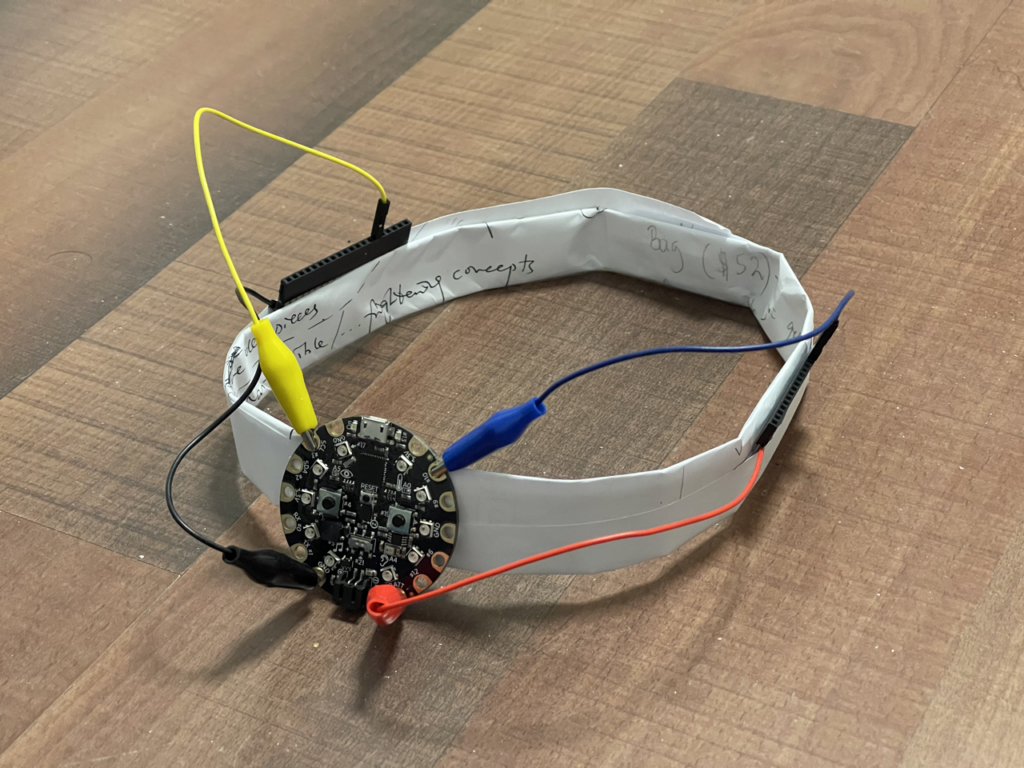
The first thing that went into my mind when I saw the word “dog” and “network” generated was the barking network scene “Twilight Bark” in 101 Dalmatians. Hence, I would like to create an “cyborg extension” to this concept, making the communication network between dogs and human possible. 

Paper are used to make a “collar” that the dog can wear. Batteries are integrated in small units inside the collar body. I used my embedded systems development board as the integrated board containing the microcontroller, translation module, signaling lights and antenna of the device. The bar on the left and right represents the microphone and speaker respectively. When the dog barks, its meaning can be translated instantaneously and sent to humans in the form of electromagnetic waves. The benevolent humans can now join the rescue of the 101 Dalmatians from Cruella de Vil without she knowing.

Class Visit 4 – Harshini Karunaratne

  1. Photography, Theater, Real Time New Media
  2. Exploration of body and gender binary, connection to environment
  3. Screen as a source of light -> projection
  4. Light transcends screen and infiltrate the way see world around you
  5. When once the sky was blue – screen based – covid, active ritual, escape the room, connect to nature, uses world building – mindfulness of the world / surroundings (e.g. world of wildfire, water / sea, 3d rendered mountains)
  6. Theater Capstone: Projections – origin from magic lantern, contrast between light and dark, 16th century projection show 21 century pre-rendering, project on fogs, phantasmagoric)
  7. Ophelia – asian reinterpretation of Shakespeare, portray after life, mermaid -> siren, incorporate self body to siren model, innate fear of water from childhood -> afterlife
  8. Poetry – just enough words to invoke feeling, invitation.

Midterm paper: a work that inspires you

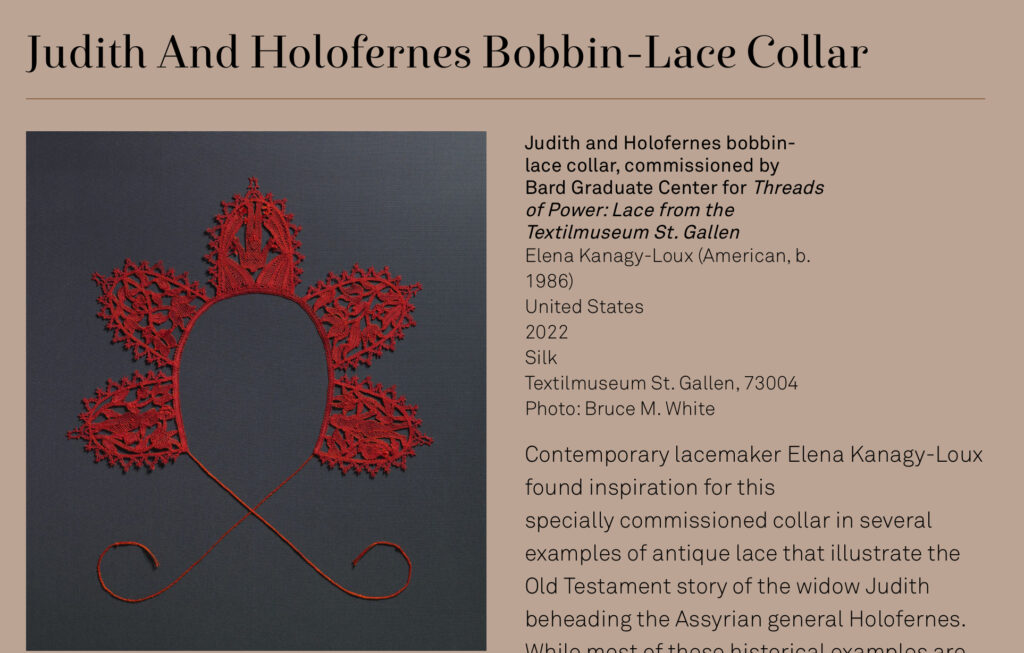
I don’t remember how I first came across this piece of work. I might interested in textile art, but this medium in particular is unfamiliar to me. Lace. I cannot deny that I was intrigued by the form, I didn’t think this was supposed to represent something. After reading the artist’s description of the project, I realised that it shared the same theme as my favourite painting. I particularly liked this Reinterpretation because it looked nothing like the ones I had been studying. Before seeing this piece, I didn’t associate textile art with an actual way of communicating, as actual “Art” (whatever art means ). I always thought of this medium as a way of doing clothes or a strait-forward image created using fabric, yarn and thread. This opened my horizons to consider textile art as an art not a “craft”. Now I realise I was looking down on one medium, I was adhering to the idea that a craft is not art, and that art is always several steps above “crafts” . This piece was a turning point for me. I had already been working with embroidery and crochet before this lace’s discovery. But I didn’t think I could convey such intricate narratives through this medium. i also think it was important to me to find this specific theme in textile work. I had been collecting different stories (displayed on media or in the art world) about women using violence to gain the power they were denied of. Judith beheading Holofernes has always been on the top of my collection top stories. I have studied different reinterpretations, comparing the painting done by Caravaggio and the one made by Gentileschi helped me see the way different artist react to the same theme. Translating this reinterpretation to a completely different medium also was a huge surprise to me. The fact that this art is something wearable and the way the shape interacts with the central theme was what I needed to find muy passion. I tried to make my textile projects into something completely functional before this, now I have been working in different way of communicate complex ideas through textiles. I always come back to this piece for inspiration. The lace helped me discover different ways of art making. It also remind me to look closely, to take my time. Every time i revisit this artwork, I realise something new. For example, I think it is a way use of medium to reate a necklace (a piece of jewellery that goes to the neck) to a theme involving the beheading of a man. The lace also introduced me to more historically details of the theme. I always thought this was a topic exclusively to painting. Seeing that Judith beheading Holofernes is a rather common topic among the lace making work explored my bubble. I could make textile art that is complex, that mixes stories, that represents something important to me; I didn’t have to stick to a more practical way of textiles. This lacework is the beginning of my freedom as a textile artist, it is what I needed to find the medium I am the most confortable with.

Fears about yourself response

Art and Fear

The book identifies two main fears for artists: fears a bout themselves and fears about their perception by others. For me, this two concepts are often related, and one fear might encompass both ideas.. I think it is interesting how it explains the importance of workin even if the result is not good (a clear example of lateral thinking). I also thought it was interesting the way it approached the “pretending” part. The impostor syndrome is really common, and the idea that one cannot pretend to make art is a great way of fighting it with logic. I also liked how the self consciousness of the artist is recognised as an advantage and a disadvantage, as well as portraying different ways artists react to this issue.

I also really liked how it tackles the idea of the artist self projection into art. It is also interesting to have someone trying to demystify the idea of natural talent. (Which usually denies the effort put by the artist)

I personally liked the expectations part. I think this is something to which I resonate a lot, and it is interesting to get a more logical explanation

Studio visit: Ephemeral Tomorrow

Ephemeral tomorrow

For musicians?

Architecture, music, visuals, (audiovisuals installations)

Codes have a meaning

Scientific background (neta?), discovery, phenomenon, reinterpretate in a poetic way scientific content

Gravitational Waves: topic reality, prerecorded data sets from observatories, raspberry pi

Solaris: real time data , meditative state, need to touch the pedestal, sound through the hands (mixing senses touch and sound)

Solaris, science fiction, no aesthetic inspiration, but mood ?

Satellarium III: real time position, Constellation communication

Epiphytes: humidity sensor, extension to communicate (plants, spinach, that send emails kind of thing?)

Aether Echo

Safety into account : regulation for lasers

Does the light disturbs the ecosystem? Is it a already human altered environment?

Midterm Paper

After a long bout of looking at different pieces from the studio visits for this class and beyond, I finally settled on a creative piece that I came across close to a decade ago. This piece had became a part of me as I grew up and influenced me so significantly that I can still notice parts of my value system and personality that I can directly tie to the piece.

This masterpiece I speak so highly of is the novel series Percy Jackson by Rick Riordan, and its following sequels.

Before I go any further, I must urge any reader to avoid the motion picture adaptation of the book at all costs. If you have already seen the movie, I am sorry for your eyes and cringe-o-meter. The movie(s) failed to capture the essence of the story.

I will go over the following reasons for why these books moved me so:

  1. Timing
  2. Medium
  3. Relatability
  4. Absurdity and Humor

Timing and Audience:

I was introduced to the book while I was fairly young, around 10 years old. I believe this age period had a huge impact multiplier. Young children have extremely malleable brains. Their brains have more neuroplasticity and their lack of experience renders even common experiences interesting. I am not conjecturing that the novel was mundane. Rather, I am suggesting that any introduction to a great piece of art will have a multiplied impact on a young mind, provided there are anchors in the artwork to facilitate appreciation of the art. Here, this anchor comes in the form of relatability.

Medium:

In my opinion, the medium of the written novel has great potential to inspire. When done right, it provides the perfect blend of abstraction vs detail, where abstraction is molded through our imagination of events in the novel (my imagination of a Minotaur, given I haven’t looked at illustrations, is personal and subjective), and detail can be provided by leveraging words that already have well established sensory anchors. (I know what a red apple looks like)

Moreover, successful implementation of cliffhangers gets readers engaged to the story line and attached to the characters. The rush of not knowing what happens is a memorable feeling.

Relatability:

Seeing yourself in the art just makes it feel more real and more yours. The protagonist of the story is a misfit, an archetype that is easy to project yourself on. His struggles throughout the story line are palpable. Navigating personal dilemma, drama, betrayal and friendships gives the fantasy novel a relatable human touch. Percy’s handling of issues throughout the novel are not perfect, and his struggle to stay true to his values brings the character closer to us.

Absurdity and Humor:

A fantasy novel is absurd by nature. Add to it some humor and relatability, and the emotional consequences will render the book unforgettable. We may forget what the book was about, but we won’t forget how it made us feel. The humor in the book arises in conjunction with the absurdity. Rick manages to create complex emotions that consist of anticipation, fear, and laughter all in one.

There is much more that can be said of Rick’s creation. I kept following every book he released until I got to college. That is how well he managed to connect with me.

Response: Art and Fear – Chapter 3

“Fear that you are not a real artist causes you to undervalue your work” (p.24)

I loved this reading because it discusses the fear people have as Artists; many artists or creatives don’t live up to their potential because of fear. The clay pot example explained this fear perfectly, how the students started theorizing on perfection to create a perfect pot instead of accepting that art is flawed and shouldn’t be fixed as it is meant to be flawed, create a pot that they will keep continuously revising and improving towards something nice.

The biggest part about being an artist is accepting that talent isn’t the playing factor in an artist’s career; it’s actually their hard work and their determination, them not caring about people’s judgments too much nor criticizing themselves too much but working hard and practicing and advancing from there on ways someone can improve their artworks. Talent should be seen as a headstart, not the winning of a “race.” practicing and putting your mind to it is how you finish the race, both the person with the “natural talent” and you.

As much as art is an expression of emotions on a medium, you need to set your emotions of fear, worry, wants, and needs aside when creating to create and not doubt yourself but build up on what you began with and watch your art improve. It makes me sad sometimes that people give up on arts. I will plead guilty to having once felt that fear because I wasn’t as good as people in the industry for years. I gave up on creating for a while, but then I realized how irrational that was of me to compare myself too much instead of putting effort, trying, and most importantly, enjoying myself. After all, big artists and prodigies exist, but this chapter perfectly illustrates two things:

1) Don’t be too hard on yourself; accept your art and its flaws, appreciate it, build on it, and improve.

2) Work hard and stay patient; no matter how frustrating, the frustration will be rewarding eventually.

At the end of this chapter, the author mentioned how we should treat our artworks as our children, which I fully agree with. I think it’s one of the best ways to approach art, a child is a lot of hard work and determination, but you don’t judge yourself; you keep teaching and keeping after the child until he can one day do the same. In this way, we are all really artists.