
Otis Sandsjö seemed to very passionate about his work, he is very creative and tries to use the saxophone to make music that is inspired from the types of music he enjoys listening to. He experiments with less conventional ways to play the saxophone. I think his music is very interesting, and I like the randomness in some of the beats in his music, because you don’t know what to expect next. This for me sounds like good music to study with or do something that requires more focus while listening to.
Author: Yasmine Elsisi
Project 2 (5 meanings and 5 representations)
5 alternative meanings:
- A dangerous group of 6-year-old kids decide to vandalize the metro with their art.
- Google maps was hacked and is giving wrong station names in an attempt to get tourists lost. This is part of their scheme to make berlin harder to navigate, so less people will crowd their favorite doner spot.
- The metro takes us to an alternate universe and each station is a gate to a new dimension.
- The government has decided to hire an 8-year-old genius to design the metro lines, since he is the only one capable making the most efficient design. Part of his deal with the government was that he gets to name some of the stations after his favorite things.
- This was the initial proposal for the berlin station names, but someone spilt coffee on the initial proposal and their plans were all lost. They unfortunately had to come up with a new design for the stations. However, recently a backup copy of the design was discovered in a secret drawer in an abandoned office. Unfortunately, it is too costly to redesign the stations, so we must settle for the less interesting design.
5 alternative things you can make with proposal 1:
- A wanted poster with a ransom of the group.
- The group takes over the city and they form an alliance with the street artists. They cover berlin in so much art, people all over the world come to see it, but if you can’t come, here’s a post card.
- A video game creator takes inspiration from the group’s persistence, and he decides to make the mobile game U-Bahn-Surfer.
- Walking by a park, you hear a musician playing his guitar, telling the story of the brave young kids who are not afraid to express themselves.
- The group expands their work and are now changing all the stations.
Implementation of proposal 2: Post Card
Inspiration: The graffiti and paintings on buildings and walls was used as inspiration for the postcard. The images collected for the postcard were primarily from Charlie’s checkpoint and Alexanderplatz. Some of the original images used are displayed below.

Implementation:
Using Canva and a postcard template, the images were placed in a collage and the transparency setting was used to blend them in. Then Berlin was added in different fonts.
Using a photoshop app, PICSART, a HDR1 filter was applied, then a radial blur was multiplied on top of the postcard.
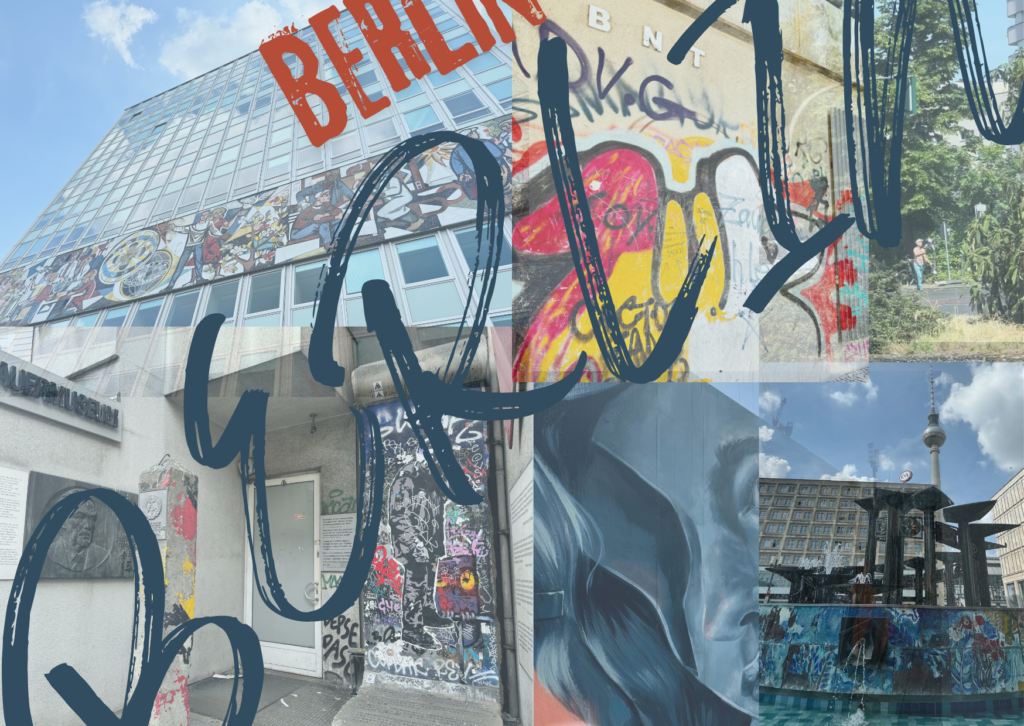
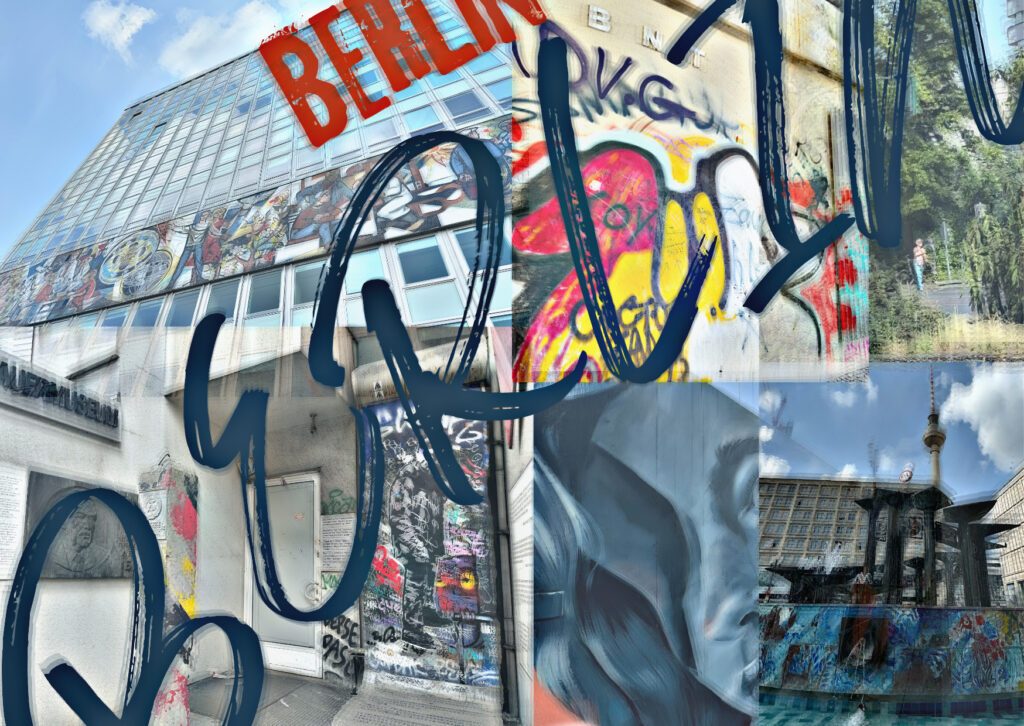
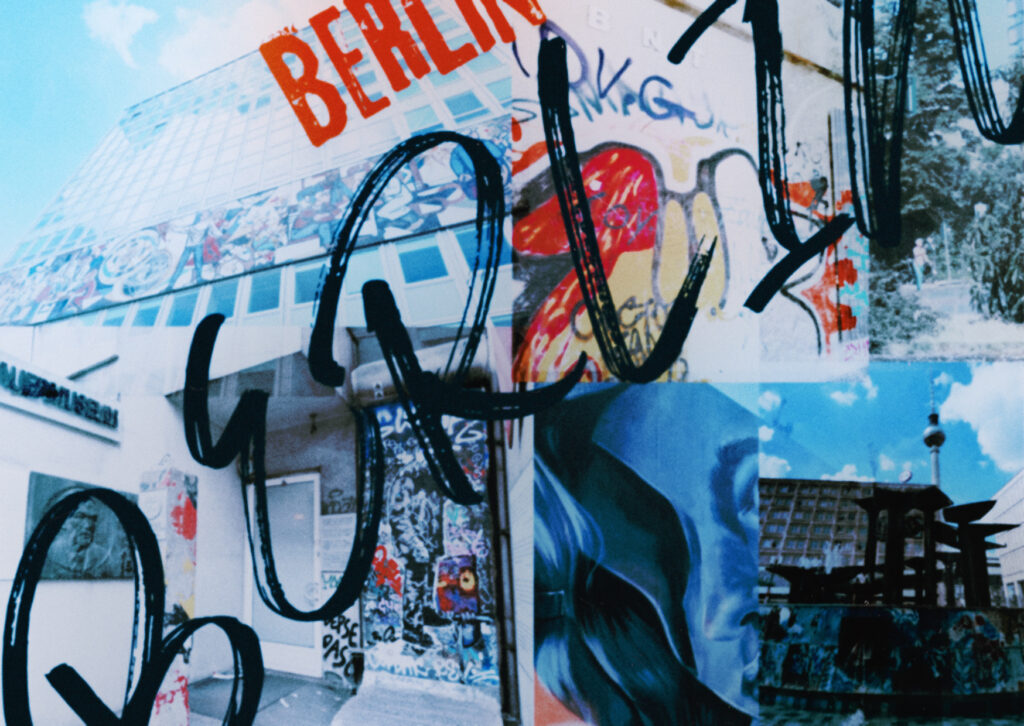
Here are the results, I wasn’t sure which one to choose as the final implementation
Kermit TED talk response
Response 1
It isn’t easy not to put too much pressure on writing a response. You still have to analyze the video, think about what was said, what wasn’t said, and write something that isn’t a repetition of what we saw. This class encourages us to be creative, so this response can be a medium to try out a creative thinking process freely.
Let me start by summarizing what Kermit said. He talked about not being afraid to be creative and how it’s okay to go down less conventional paths for the sake of creativity. Even in our conventional jobs that don’t seem to allow room for creativity, we can find ways to think outside the box because creativity can be expressed in everything. He emphasized adopting a beginner’s mindset, like children, who see every idea as a path to many possibilities and inspiration. At least, this is what I understood.
He also mentioned that the people around us—friends and mentors—inspire us to be creative. Ideas don’t come from nothing; you need to start from someone else’s thoughts or ideas. Find your inspiration from a mentor, someone you know, or someone whose work you like.
I think this is all great, but it doesn’t really tell us how to think creatively. You can’t be afraid of something that you don’t even know you can do. I feel that these days, especially in university, there’s more fear of not being creative than of being creative. There is so much pressure to come up with something amazing, especially in things we barely know how to do or understand, that it makes us less creative. As you said in class, you need to release some pressure in order to be creative.
So, how do you be creative? By the end of the class, we should know that, but I would say that skills and knowledge are the most important part. There should be a buildup of information and stress, and then, when you release some of the pressure, you have enough information to come up with something interesting. At least, that is what I have experienced. Now realizing that this is to be posted where anyone can see it, I get what professor Sherwood meant by the fear of sharing what you’ve made.