Making Assignment 2 – Underwater

Shahram Chaudhry

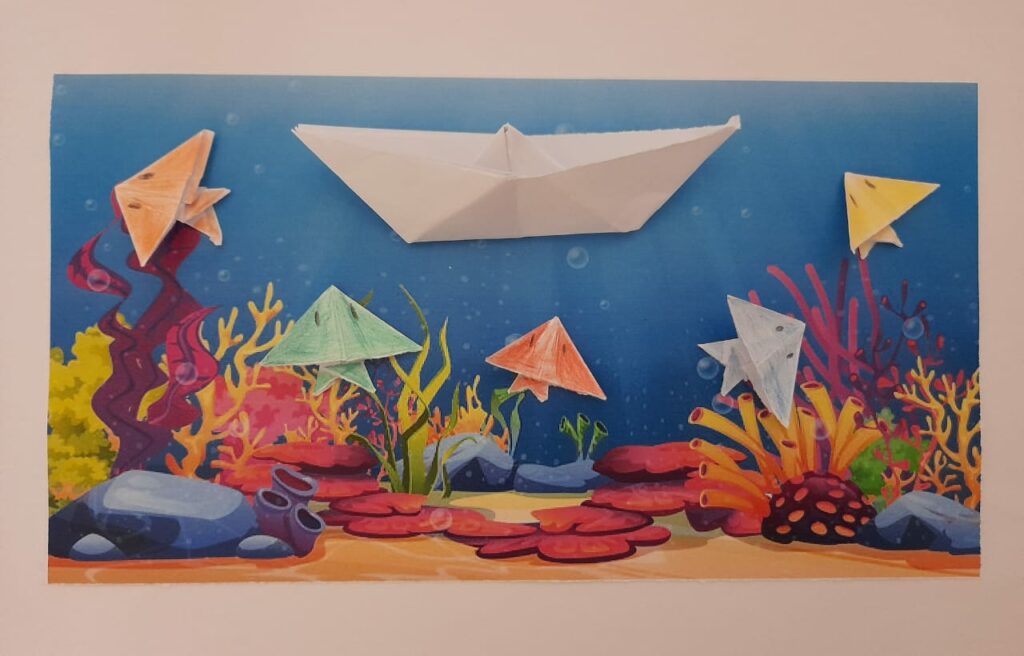
In class, we discussed games that involved making origami. With that fresh in my head, when I got to jotting alternative ideas for my “underwater” project, making an underwater scene using origami was on the top of my list. Since I had previously used the topic metaphorically, this time I wanted to use the literal meaning of underwater by depicting an underwater scene. 

I found a picture online that went well with my idea and printed it – trying to figure out the correct color settings for the printer was quite a challenge though. Then I got to making origami fish and of course, I could not miss including a boat – I mean that’s the first origami that we were taught as children. I have to accept that when I tried to make a boat consciously, I got stuck and couldn’t figure out how to make it. But by solely relying on muscle memory I was able to make an origami boat. 

Then it came to deciding the colors of fishes and I wanted to choose meaningful colors. I used blue to represent calmness and tranquility, orange to represent vibrant and enthusiasm, yellow to represent joy and optimism, green to represent growth, harmony and balance and finally red to represent passion, strength and vitality. I kept the boat white to symbolize purity and simplicity. I think these are all the traits of a perfectly balanced system (in this case my underwater ecosystem) but in broader terms the general societal structure and system.
Reading Response 2

Shahram Chaudhry

In the introduction, Bono first distinguishes between creativity and lateral thinking by explaining that creativity is the description of a result while lateral thinking is a description of the process. When we admire someone’s creative result such as a painting, we are appreciating the outcome of someone’s creative process. On the other hand, lateral thinking refers to a cognitive process that encourages unconventional and non-linear thinking. While creativity is often attributed to the result, lateral thinking focuses more on the process of thinking itself.Lateral thinking is concerned with thinking outside the box and looking in a different way at things that have always been looked at the same way. The main distinction between lateral and vertical thinking is that because vertical thinking is sequential, there’s no room for mistakes while in lateral thinking one could go wrong at one or more stages and still achieve a fruitful outcome. 

The writer uses the analogy of digging a hole to explain the concept of lateral and vertical thinking and I don’t think it can be explained in any better way. He compares lateral thinking to digging different holes and vertical thinking to digging the same hole deeper. Now both actions can be equally important depending on circumstances and some situations might require both of them together. So lateral thinking and vertical thinking go well together and are complementary. In conclusion, while lateral thinking encourages individuals to adopt a mindset that embraces ambiguity, welcomes new possibilities, and explores diverse perspectives, vertical thinking helps in achieving results in a particular direction, and both are essential to success.

Studio Visit Response

I absolutely enjoyed today’s visit and Markus’s talk. I loved how he’s so passionate about his work and how he constantly highlighted the importance of being driven. He also emphasized the need to put in the extra effort so that one could stand out among their peers. I was also fascinated by the idea of using perfumes as an inspiration to make music, that’s a pretty good example of thinking outside the box and not limiting oneself to the constraints of the convention. 

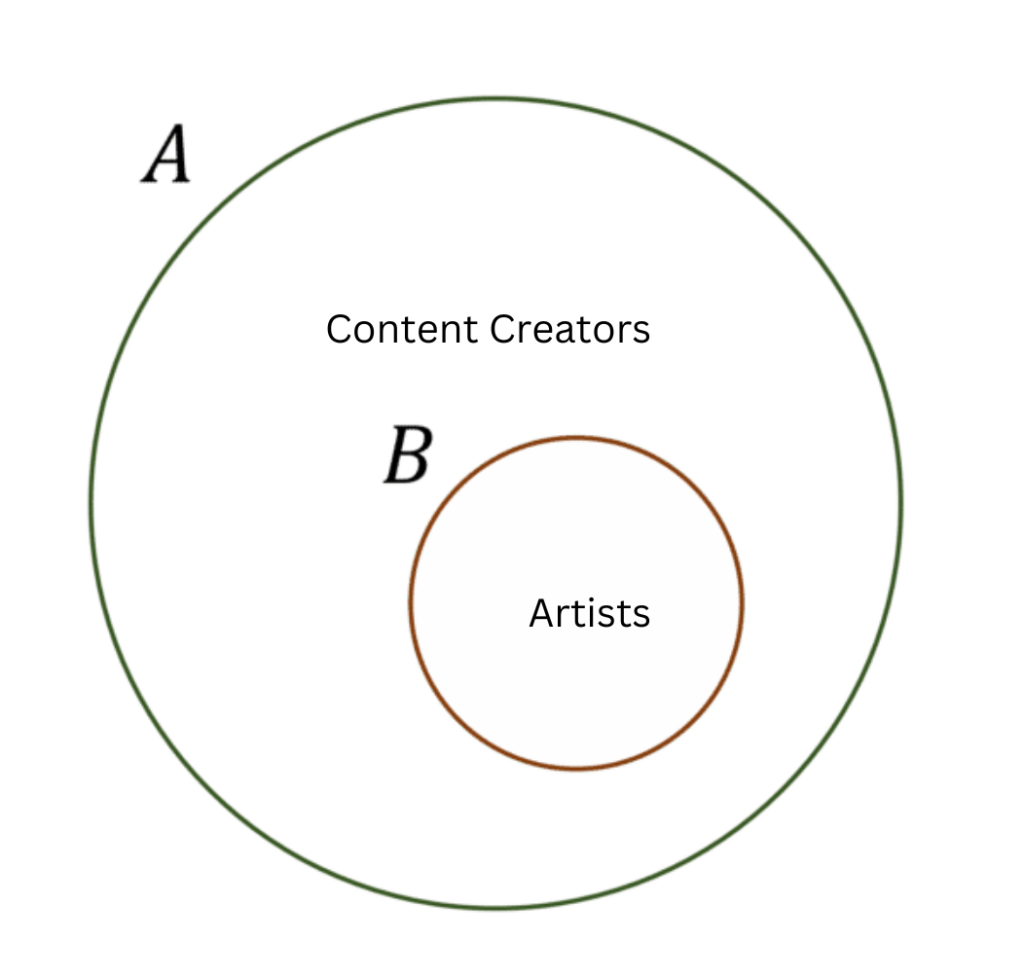
However, there were a few things I don’t quite agree with. Firstly, he talked about how our goals should be clearly defined and set beforehand. Just yesterday, Kermit discussed the idea of not knowing the destination when starting the journey and figuring everything out on the go. I think when it comes to art especially, this is how it should generally work. Also, I believe that the distinction between artists and content creators was too sharp. I think that artists are types of content creators too, just with more creative freedom. (See diagram below)

Reading Response #1

Shahram Chaudhry

While Kermit defined creativity in several ways from seeing the world through an unusual perspective, to trying to make it through living in a swamp, the idea of creativity as being who you are and the thing that keeps you going resonated the most with me. The belief that you’re either a creative person or a technical person has been ingrained in me through my country’s academic culture and I’ve been made to believe that I’m not creative at all (I never got bored in NYUAD so I’m definitely not ‘not creative.’) I’ve conveniently justified my reluctance to take creative chances by using lack of time as an excuse but this class would be a great opportunity to explore my creative side. Also, I realize the importance of not being afraid of failure because what might seem as a mistake or failure could produce different but entirely useful outcomes. “Sometimes, it’s not important to know the destination when we start the journey,” ( I reassure myself as I’m about to figure out how to reach a lake 1.5 hrs away).

Making 1 – Underwater

As I stand by Lake Wannsee with two of my classmates, I am regretting the decision to visit the lake. Maybe I should just have stayed back and completed my assignment or maybe not! 

“He’s way in over his head,” Enock comments upon seeing a child swimming in the lake. This reminds me of not long ago, during the final week of the spring semester, when I was “underwater” too. I was struggling in the Data Structures course because the workload was just too much with major assignments and quizzes due the same day. It was like I was drowning in a C of Data Structures. To top it all, I had grade issues in one of the assignments which meant that I was constantly afraid of not being able to pass the class and having to take it again. This constant stress obviously affected not just my mental health negatively, but also my focus, thereby affecting my work for the other courses too. Around the same time, Pakistan was facing political unrest and was on the brink of a civil war. With all this going on, it  was like I had hit rock bottom. What I felt then was no different than what a child who doesn’t know how to swim would feel if they’d been pushed into a swimming pool without any prior warning. It felt like I had been underwater for too long and there was little chance of survival. 

But then the day I had to fly to Berlin, my problems started sorting out. I passed the course and I no longer had immense academic stress. Also I found the idea of being in a new country surrounded with new people very thrilling and strangely comforting. Berlin was like the coast to me! I’ve learnt that life will throw you underwater often and life’s all about learning to ‘swim’ your way out of trouble. 

The fish is struggling outside water, and I’d struggle underwater. This means that some situations might work out for some individuals but not others. At the end of the day, it’s about being resilient and trying to push through!