
Art and Fear – The Nature of the Problem – Sara

“The best thing you can do is make art you care about – and lots of it!”(p.6)

I liked this chapter of the book, and the beginning of it makes me want to read the rest of the book. These few pages trying to tell us that someone must be an artist to believe in themselves and accept how much they have done regarding their art practice. The author shows us the importance of believing in yourself, putting effort and hard work into your pieces, and accepting the level of artist that you are at now.

One thing that stuck with me was that he mentioned how talent does not play as big of a role for an artist as we think. Still, it is rather a bonus inherited by chance, but what makes a good artist is his hard work, effort, expression, and determination. This is something I fully stand for, as I think many people give up at the beginning of their creative journeys because they do not “have what it takes to be an artist,” what they tend to misunderstand is that this “it” is effort, patience and lots of hard work, it’s the journey the artist goes on, how he progresses his work and his practice.

This chapter is a good way to start this book called “Art and Fear,” I have felt before that I do not have what it takes because I would see people around me, around my age, sometimes even way younger, that I deemed more talented than me. But art is an outlet, and I have seen my progression in my techniques and pieces after not giving up and continuing the hard work. I think this applies not only to art but to anything someone would want to pursue; Do you get a love for football but never played? Apply this strategy. Do you want to code websites but don’t even know how to code? Apply this strategy. Do you have any other interests you want to pursue but think it is too late, or you are not talented enough? Apply this strategy.
Innovation and Suspended Judgement – Sara – Lateral Thinking – Bono

“In practice, backwards thinking is however more concerned with explaining an effect whereas forward thinking is more concerned with bringing about an effect.” (p.93), I think in this scenario, both of these ways of thinking are equally crucial to the innovative side of your brain when it comes to coming up with new ideas, i think it is both crucial to move forward, but also understand how you even got this far. When you are stuck, you go backwards in order to understand how you got stuck where you are now and be able to keep moving foward with your innovations.

“Being effective means being right only at the end” (p.95) When brainstorming and coming up with new ideas, the author suggests that using lateral thinking throughout the process is crucial and that at the end we use our vertical thinking and make sure that what we suggested works and is doable.

I think the author in these chapters wants us to understand the importance of innovation (what is it consisted of) and encourage us to not judge ourselves nor our ideas when we are becoming creative but instead build on them, and see what could be achieved based on what was thought. Despite him agreeing that one would need to judge the end of their project, he heavily discourages us to start rationalizing and treating our creativity like we are in classroom where we are constantly expected to say the correct thing or correct answer, because in creativity, there are no correct answers as long as the final product is achievable or at least, attempted.

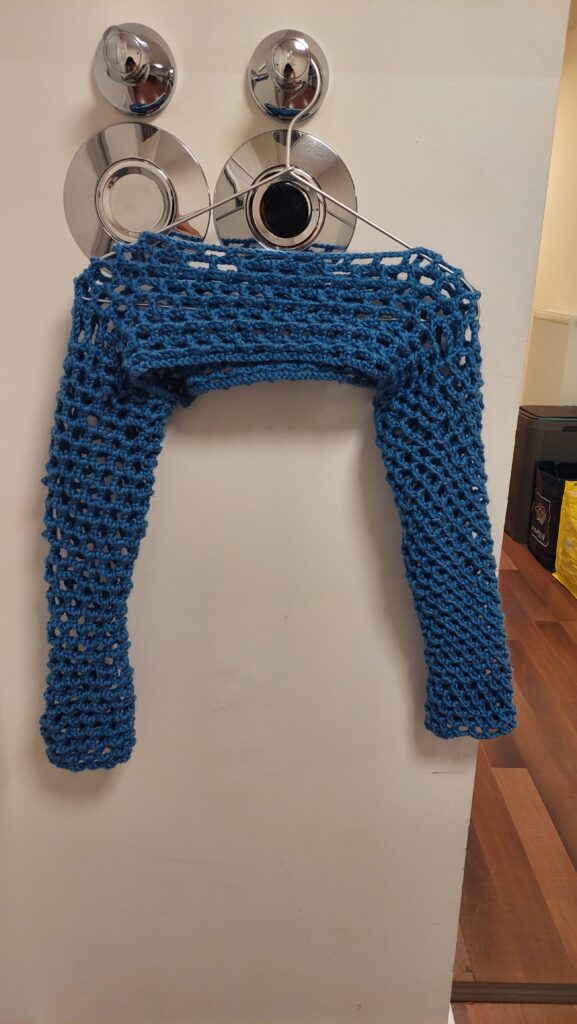
Make Assigment: Blue Sleeve

I was unsure of what to do for this assignment. I still wanted to try something outside my comfort zone, but I also wanted to explore one of my interests.

For some time I have been thinking about documenting my crochet projects so I can have an archive. Crochet documentation is usually characterized by visual support: pictures of the finished design, videos of the stitches and patterns written in an incomprehensible language. When I think of my projects, I think of what I was doing while I was crocheting. I often crochet during my 5 minute breaks while studying or when I listen to a podcast. I wanted to assign a mix of sounds to each project. For this one, I used different sounds I associate with my last project and actual recordings of my environment while I was crocheting. The blue sleeves is a project I started during finals week to help me focus, especially while studying chemistry. I finished the second sleeve yesterday while going back to the dorms, and I finished weaving the ends in my room while listening to a podcast (about Darth Vader). The audio is not supposed to be “musical” or have actual rhythm, it is more a fingerprint of my process than a musical piece on its own.

Here is a link for the final audio:

https://drive.google.com/file/d/1gyaknu6m6B_kM9RMfMS2YGZ6rBTr1ME-/view?usp=drive_link

Here is a photo of the final product for reference: