Why?

I want to record a video on the street.

Why do I want to record a video on the street?
Because I want to capture the vibrant atmosphere and diverse sounds of the city.
Why is capturing the atmosphere and sounds of the city important to me?
Because it provides inspiration and raw material for creating unique and authentic music compositions.
Why do I want to create unique and authentic music compositions?
Because I believe in the power of originality and self-expression through music, and I want to share my creativity with others.
Why is sharing my creativity through music significant to you?
Because music has the ability to evoke emotions, connect people, and leave a lasting impact on listeners.
Why do I want to leave a lasting impact on listeners?
Because I want to inspire and uplift others through my music, creating an emotional connection and bringing joy to their lives.

I ended up combining loops and beats in Soundtrap to generate an mp3 audio with a rhythm meant to evoke a sad emotion.

Here is the final audio:

Here is the link to my Soundtrap mix: https://www.soundtrap.com/signup?ref=8e200d9418edb376f104867dd8e21e2d


Make – Why?

Yesterday, I got lost while traveling through the city although I was following google maps for directions. Therefore, I started with the question “why do we need maps ?” and continued with my why questions.

  • Why do we use maps?
    For navigations purposes
  • Why do we need to navigate?
    To get to a place we want.
  • Why don’t we just follow our instincts and go?
    Because instinct isn’t a reliable source of information.
  • Why don’t we follow it despite this problem?
    Because we we’ll get lost if we do.
  • Why don’t we want to get lost?
    Because getting lost can be dangerous, stressful, or time-consuming.
  • Why is getting lost dangerous, stressful, or time-consuming?
    Because we might encounter hazards, such as wild animals, bad weather, or hostile people. We might also miss deadlines, such as appointments, flights, or meetings. We might also waste resources, such as gas, money, or even energy.
  • Why can’t we go to place without using any of these resources?
    Because we can’t just get to places. We need to make use of different means of transportations. And this requires money and energy.
  • Why can’t we just use clouds for transportation?

Reading Response – Lateral thinking chapter 1

The author introduces the concept of lateral thinking, which he claims is a way of generating novel and useful ideas by breaking away from the conventional patterns of thinking. He argues that the human mind is very good at recognizing and communicating patterns, such as names, words, symbols, etc. These patterns are formed by the self-organization of information in the mind, which is a natural and efficient process. However, this process also has limitations, as it tends to resist changing the existing patterns or creating new ones when faced with unfamiliar or contradictory information. The author proposes that lateral thinking is a technique that can overcome these limitations and help the mind restructure information in different ways, leading to new insights and solutions. However, I don’t agree with some of the arguments that the author makes in this chapter. He suggests that lateral thinking can be deliberately applied to any problem or situation, but he doesn’t provide specific examples to support his claim. I think that these claims are too unrealistic, as both types of thinking have their strengths and weaknesses, and they should be used in combination and balance depending on the context and the goal. Therefore, I think that the author should provide more evidence and examples to support his theory and show how it can be practically applied in different domains and scenarios.

The way the mind works response

The chapter covers communication, patterns and it uses. It starts by explaining communication as a code, as a series of cues that are interpreted by us and that have a meaning. Since it is a code, it uses patterns to establish meaning. For this reason, communication is not necessarily a two way road. Humans pick on cues from the environment, we find patterns, even if they were not intentionaly put there, and even if we cannot respond to them. This makes me think of how can personal experience can present a problem for communication. Not everyone has the same pattern system, which causes misunderstandings to interpret the same information. I wonder how we manage to have a close enough sysmtem to even begin to communicate. I guess this is what the book means when it says that it doesn’t matter if patterns are worng, as long as they are definite. I find interesting the idea of the mind being a passive element of organizatoin, which is probably why pattern recognition is not effective all the time. Cues are ignored or misinterpreted all the time. I am not sure I understand how lateral thinking can be used to overcome these problems. I get the idea of the patterns to be “broken” in order to find solutions, changing the perspective to arrive to a different idea. But I fail to undestand how this could be a mechanism, a consistent one at least .

Reading Response #3

~Sid

The first chapter of the book tries to highlight the way our minds work, how this way of working is useful, and the disadvantages caused by this system.

The author describes the mind as a pattern recognition and a self organizing system (as a virtue of its structure itself) . I find myself agreeing with most things he proposes. The mind looks for patterns and uses these patterns to make sense of the world. We truncate what our senses perceive into codes, the minimum effective dose of information needed to make a judgement about which pattern our perceptions fall into. This is the what magic tricks, riddles and still image visual illusions take advantage of, the mind’s tendency to categorize and pattern match to understand.

There are a lot of inherent benefits of this system.The pattern web can store an ever increasing amount of information. The access time for repeatedly accessed patterns in also quite low. However, the author is interested in how to mitigate the downsides of the system, such as: falling into rigid patterns of thought, difficulty of changing patterns to drive insight, and difficult of interconnecting information across patterns is difficult.

Bono has laid the groundwork to make us care about learning to think laterally.

Lateral Thinking – Chapter 1 – Reflection

Reading this chapter, De Bono has made me reflect on how I remember and build upon things. I like how he shows us through a series of examples/mind games why lateral thinking is essential to unlocking our whole creative selves.

Since everything is coded, stored, and perfectly filled in our mind, it does give us difficulty to grow a thought horizontally; the more I thought of the outcome of today’s “making assignment,” the more I understood De Bono’s examples. Asking why frustrates me sometimes and comes off as annoying, but if I hadn’t done that, the outcome of my making project would be pretty predictable to most people, and I wouldn’t have reached the topic of “memories” from the word “sleep.”

I found it interesting the assembling the geometric pieces into a big one played out and how humans tend to go for the simplest, most straightforward way of solving a problem. (very technical and lacks that sense of creativity), but solving that arrangement of blocks into a geometric shape, using lateral thinking, makes us come up with innovative, new, and fresh solutions to our dilemma. (seeing the parallelogram instead of a square, even though the square is a correct answer and more straightforward initially) This, again, shows the importance of lateral thinking on human development and how crucial creativity is for the progression of humans in many fields, not just the arts.

So far, I enjoy this book, as it emphasizes the importance of lateral thinking and creativity within everyone, not just “artists,” but shows us examples and moments where creativity would be essential in our everyday lives in human society. Additionally, we see how, even with problem-solving, creativity is much appreciated 🙂

Making #3

I was thirsty when I started.

My internal monologue:

I need to drink water.

Why ? Because I need water to stay alive.

Why do I need to live? Because dying is not good.

Why is dying not good? Because it is scary.

Why is it scary? Because we do not know what happens after death.

Why are we afraid of the unknown? Because it might be dangerous.

What if death is not dangerous? What if death was adorable instead?

What signifies death? The grim reaper.

What is cute? Puppies or Kittens…..

Now it’s time to use Runway. With their tools, and an a lot of pictures that didn’t meet our vision we arrive at this:

Description: Grim reaper having tea surrounded by cute kittens + crows in the background (there were a crows making a lot of noise here, so I had to add them in since it was stuck in my head)

But Why?

Why do we sleep? To get some rest.

But why do we rest? To be ready for the next day.

Why do we need to be ready for the next day? To hop on a new adventure.

But why would be hop on a new adventure? To learn about life and make memories.

But why do we make memories? To never forget it.

This is the thought process I had when I was questioning why I chose “sleep” as a topic of inspiration; four “why”s later, we are talking about never forgetting memories.

For this assignment, I then got inspired by a diary my mom made of me when I was young of a bunch of random memories of me that she did not want to forget.

That inspired me to start a scrapbook about my time in Berlin and my daily adventures here so that when I read it a few years later, I wouldn’t have forgotten anything, even though I slept the day before reading it or not.

Reading Response 3 (Lateral Thinking Chapter 1)

Shahram Chaudhry

In chapter 1, the author talks about the code system of the brain and how it can only work with preset patterns. These patterns are worked beforehand and have code headings so when certain information is required, only the code name needs to be transferred which serves as a trigger to identify and acquire the required information, saving time and effort. So this means that humans can react appropriately to a situation almost instantly without having to examine it in detail beforehand and sometimes even while the situation is developing, using their prediction skills. 

The authors also discuss the mind as a pattern making system and how its effectiveness is often associated with its ability to create patterns, store them and recognize them. Exploring the concept of how these patterns are made, limited attention span can play a huge role because it means mostly a certain part of the brain will be activated, which will most likely be the familiar one and that part of the brain has more chances of being activated in the future because it is becoming increasingly familiar.   

While the pattern  recognition system has its advantages such as quick recognition and reaction, established patterns cause the mind to become rigid and non accepting of change. Also another problem is generalization of information, anything that slightly resembles a pattern is recognized as such so this can polarize information, leading to extreme opinions. 

The mind is adept at creating concept patterns, but it faces challenges when it comes to modifying or updating them. This limitation highlights the importance of lateral thinking, which encourages innovative and alternative approaches to problem-solving.

I also love this quote from the reading, “A memory is anything that happens and does not completely unhappen.” However, I don’t quite understand the landscape and the jelly example. 

Making – Assignment 3

Shahram Chaudhry

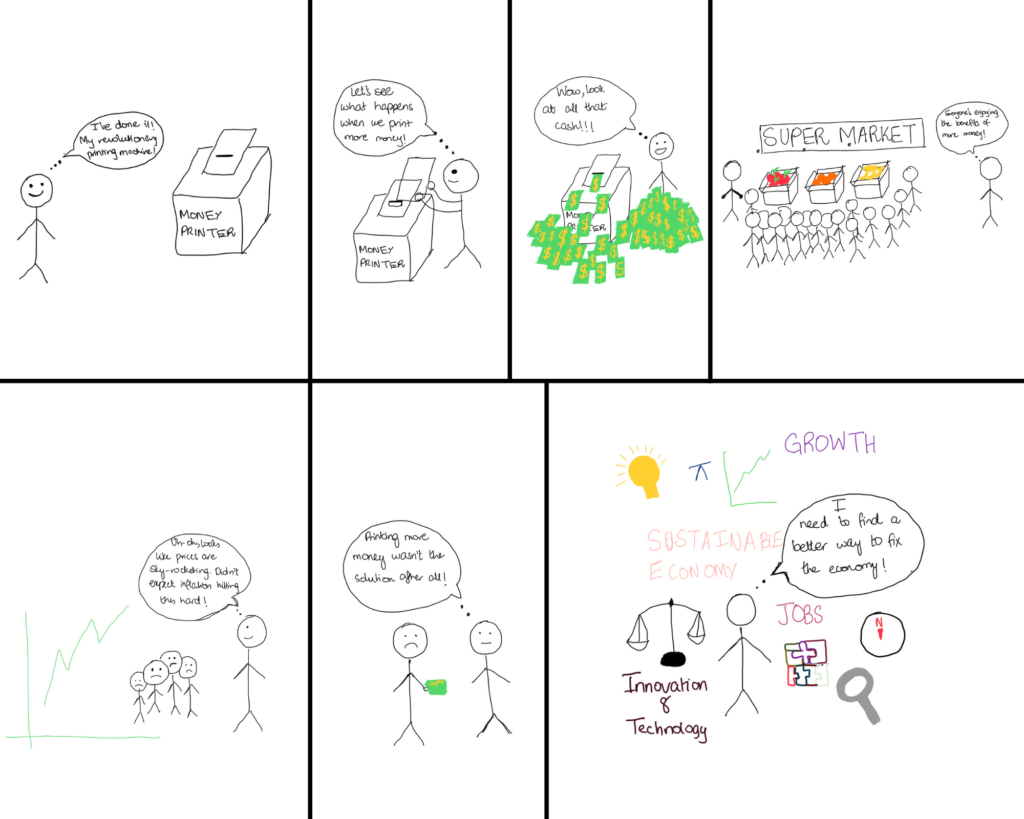
The most basic question we ask when we’re introduced to the concept of poverty as children is , “Why can’t we just print more money?” The answer to that could be that it would lead to inflation and decrease the value of the currency. 

“Why does printing more money lead to inflation and decrease the value of the currency?” 

A possible answer could be that printing more money increases the money supply without a corresponding increase in goods and services, creating supply demand issues.

“Why does an imbalance between supply and demand result in inflation?”

When there is more money in circulation relative to the available goods and services, people have more money to spend so the demand increases without the supply increasing causing prices to rise, resulting in inflation.

Why does an increase in prices due to inflation decrease the value of the currency?

When there is inflation, the purchasing power of each unit of currency decreases. 

Why does a decline in the exchange rate further reduce the value of a currency?

When the exchange rate of a currency falls, it means that it can buy less of other currencies impacting international trade, increasing import costs etc.

In the comic, the character, let’s name him Abigail Johnson, tries printing money and then realizes that it has negative consequences such as inflation, and people not being able to buy the things that they were able to before.