I liked this visit. The pace was slow at some points, but overall what he was saying was interesting. I liked how he showed us his watercolour paintings. I thought this really showed a part of his process, and it was interesting to see that he uses this medium as a preparation/ inspiration to do digital art. I also liked how he shared some of the problems he faced during his installations. I wished he talked more about how he dealt with the lack of equipment or the restrictions he faced. I wished he talked more about how he came up with his designs when he could not visit the actual location. He did mention it, but I wanted to hear more about it. I liked seeing his progression over the years.
Month: May 2023
Make Assignment 4- Haya & Sophie (Graffiti)
Topic: GRAFFITI
Why do people do graffiti outdoors?
So people can see it
Why do we want people to see graffiti?
Because we like showing off and we love attention
Why do we love attention?
Because were narcissists
Why are we narcissists but don’t like narcissists?
Because we don’t like seeing our reflection on others?
what about your reflection in the water?
Because water is trippy
Why is it trippy?
It just is.
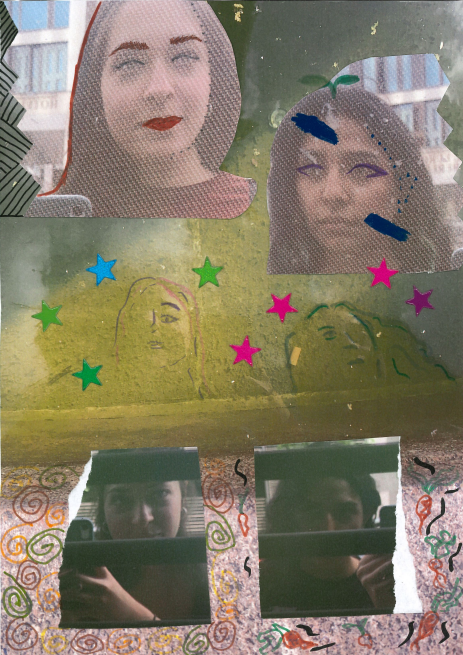
We initially decided to do our “Why” question as a pair to generate more ideas and move more into lateral thinking. Working on our own resulted in a more vertical way of thinking and we wanted to stay away from that. We did several iterations of the “Why” questions with different topics, but we only chose one at the end.
For our topic, we chose graffiti because it is something that we have been seeing around on a daily basis. From there, we somehow branched into narcissism, reflections, and water. We started with one idea, but we ended up combining several of the topics that were mentioned in the questions.
We brainstormed the projects we could make with the topic of narcissism, and what’s more narcissistic than portraying ourselves. We went around the city to find reflective surfaces such as windows and fountains to portray our narcissism. Then, we ended up with three different surfaces and reflections, one in the fountain, one in a window, and one in a building.
When discussing the “reflection” part, we explored different reflective surfaces, and water got our attention since we even mentioned it while doing the questions. We then realized that this should be the central image since it goes back to narcissism as the origin. Since this world comes from the story of Narcissus that drowned while admiring his reflection. Good news is, we did not drown (because we are not actual narcissists).
Our initial fountain was not as reflective as we expected it to be, therefore, we walked around the city, beside the Brandenburg Gate and Friedrichstrasse to explore other fountains and options. At the end of the day, we went back to our initial fountain to where our idea was inspired (the sun was at a better angle then so it was more reflective).
Photos only reflect one part of our narcissism, and we decided to take this matter into our hands. What’s more narcissistic than photos of ourselves? Photos of ourselves merged together and “edited” to show our best self. We then went back to the concept of graffiti and decided to draw over our pictures and around in order to better represent our project.
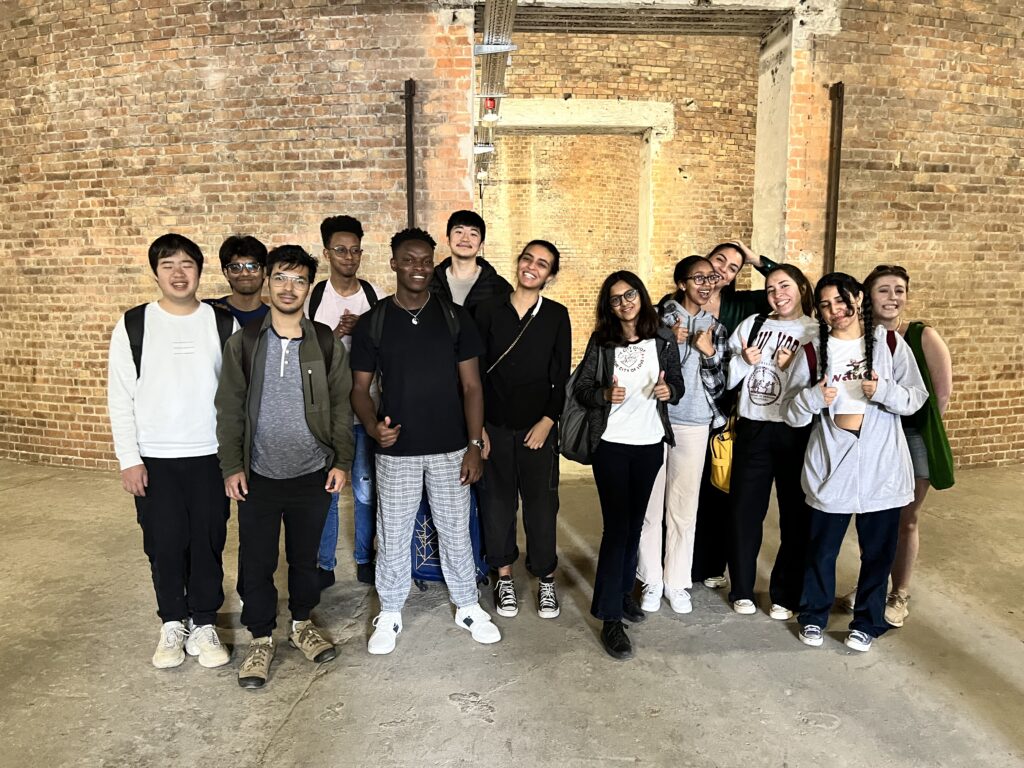
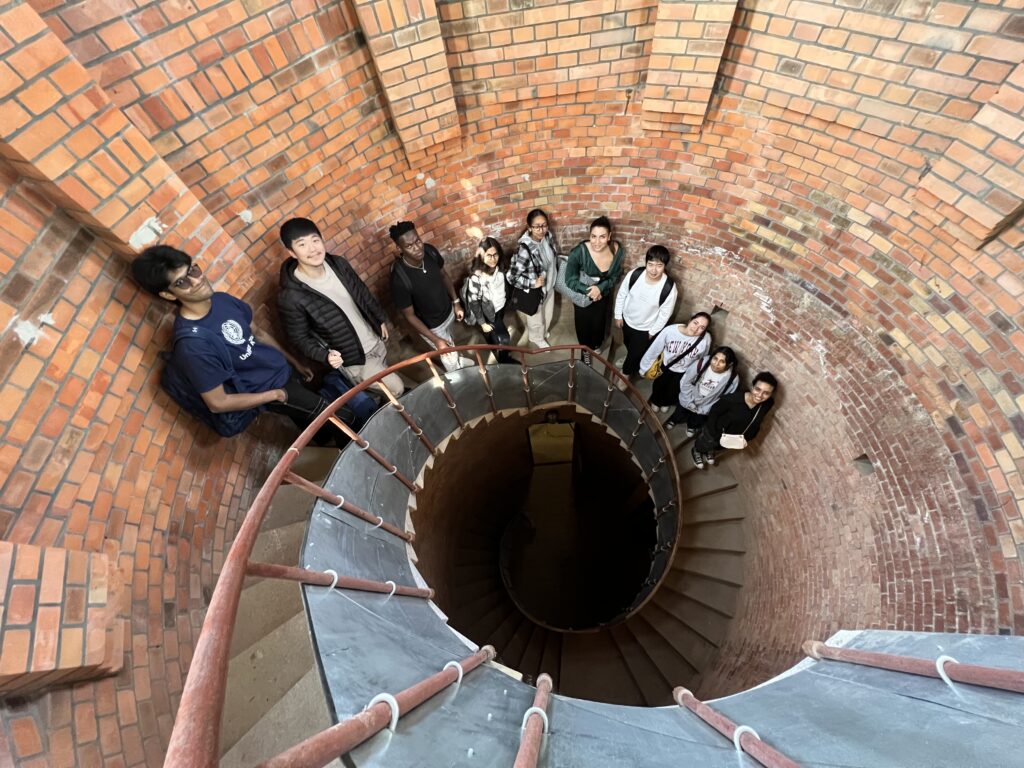
Große Wasserspeicher – class visit
Making Assignment 4 – NYU Intercampus Portals
When I was thinking about physical borders yesterday, one topic that came into my mind was our very university: NYU, which is set across borders — strictly speaking, 15 of them. To connect all of them, why don’t we erect a portal at each campus? I am tired of flying on intercontinental flights ten times a year😉.
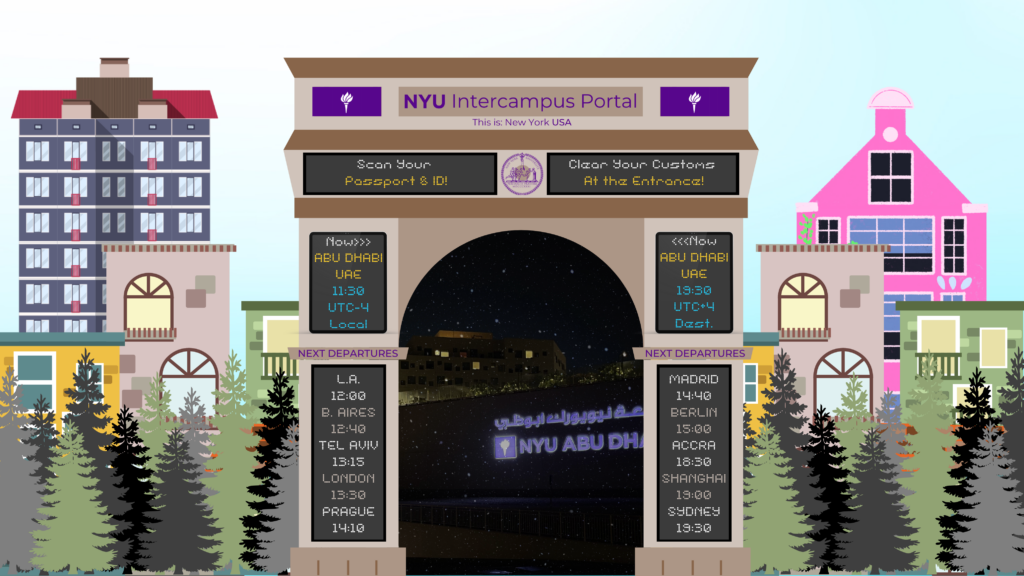
This drawing of the portal was made by Canva. I used a model of the iconic Washington Square Arch as the main structure. The departure times were also chosen in a way assuming that portal crossing is instantaneous. The users would not end up at their destination during early morning or late night.
In addition, there has always been a superstition (though not true) that someone walking under the Washington Square Arch would fail courses and not graduate. In this way however it also prevents anybody to walk literally “under” it 😹.
By the way, the portal site at NYU Abu Dhabi, as you can see from the picture, is located at the construction site at the west of our campus. Since I don’t really know what project is currently going on there, so why not let it be a portal?
Class Visit Response 1 – Robert Seidel
These are the notes that I took during and after the talk:
- He uses random drawings to clear the mind before a project.
- Exploring lights and colors, merging his understanding as a biology student (evolution, decay, rebirth, and growth) into his creation.
- Find the personal pathway with any available tech, not being restricted by their conventional uses.
- Enjoying what I am doing now as we’re not constrained by deadline, budget and industry.
- Hybrid Films – non-traditional form of presentation. Integrating films with multiple media other than screens. Ideas not restricted by scale. e.g. LED on Buildings / walls, projections…
- Merging with Reality. e.g. natural history museum – film includes abstract elements from fossils, plant, animals….
- Audience is much more intelligent than you think. Just tell the story in your way, stay true to it. It can translate to others.
- Work in contrasting locations open new inspirations.
- Museums are collection and condensation spots of human knowledge. Easily resonate and create abstract representation of ideas.
- Projection Sculptures – creation of both projection and objects. Need both to work. Revitalize old structures, like adding soul to them
- Hysteresis – Covid, Feeling Torn, Feeling Tension Use AI to fuse renaissance style into dancer movements. AI is trained to be good at recognizing patterns (e.g. recognizing muscles – renaissance style) actively that regular filters can never do.
- Openness to interpretation of audience ideas may help, but the backbone should still be yours.
They are very useful for me as I can really resonate with and admire his work. I would love to create a piece that engages everybody, remain in their minds unconsciously, and closely related to the local environment. Especially after visiting the Großer Wasserspeicher, I really would like to aim for a project that utilizes the whole space with sound and light that people can interact with. It would be best if it can connect to the complex history and symmetric, circular topography of the place that gives echos.
Reading response #3
The chapter made me wonder what is the role of ego in all of the construction and reconstruction of mind patterns. The tendency of the brain to retrieve information that is similar to what has been stored before explains things like confirmation bias. But why is it so hard to accept that our previous pattern (e.g. opinion) is not useful or trustworthy anymore? Why is it hard to accept how limited our brain system can be? Perhaps it would be interesting to expand the discussion to the limitations of our personality in itself.
Assignment #3
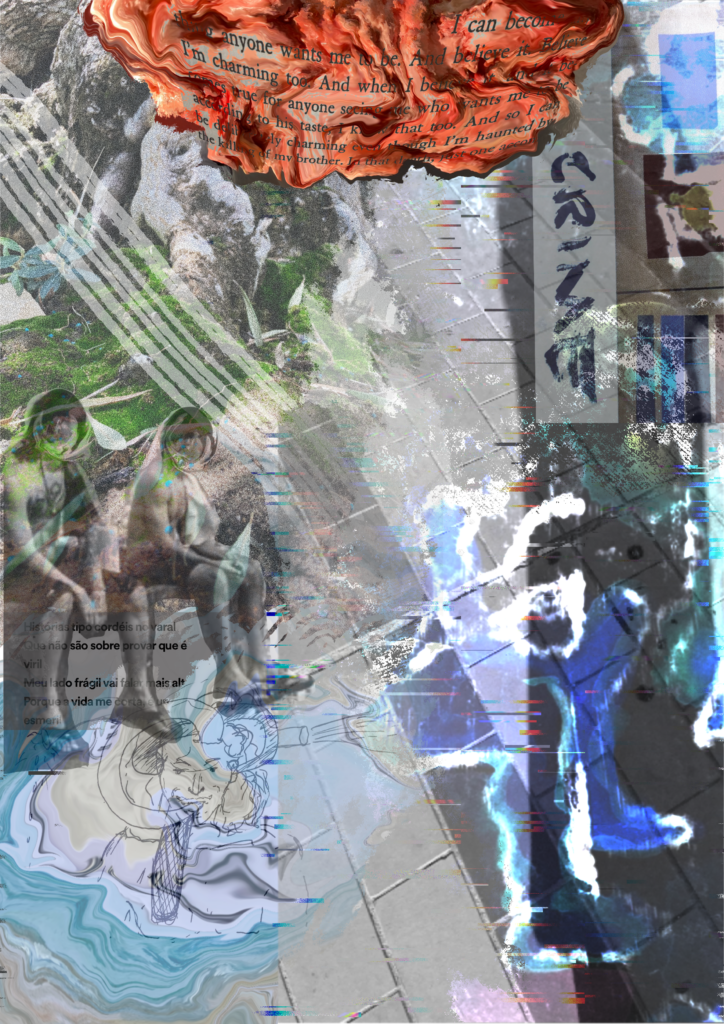
The questions made me think of ways to represent or see myself beyond “hair,” or perhaps away from any bodily, aesthetic or figurative expression. This collage is a representation of myself based on photos, artworks, songs and quotes that are dear to me. It is a self portrait that tries to abstract from my corporeal existence.
–
Why do I have hair?
– biological/evolutionary level: my hairy ancestors were less prone to damage on their heads, skin cancer etc. so they were able to live longer/better and reproduce
But there are many bald people doing fine today. Why do you choose to keep your hair?
– I find it pretty.
Why?
– I like how I look, I’m used to my hair, and I find other people with similar hair, pretty.
You could get used to no hair and you also find some bald people pretty.
– I’m scared that I’ll look terrible without hair and it would take me a while to get used to bald.
Why couldn’t you wait for how long it takes?
– Because it’d hurt my self esteem.
Why?
– Because I base how I feel partially on how pretty I think I am.
Why?
– I don’t know…
This exercise felt a bit weird because my mind is always two questions ahead of my writing, so here are other topics I thought I would boil down to after asking Why: body neutrality, social acceptance, stereotypical femininity, my hair is a source of compliments many times (?).
looking to the past (present)- making assigment
Why do we have monuments?
because we want to remember
why do we want to remember?
because these things are important
why are these things important?
because they define us
why do they define us?
because we changed after these events happened
Why did we change?
because we experienced something new
“why do we want to remember”
The idea is to build a time capsule for this year and then imagine what someone from a different time would interpret the objects.
- smarthphone
- vape
- a used mask
- someone’s spotify wraped of this year (last year?)
- food recipes
- a pair of converse
- airpods
- memes
- tote bag
- scrunchies
- diary entries (without context)
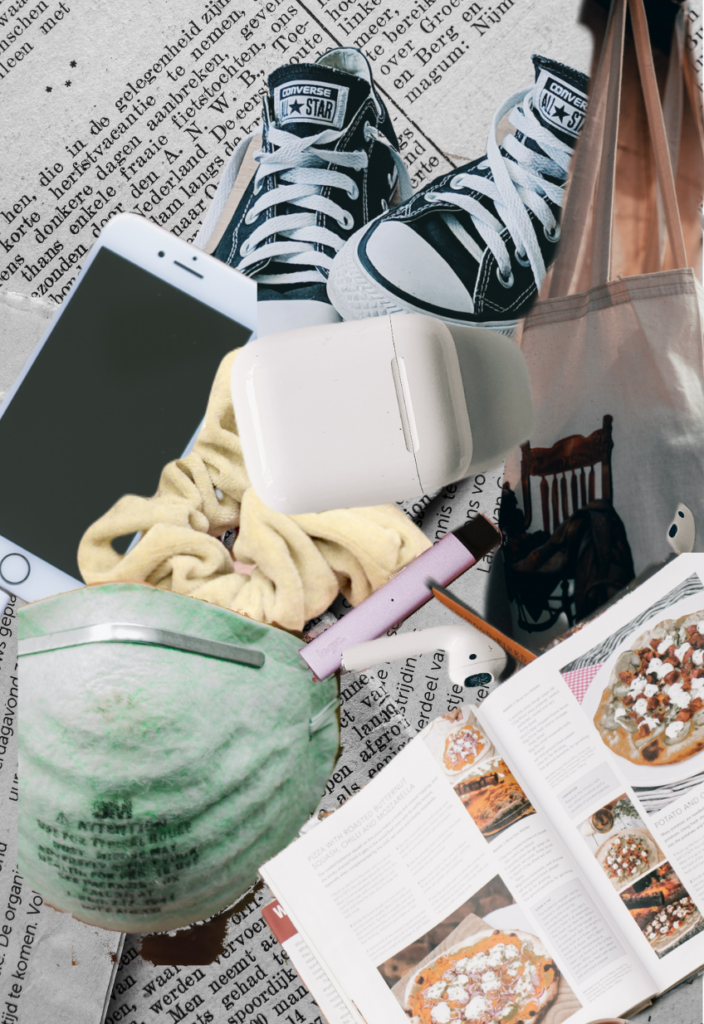
“This civilisation is surrounded by mysteries, there are more questions than answers whenever we try to undestand their ways of living. For example, it is still unkwown why this type of bag was popular during the time, the shape is not useful for large objects and it lacks a way of closing them to protect the items. For this reason, it is believed that it was used to transport live forms, such as babies. This primitive method of transport is worth more studies, because it might reveal their relationships with younger members of the species. Another big mystery is the little block that produces smoke. Some scholars believe this was used as a ritual artifact, more specifically, in a special type of ritual involving the young adults to ensure the well being of the community. Another interesting artifact is…”
Reading response-Chapter 1.
In the book’s opening chapter, the author delves into the inner workings of our minds and explores the advantages and drawbacks of our pattern recognition and self-organizing system. According to the author, our minds seek patterns to comprehend the world around us. When processing our sensory experiences, our minds distill the information into concise codes, enabling us to categorize and make sense of the patterns we encounter. This inclination towards pattern matching makes magic tricks, riddles, and visual illusions so captivating.
The system our minds employ carries inherent benefits. The network of patterns within our minds can store vast information, and retrieving frequently used patterns is swift and effortless. However, the author also raises concerns about the potential downsides of this system. One of these downsides is the tendency to become entrenched in rigid thought patterns, which can hinder our ability to think creatively and adapt to new situations. Additionally, the challenge of altering existing patterns to gain fresh insights can impede our progress. Moreover, the difficulty of connecting information across different patterns poses its own set of obstacles.
By shedding light on the workings of our minds, the author prompts us to consider both the advantages and disadvantages of our pattern recognition and self-organizing system. Understanding these intricacies can empower us to harness the benefits while mitigating the limitations.
Response to de Bono Chapter 1
As Bono highlighted in this chapter, the mind’s ability to create and recognize patterns is valuable to us as a survival tool. When I read about how patterns become increasingly established and rigid, shaping our attention and causing anything resembling a standard pattern to be perceived as such, it reminded me of a paragraph I had encountered before. This particular paragraph consisted of words where the first and last letters were in place, but the letters in between were scrambled and rearranged. For instance, “I cnduo’t bvleiee taht I culod aulaclty uesdtannrd waht I was rdnaieg…” According to research from Cambridge University, the ability to still read and comprehend this sentence demonstrated the incredible power of the human mind. It revealed that the order of letters within a word doesn’t matter as much as the placement of the first and last letters. The rest can be a total mess, yet we can still read it without difficulty. This example really exemplifies the efficiency of our pattern creation and recognition system.
Another thought that crossed my mind was the act of reading in general. I recall reading somewhere that once you acquire the ability to read in any language, your brain automatically reads words when you encounter them. It’s an involuntary process, and it remains a constant presence, unable to be eliminated. I believe this goes to show how pattern creation is an unconscious ability of the mind.