MAKE – Apple Picker/Storage – Majid, Enock, Ahsen

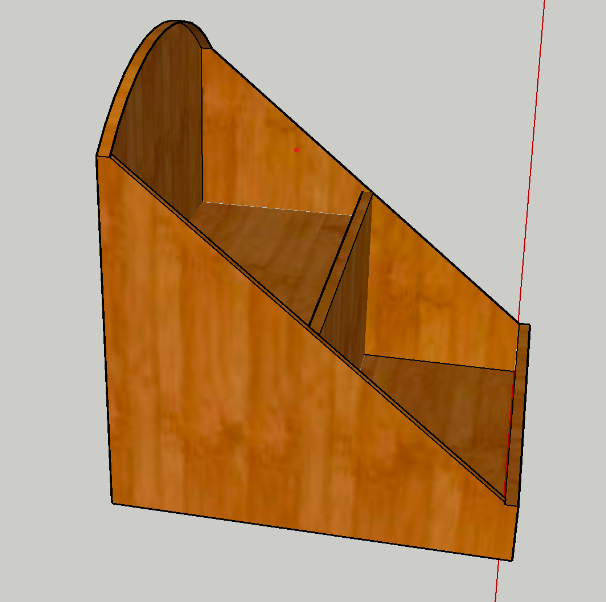
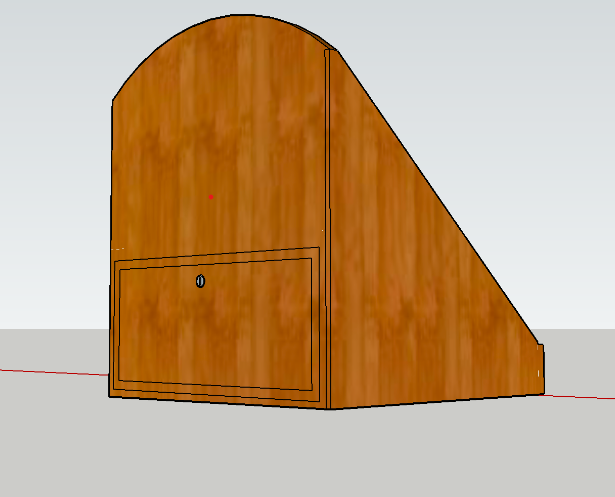
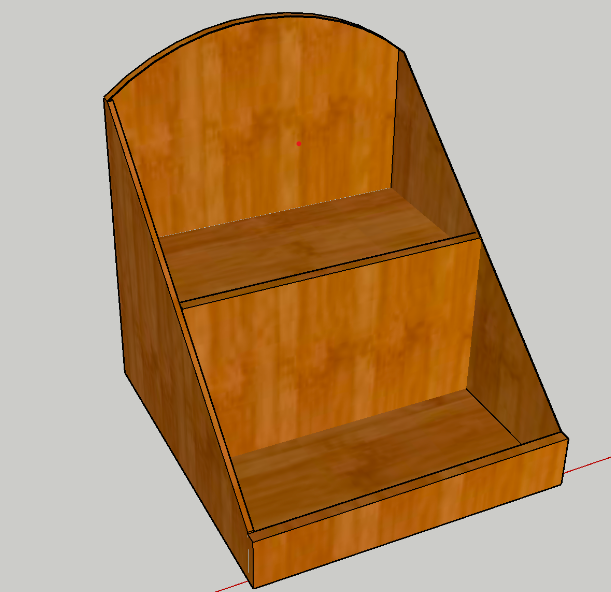
For this project, Enock designed an airing rack that doubled as apple storage. Recognizing the importance of proper ventilation and exposure to sunlight after washing, he aimed to develop a solution that fulfilled these requirements efficiently. He utilised SketchUp to create the 3D model to aid in the design process. This allowed him to visualize and refine the design. The rack was specifically designed to facilitate optimum airflow, ensuring the apples would dry thoroughly while exposed to the sun’s rays.

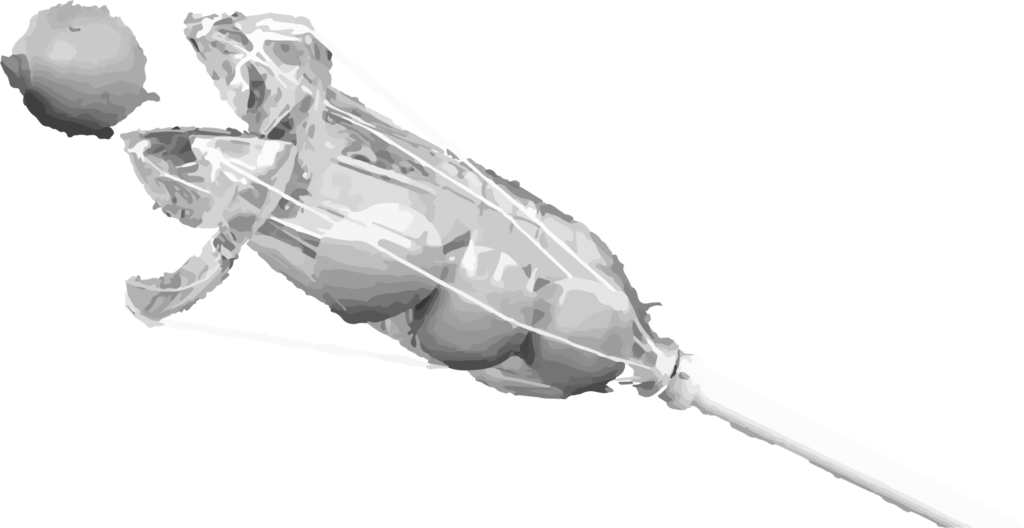
Ahsen worked on a sketch for out apple picker product. He created this on illustrator which was then exported to Majid.

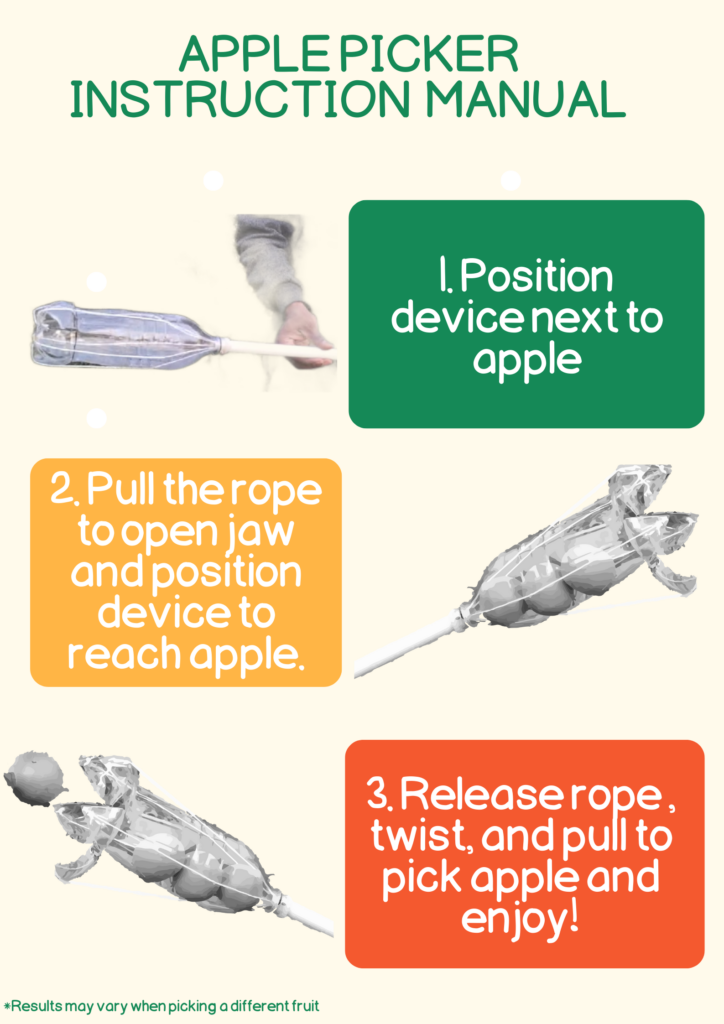
Every tool needs an instruction manual, so Majid decided to create one for the apple picker. He used images from Ahsen’s sketches and put it all together on Canva

Reading Response – Art and Fear (pp23-36)

Majid Ibrahim

I think that this chapter heavily ties into the previous one with regard to the suspension of judgment. We are innately perfectionists, that is what has allowed us to develop as a species. However, now we are paying the price for this ability we possess through the constant inner critic criticizing our every move. This leads us to have a fear of making mistakes which will inevitably hinder our ability to explore all the possibilities our minds can conjure.

Instead, an artist should focus on what is possible within his current capabilities and actually lean into the imperfections in their work to learn and grow from them. Each mistake helps us get better at what we do and how we see art. Accepting our flaws can help us become more open and willing to take risks. This method lets us use our imaginations instead of letting it drag us down.

Reading Response 5 – The Nature of the Problem

The main argument that the author makes is that art is not expression of self, but artmaking (the process) is a way that tells the maker more about his or her nature. Art are often left unfinished due to a wide range of fear, one of them being fatalism. I personally resonated with this concept as I usually question if I am talented or educated (in terms of craft and art) enough to make art. The author’s argument about art skills can be learned and art are made by ordinary people is really informative and help me see the process and skills of making art in new ways. Another point I resonated with is the “arrogance” that the artists are sometimes gripped by their faith in their deep understanding of a topic and disregards others who understands it in a different way. 

However, I did not agree with the author’s point in saying that the art is not an expression of self. Since we are discussing artistic thinking as “art” here, the word “art” is defined more specifically separated from fine craftsmanship or simply aesthetically pleasing objects. Hence the argument that art arouse before consciousness was invalid. I believe that the core of artistic thinking is a positive feedback loop of discovering and expressing oneself, while building confidence and self-understanding during the process. The result is highly tied to the process and can also be expressive of the artist’s ego.

Studio Visit: Field

Different from previous visits. R&D emphasis, physics simulations + creative liberty. Clients, abstraction, teamwork….culture. Inspiration from real life. “Visual Anchors”.

Reading Response 4 – Innovation and Suspended Judgement

In the preceding chapters, the author discussed deliberate generation and challenging of assumptions. These are basically the “coming up with 5 alternatives” and “asking why” that we have practiced before in class. However, they are not far removed from original vertical thinking as they are more backwards thinking, which are based on explaining some effect instead of bringing about some effect. Innovation is more forward thinking. To apply it, one should know suspend judgement, which means not judging if the step is right until the end.

One of the dangers associated to being right all the time that I didn’t recognize before reading this book is that being right usually let people think that right is enough, while blocking the possibility of a better arrangement. Another thing that is informative to me is that I always take care of the absolute correctness before I speak. For example, when commenting others online, whenever I came up with an idea, I have to do research and logical thinking to ensure its correctness as to avoid any criticism. I would say this is acceptable in some circumstances, but if the environment is more acknowledged with the use of suspended judgement, we should learn to consider wrong ideas and see its use, both in stimulating new ideas and to push people forward (sometimes you have to lie a little bit to convince others).

Reading Response 4.2 – The Nature of the Problem (Chapter 1)

Shahram Chaudhry

Based on my experience of completing assignments for this class, I agree with the author’s perspective that unfinished work often holds an allure, as we imagine the possibility of achieving better results. However, amidst this uncertainty, it is crucial to discover a personal motivation or spark that drives us to create, even when there is no external audience or reward. The author also emphasizes the importance of not subscribing to the notion that artistic talent is solely innate, as it can discourage creativity. Ultimately, talent becomes indistinguishable from hard work and perseverance in the long run. As an example, I may not possess the same level of intelligence as my twin brother, but through my dedication and effort, I often achieve similar or even better outcomes. In other words, art is created by ordinary people. Our flaws and weaknesses, though they can pose challenges in completing our work, can also serve as sources of strength. For instance, I have a friend who procrastinates a lot and completes assignments just before the deadline, even if he has ample time. While this approach may seem risky, his ability to work well under pressure turns this shortcoming into an advantage, enabling him to finish the same assignment in less time and allowing him to allocate more time to other tasks.

The author also raises a significant point that I initially disagreed with but now find compelling. They argue that even cavemen were creating art before they were consciously aware of the concept of self. Therefore, the belief that art is purely a means of self-expression is inherently biased. Another flaw in associating artists solely with their art is that it implies that flawed art reflects a flawed individual, while the absence of art renders one devoid of personhood. Instead of adhering to this ideology, one should embark on a personal journey to discover their unique approach to creating art.

Reading Response 4.1 – Innovation and Suspended Judgement

Shahram Chaudhry

In these two chapters, the author emphasizes the importance of lateral thinking and suspended judgment in driving innovation and progress. They highlight the blurred distinction between backward and forward thinking, where backward thinking involves reevaluating progress and adapting future actions, while forward thinking entails creating something new. I believe that both approaches are complementary, as moving forward often necessitates reflecting on the past.

Suspending judgment is a valuable skill because the fear of being wrong often inhibits our exploration process. The constant need to be right, ingrained in us through vertical thinking, limits our creativity. Unfortunately, the prevalent banking system of education worldwide largely promotes vertical thinking. For instance, in high school, if we struggled to solve a particular type of question, teachers would simply instruct us to memorize the method. While this approach may yield immediate results, it proves detrimental in the long run as we fail to truly learn. This is why lateral thinking is essential.

Lateral thinking focuses on being right in the end, rather than constantly judging throughout the process. It allows for various ways of restructuring information and ideas, even if they may not initially appear correct, as they can lead to sound outcomes. By delaying the evaluation of ideas and refraining from discarding those that seem wrong, we can overcome the fear of being incorrect and extract the most value from each idea. Even when we are wrong, the author suggests that we should focus on how seemingly incorrect ideas can propel us forward. The example provided by the author of carrying water in a bucket with holes is compelling. While most of the water may flow out, there is still progress towards the ultimate goal of transferring water. It is a better approach than being disheartened and doing nothing. In fact, using the broken bucket may even inspire us to think of alternative solutions, as necessity is the mother of invention.

Studio Visit 2 – Field.io

  1. Field.io is a very inclusive creating environment that engages all its members as a community. They are R&D based and their start point for creation is play or experimentation. Their medium is computer graphics with a focus on physical simulation
  2. Physical simulation can either visualize / generate feelings for abstract topics or extract abstract topics from a concrete object. In other words, it is like finding an visual anchor that can slightly guide the audiences’ imagination on the concept. The former aspect can be exemplified by the IBM project, while the latter one can be exemplified by the Quantum Computing project. 
  3. Their projects can be also used to intensify a feeling that people feels in some environment. The key is to capture elements that condenses the vibe of the environment. Examples include the London and Beijing Adidas project
  4. One of the creators are inspired by narratives instead of previous CG examples because this provides freedom to create something unique. However, the other one thinks that the narratives alone are too flat.

Reading Response – Art and Fear (pp1-7)

Majid Ibrahim

The author criticizes the notion of talent being the sole determining factor to an artist’s success. I wholeheartedly agree with that point. I think that believing in that mantra, even though it may seem to be true, is ultimately self-limiting presumption. There is no benefit or utility in adopting such a mindset and discourages a person from pursuing an endeavor before he/she even begins. 

The author’s point about self-doubt is also something that resonates with me. When pursuing an endeavor it is often our own inner critic that shuts us down rather than other people. The never-ending need to achieve perfection will always be an innate part of human nature, however, we need to learn to embrace the fact that we are imperfect beings and as a result produce imperfect work. Our inner voices often criticize us for just being the way we are meant to be. We need to learn to ignore/subdue this discouraging inner voice.

Artmaking, like any other skill in life, can be improved upon. Repetitive and unyielding consistency in practice is what yields significant results in the long run. Having that fatalistic mindset would achieve nothing but dissuade a person from putting in the hours of practice that could have turned them into great artists. While in practice, it is also important to not pass judgment on yourself as it is in the process not the destination.