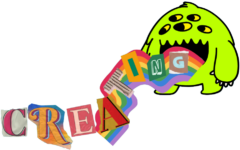
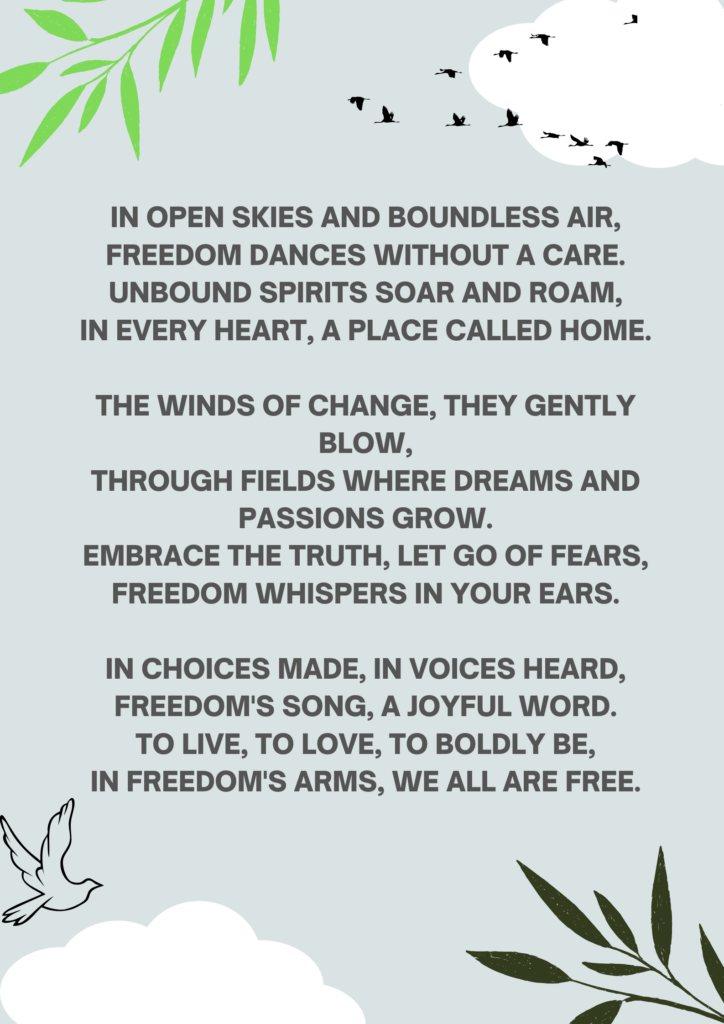
For my second making assignment, I decided to go with the concept of freedom. I was thinking about dinosaurs and the first thing that came to mind was how they have free will and the freedom to roam.
When I think about freedom I tend to think about an open air when one is allowed to roam around to live. I decided to write a poem about freedom to interpret these thoughts into words.
During our studio visit today, he emphasized the end goal of our creativity and where we want to be in the future. He kept on mentioning what we want to get out of all of this and to have a clear idea in mind. On the other hand, I believe that we don’t necessarily have to have an end goal in mind when we start creating. As mentioned previously in the TED talk and in class, one should have the mind of a child where everything is new and inspiring to them. As you continue on your creative journey, you gain inspiration along the way which develops and changes over time to eventually reach an end goal.
Additionally, he discussed the difference between being an artist or content creator and what category we see ourselves in. In my opinion, they both run in the same circle as they both lead to creativity. Moreover, I enjoyed the idea of using perfumes as a creative medium. I found it interesting how you can link certain scents to different emotions, places, or sounds. From previous experience, I know that certain scents hold memories when we come back to the smells. This is a very interesting and creative concept in my opinion to spark creativeness in our lives.
Creativity has been long regarded as a special talent, a result-driven perspective that people “without this talent” is difficult to grasp on. This book introduces the notion of lateral thinking, a mode of gathering and processing information closely related to creativity that anyone can learn to gain using his or her insight. This book describes lateral thinking as restructuring, escape and the provocation of new patterns, which I see related to one of our classmate’s thought on creativity as “remixing existing ideas”.
Lateral Thinking is complementary to traditional, or vertical / logical thinking used in math and logic. Lateral thinking is generative and vertical thinking is selective. Hence, I believe that one should master both in order to be creative. Moreover, vertical thinking is dealing with the middle steps between the starting choice and the conclusion. It is sound and strong, but cannot extend beyond the constraints of the initial perceptual choice. It questions the initial assumptions and prevents the arrogance of any seemingly rigid conclusion. Lateral thinking is like digging a hole at a different place. For me, it is like as if we are useing different probation techniques to understand the full properties of some new material.
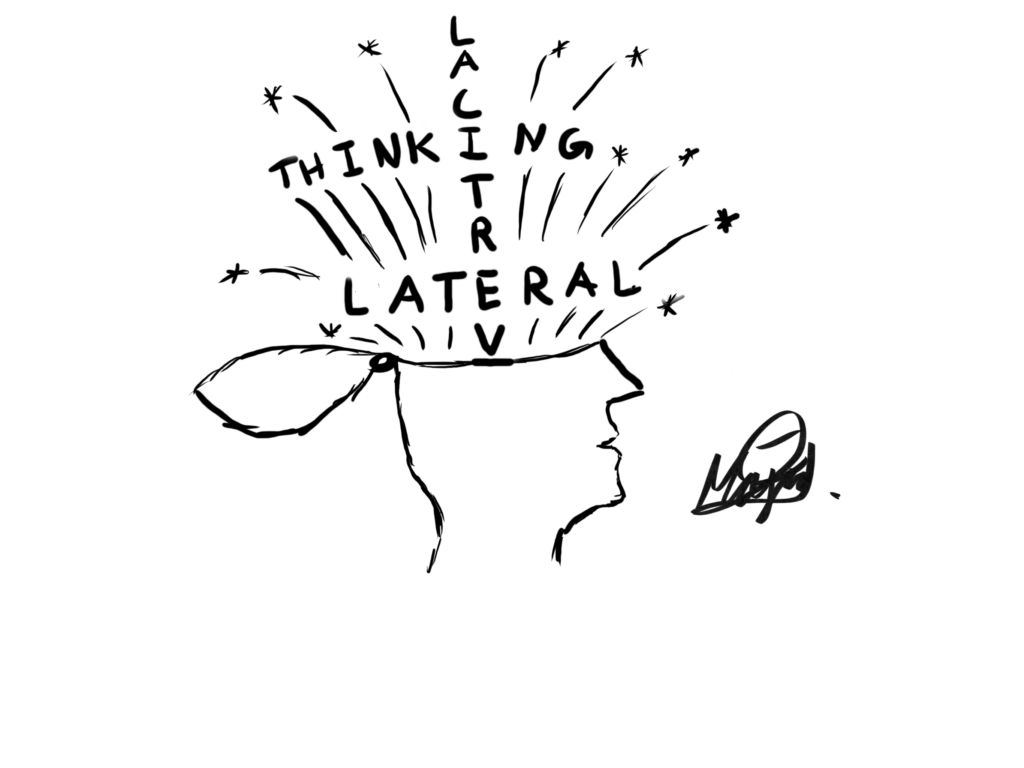
My previous prompt was volcano so an alternative idea i got from that in the last class was eruption. I was thinking of how to make it more abstract, so I decided upon an eruption of ideas. As I reflected on this, a idea sparked in my mind — an eruption of ideas. I came to this idea as I wanted to delve into something more abstract, where the eruption wasn’t about molten lava but about the burst of thoughts and creativity within my mind. I got the visual inspiration while looking at the cover art of a book. I imagined a captivating image where my own head would erupt with a bunch of new ideas.
To give the image depth and meaning, I decided to include the words “Lateral / vertical thinking.” These words held special meaning for me as they encompassed the concepts I had learned about the same day.
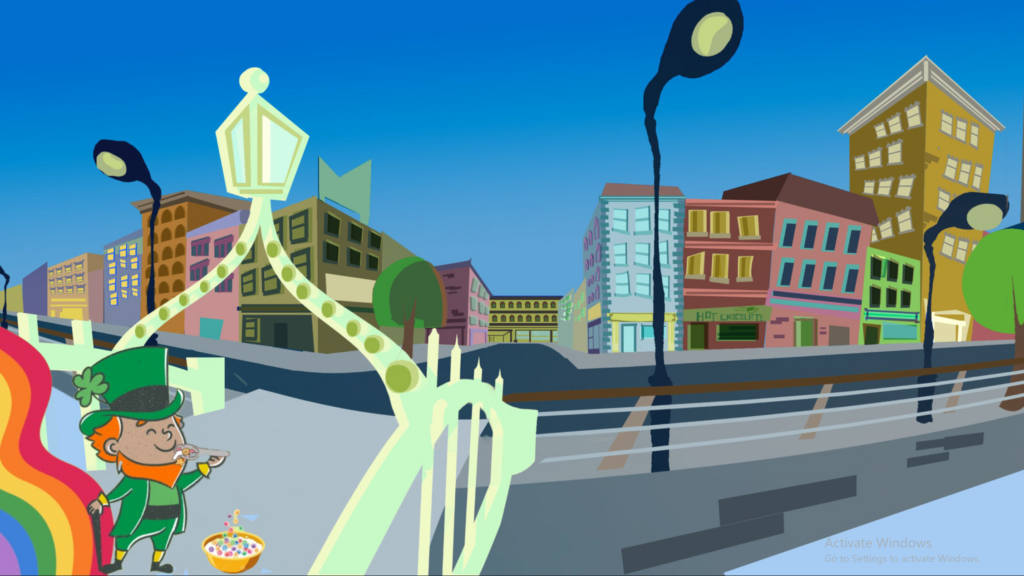
The topic I chose out of the five topics I wrote down in class is Froot loops. Froot loops is “a sweetened, fruit-flavored breakfast cereal produced by Kellogg’s and sold in many countries. The cereal pieces are ring-shaped (hence “loops”) and come in a variety of bright colors and they share a fruit flavor (hence “froot”)”. I wanted to make a visual creation with froot loops, but I also felt like that would need some kind of story, so I made a rainbow-themed picture using bits and pieces of pictures from the internet and gave it a rainbow-themed story:
The Leprechaun’s Return Home
A leprechaun makes his way back to his home city Dublin, clutching a precious golden bowl. Inside the bowl lies a magical treat—the Froot Loops Rainbow Cereal, the legendary pot of gold at the end of the rainbow. As the leprechaun makes his way to town, a rainbow follows his every step. Together, they bring the promise of joy and wonder to all who taste the rainbow-filled breakfast bliss.
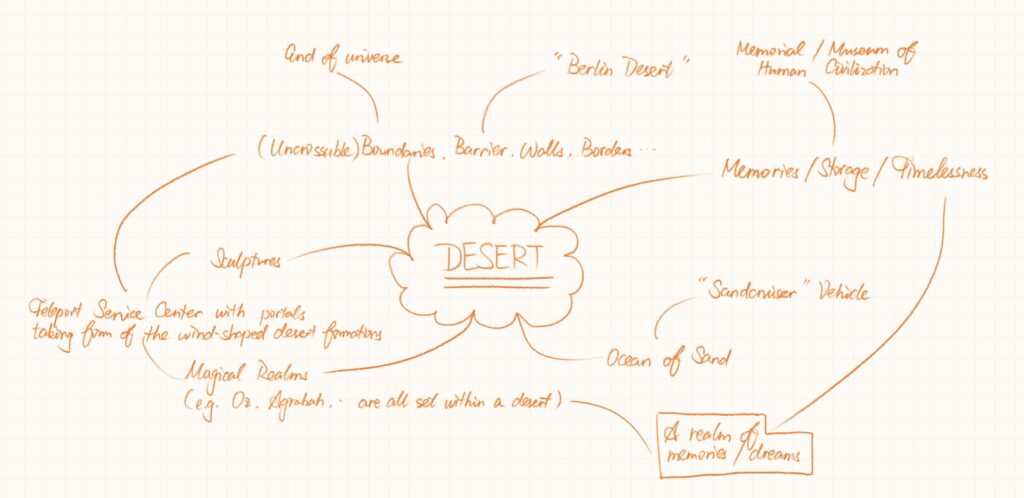
This assignment extends on the topic of the last one through the concept of creative lateral thinking. I first came up with five alternative concepts / meanings that are related to desert and then several things I can make from one of the five alternatives. The results are shown below.
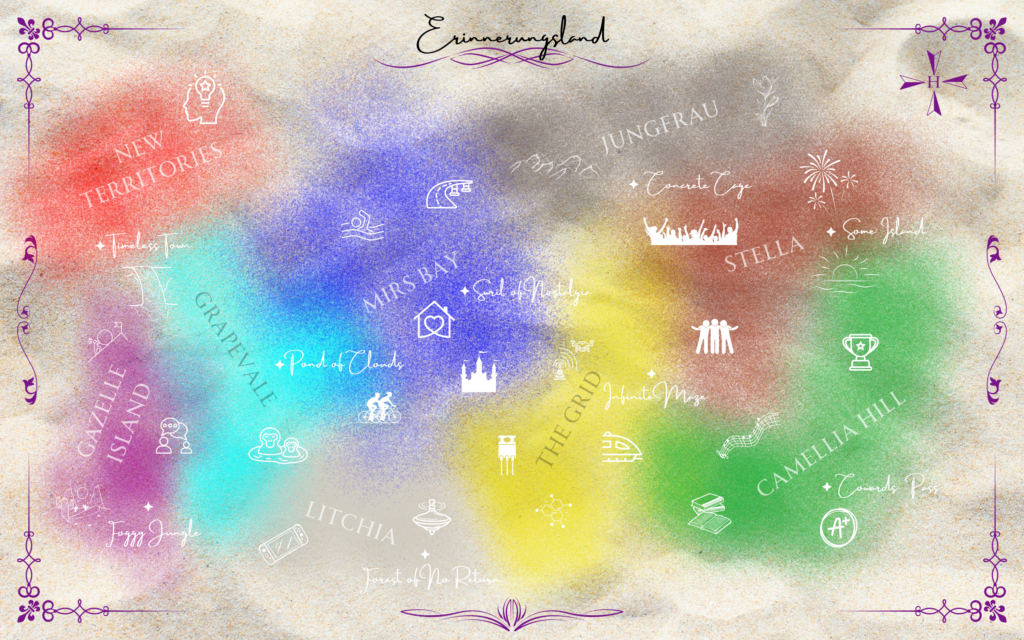
Suddenly, the concepts of memories and magical realms lighted a spark in my mind. Even as an electrical engineering student, I have always been intrigued in psychological concepts, whose discipline investigating the brain, the closest thing that we cannot fully understand but utilize through instinct. Hence, memories, or other brain functions, can be having a sort of “magic-like” property under current understanding of neuroscience. I have also been actively collecting and sorting memories through photos, videos and social media posts to make them ready and able to be reviewed and relived anytime I want. Every piece of wonderful memory to me should be treasured, like gems in the desert of all information that I gathered through my brain. Moreover, I have been interested in and making transit maps for a long time so why don’t I merge these two together to create a map of my personal mystical realm beyond the furthest reach of the vast desert of consciousness?
Hence, I called my work the “Land of Memories” or “Erinnerungsland” in German. From my very own perspective and cultural and linguistic background, it is also interesting how the fusional nature of German word formation makes the word sounds like a place that exists somewhere in fiction. However, this realm is not consisted of actual detailedly grained memories but that feeling I escape to every time I feel frustrated. The general images / feeling of the memories that someone think of them a long time after they have experienced it are what remains to be long-term in mind, and they are usually the most positive / negative things you felt at that moment (of course for this work only positive ones are considered). It also included idealistic or fictional elements that I believe to be harmonic and connected with other real-world memories. This place should be an embodiment what I feel to be idealistic and perfect, and nourishes, fosters, and reboots my tired mind after frustration. Since the feelings are already abstract, I decided to put icons to represent memories instead of other literal elements. These icons
Using Canvas, a software that contains innumerable vector image resources, I can make this map. First, I took a sandy background to symbolize the immense desert of consciousness. Colorful sands are then added to different clusters corresponding to different kinds of valuable memories. Places and symbols are added by hand to give this map an antique and mystic vibe. The stars marks the places I wanted to be teleported to most whenever stuck in the corresponding feeling.
Explanation of the names:
Mirs Bay – My hometown of Shenzhen, a coastal town with alternative name “Mirs City”, contains golden memories of my family, core of everything.
Litchia – Rendered name of my elementary school, contains childhood memories.
Jungfrau – Jungfraujoch, Switzerland. A Childhood Trip that inspires me to care for Mother Nature. Contains relaxing memories spent with everything naturally created around us.
The Grid – My natural inclination towards systematic disciplines such as physics, chemistry, and engineering and my memories of seeing the beauty within the numbers and formulas.
Stella – Changsha, a bustling town in Central China that is always in party mood and never sleeps, a place where I had my middle and high school educations, made a lot of friends there.
Camellia Hill – Name of the place where my high school sits, contains good memories of me studying, competing, and preparing for applying our dream schools with my friends.
Gazelle Island – Obviously Abu Dhabi. Contains memories about how I transcended myself when being in such an international and accepting environment in the past years, as well as the meaningful conversations I had with my friends.
Grapevale – A trip to the Caucasus (Georgia and Armenia) last year, sparkled my interest in world travel and made two of my best friends in collage.
New Territories – Memories being made and yet to come…
The stars marks the portals that connects to places, symbolizing bad feelings.
Swirl of Nostalgia – Missing Home
Forest of No Return – Too obligated / concerned
Concrete Cage – Lost in the Modern Cities
Infinite Maze – Purposelessness
Some Island – Loneliness
Coward’s Pass – Defeated
Foggy Jungle – Pessimistic
Pond of Clouds – Melancholic
Timeless Town – Stuck in the Past
The direction indicator points towards “H”, meaning Home or Heart.
If made interactively, this may also be a good way for people to sort memories. Possible implementation: use AI to analyze and categorize gallery input and generate new “territories” and symbols as user record more of his or her life. The icons acts as an access point to the AI-synthesized video of that part of memory.
I do not consider myself a creative person, but this passage gives me hope as it says that creativity can be developed and honed through intentional thinking techniques. The concept of lateral thinking as a deliberate and purposeful process resonates with me.
Personally, I find that my default mode of thinking tends to be vertical, relying on logical reasoning and established patterns. While this mode has its merits in certain contexts, it can limit my ability to explore unconventional solutions and perspectives. The passage encourages me to be more mindful of when to switch to lateral thinking, recognizing situations that call for a more exploratory and imaginative approach.
This passage is a reminder to break free from the autopilot mode of thinking and to approach problems and challenges with intentionality. By setting the intention to engage in lateral thinking when needed, I can actively seek out alternative viewpoints, challenge assumptions, and restructure my patterns of thought.
Overall this passage shed light on the importance of “thinking about thinking” in which I would reflect on the way I structure my thoughts. Self-awareness is also a key factor as it is what makes a person able to even recognize what mode of thinking he is in so that he can adjust accordingly.
I absolutely enjoyed today’s visit and Markus’s talk. I loved how he’s so passionate about his work and how he constantly highlighted the importance of being driven. He also emphasized the need to put in the extra effort so that one could stand out among their peers. I was also fascinated by the idea of using perfumes as an inspiration to make music, that’s a pretty good example of thinking outside the box and not limiting oneself to the constraints of the convention.
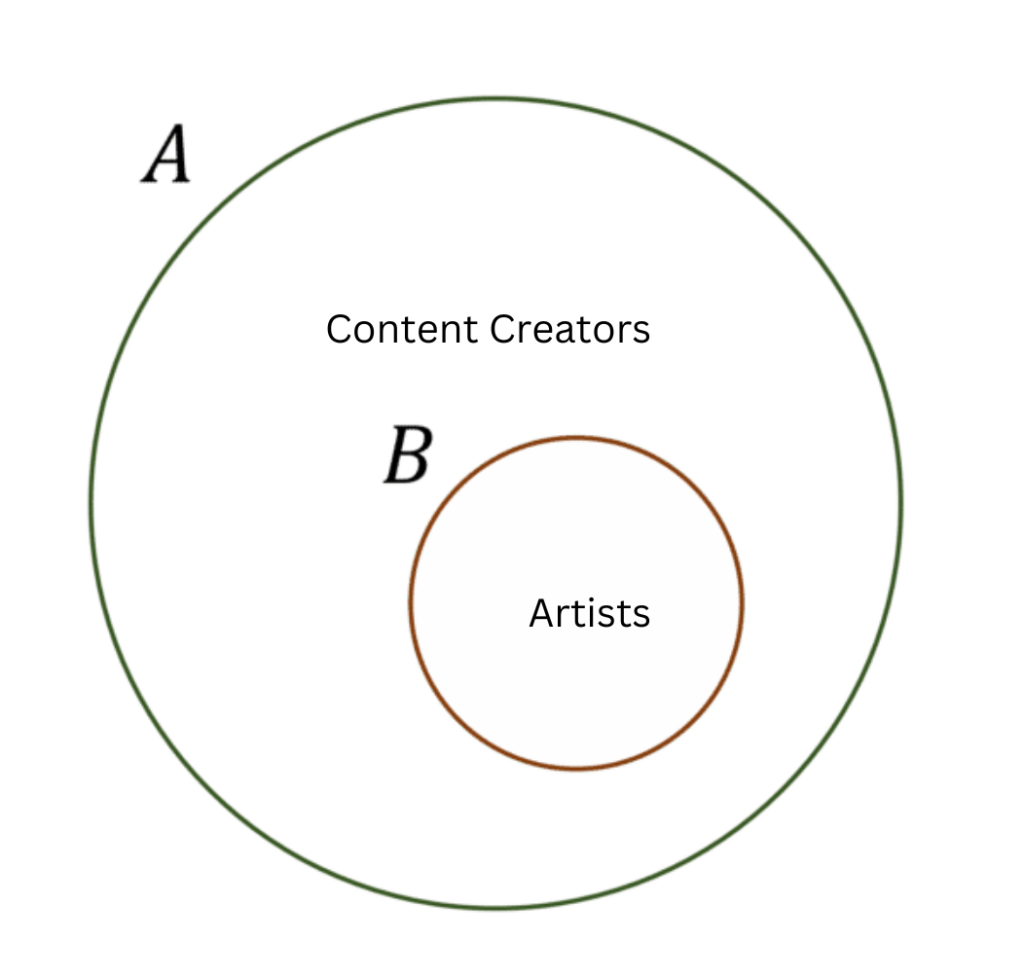
However, there were a few things I don’t quite agree with. Firstly, he talked about how our goals should be clearly defined and set beforehand. Just yesterday, Kermit discussed the idea of not knowing the destination when starting the journey and figuring everything out on the go. I think when it comes to art especially, this is how it should generally work. Also, I believe that the distinction between artists and content creators was too sharp. I think that artists are types of content creators too, just with more creative freedom. (See diagram below)
“What do you want?” was one of the most frequent questions that Markus Popp, aka Oval, asked us during our visit to him. He’s an interesting artist, and appears to hold strong opinions about the creative process.
There were many aspects of his process that I agreed with. He says that independent artwork often requires more grit and perseverance than working in a cubicle. In addition, one must constantly innovate and look for alternatives, since if you don’t, the number of people with similar talent, grit and ideas as you will shadow your work.
However, there were some ideas that I did not resonate with. He believes that you must have something that you’re after, a driving goal or ultimate desire of sorts, in order to push you to create good work. I believe that every artist has their own journey, and that journey does not always need a destination. Good art should be possible just through the virtue of curiosity, and shouldn’t require goals (like fame).
I found most of Markus Popp’s point resonating to me. First, I also believe that seeing the big picture in every way is important for everyone to not loose track in his or her life. Having a goal can justify one’s question about the purpose of life and not involving too much, meaning solely involving in his or her career path and point of interest, can make him or her a full person. Seeing the big picture also means being an observer. When standing in a third-party perspective, I can see the development and trend of a field in a more comprehensive way. I took this class for similar reasons as an engineering student. For me, I would love to engage in work such as research and product development engineer but not as a pure researcher or task-oriented engineer as I want to engage in actual solutions that can make people’s life better step by step. Engaging in creative activities can let me think outside the box and see new things in new perspectives that a normal task-oriented engineer would never see. I like to see my contributions adds their effects to the world as a whole. Second, I reckon that developing the previously said “big-picture” way of thinking can help add your touch to the field you are interested in. For example, his familiarity with perfumes and scent can aid his music composition and “signs” his albums with tangible themes uniquely to him such as scents, romance, etc. Third, he also emphasized the importance of punchline thinking, triumph moments, and moments that surprises yourself. These can reassure you that you are on the track you original envisioned to accomplish when feeling too dragged by necessary technicalities and details (e.g. Marcus uses these to mediate his music making process when being drawn to sit at a laptop for 16 hours due to the detailed work of using the music software).
However, I was initially a little baffled and now partially disagree with his drastic distinction between the artist and content creator. To me, although people, in terms of their goals, may aim more towards answering to his or her own instincts or to create content when asked by others, everyone should be the mix of the two. They complement and develop on each other. For example, some content creators may find it useful to add his or her personal touch to a content creating process and some artists are also creating content for this world to some extent in order to live. They may also share the same goal but work towards it in different ways. I also partially disagree on his current position on avoiding the AI until there exists an established effect of AI on the creation of music. Although I believes that using AI purely may let the artist tend to use it for the whole creation process, losing the small propulsion and sense of achievements from the regular triumphant moments as well has the creator’s soul, uniqueness and aim for perfection, completely avoiding AI is not a good practice. AI can be an aid for lateral thinking, it is like having an friend that has perspective and thinking process completely different from anyone you can find (obviously because they are wired completely differently from any human). Using AI for hints and brainstorming or gathering inspiration can actually be quite helpful in my opinion.