Chocolate: childhood games

Chocolate ⇒ Games, playing ⇒ childhood, friends

Hand gestures ⇒ languge, code ⇒ secret code among friends

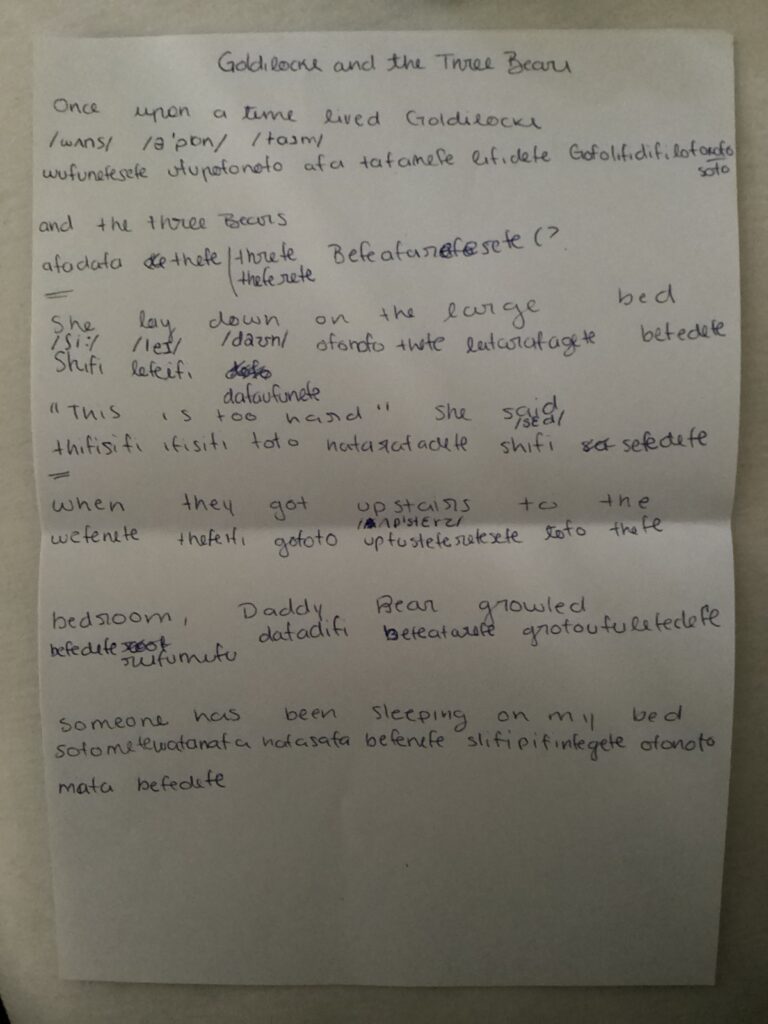
These two paths brought me to something called “the f language” in Spanish. It is a funny way of communicating for children. The idea is to add a syllable with the letter “f” to each syllable within the word. For example, the name Kate would be “translated” to Kafa-Tefe. I thought it would be an interesting idea to pass this game to English. For this reason i “translated” some passages of a fairy tale, i chose Goldilocks, and this are the results.

“ wufunefesefe ufupofonafo afa tafamefe lifidefe Gofolifidifilofokofosofo afadafa thefe threfe Befeafarefesefe.”

“Shifi lefeifi dafaunefe of ofondofo thefe lafarafagefe befedefe -Thifisifi ifisiti tofo hafarafadefe- shifi sefedefe”

“Wefenefe thefeifi gofotofo upfusteferefesefe tofo thefe befedeferufumufu dafadifi befeafarefe grofoulederefe -sofomefewafanafa hafasafa befenefe slipfipifinfegete ofonofob mafa bederefe-”

I used the International Phonetic Alphabet when I was not sure of how to add the fa/fe/fi/fu sounds.

Lateral Thinking – Reading Response

In this brief reading, one quote specifically stood out for me:

”Lateral thinking is generative. Vertical thinking is selective”(p.12)

I really liked this quote because I believe it perfectly encapsulates the concept of a creative process. For instance when I am choreographing a new dance recital, I start playing the song I want to dance to, and throw a series of dance moves and see what feels like the best option, I move fast, then slow, then add a jump or two, maybe even a twirl. All these moves, would come from lateral thinking, me trying to generate different ways or ideas to fill the times of the music and making it seem good. After I generate all these different dance steps and ideas, I like to turn on my vertical thinking and see how I can combine these dance moves, and turn them into a proper dance choreography. In my head, both the “rational” and “creative” are crucial for my final piece, for my final goal. Which is why, It really stood out to me what the author said in the mentioned quote. I also fully agree with him about how these two ways of thinking complement each-other and therefore, we are unable to reach our final goal, which is the project completion, without the two.

This also pulls me towards the Ted Talk we watched with kermit the frog where he used the term “Controlled Chaos”, I think that the complement between The two ways of thinking, is in a way, a controlled chaos as well.

Reading Response – 2

In his book “Lateral Thinking: Creativity Step by Step”, Edward Bono introduces a new way of thinking that he calls lateral thinking. He defines it as a process of finding and rearranging patterns in information to generate novel and original ideas. He contrasts it with vertical thinking, which is the conventional mode of thinking that follows a logical and linear path to reach a single correct solution. He argues that lateral thinking is the true source of creativity, while vertical thinking is useful for analyzing and validating existing information. He also claims that most education systems favor vertical thinking over lateral thinking, and thus limit the potential for creative thinking. As a university student, I can relate to his critique of the education system, as I have been trained to think vertically most of the time. I think that vertical thinking is important, but not sufficient, for solving complex and dynamic problems. I would like to learn more about lateral thinking and how it can enrich and diversify my thinking skills.

Lateral thinking introduction response

The book explains what lateral thinking is by relating it to some other terms. Humor, creativity and insight all share basis with lateral thinking. I think humor is often forgotten when talking about creativity, so introducing it to the conversation helps to expand the understanding of lateral thinking. I also think comparing it to vertical thinking, which is more usual, helps to understand better the concept. The analogy of digging a hole was amazing for me, it cleared out the difference and how both complete each other. I also liked the way artistic creativity was approached and how there is usually the misconception that creativity is a gift that only few posses. The book also highlights the importance of lateral thinking as a process sand not something that “just happens”

Studio Visit: oval

The visit to the Studio was interesting. However, I do not agree on most of the artist’s opinions, which I actually think is good, because it made me realise I had opinions on certain topics. Diving between Artists and Content creators didn’t seem like a great idea to me. I see what he was trying to convey, but I felt his ideas on creativity (and the idea of artists/ content creator) were limited to music. Which makes sense, since that’s his artistic career. I wished he had explained more about his own process behind some o his artworks, it could have been interesting to know, for example, where he got the concept behind his latest album, how it evolved over time and what he would have change now.

Artist visit notes

  • I found his use of perfumes as creative inspiration very interesting. As someone who connects feelings to perfume and music I thought this link was brilliant to have as an established artist. I could see the “uniqueness”, the “my music plus X” in this regard.
  • I thought most of the points he was making were quite contradictory
  • Content creation is different from Art. I always knew this, but Markus Popp made the distinction a bit clearer.
  • Does the length of time it takes to create something speak to the quality of the thing created??? Markus Popp seems to think so
  • Artists (him specifically) don’t like AI

I didn’t agree with most of what the artist said, but again I did appreciate the love and respect he has for his art and what he brings into the artistic scene. The perfume and music combination was by far the most interesting thing he showed us/talked about. I wish he would have elaborated on that more. I do think, however, that the music he made was more for his time in life when he was wearing that perfume than it was for the feeling the scent of that perfume captures. These are two very different things. It is the latter that I find more interesting.

Making Task #2

This was a really fun and nostalgic challenge for me as I had to turn my childhood time wasting game into a new box of ideas for my making tasks, each time I get a new task, I will write it on a piece of paper, and put it in this task, in order for me to see how much I have progressed since this task.

It was really fun to play DIY arts and crafts when you lack most of the material, but I let creativity take the wheel and guide me through how to turn the surface of my game and its distinct shape, into a box for my future ideas.

As I will have all my ideas in this box, I will be able to “Travel through my ideas” and in some way i would still be time traveling, for some reason, my goal for this exercise was to keep something of the game from the previous assignment and just build up on. It without fully modifying the existence of the first, which is where the concept of traveling through time came from.

Reading response #2

response to: Lateral Thinking – Introduction

When discussing the ways in which ideas are updated, De Bono mentions that “(…) the [conflict] method does not work at all when the new information can only be evaluated through the old idea.” I found this really interesting as it reminded me of the importance of ideology in the formation and propagation of knowledge.

Back home, in Brazil, there have been increasing attempts to remove racist, mysoginistic and other bigoted content from traditional books, many of which are read in school. The idea is to rephrase those stories according to the morality of our current time. From my understanding, this sounds a lot like the linear progression inherent to vertical thinking. In my opinion, however, this strategy of simple erasure is fruitless when it comes to educating a new generation in social and political problems that, to quote de Bono, cannot be evaluated objectively. Instead I would suggest a strategy, perhaps similar to that of lateral thinking, where those stories are contextualized. After all, only by evaluating the past can we understand the struggles and ideological shifts of the present.

Artist Visit – Sara

As someone that isnt really familiar with the art of music as much as the other arts, it was interesting to hear what art means from a musician’s perspective, despite me not being able to feel his feelings and understand truly and deeply his art process. I found the idea of capturing scents and turning them in a way into sounds and songs, very interesting to me and would like to look up or learn a bit more on how that actually happens and how does it work. Overall, new experience.